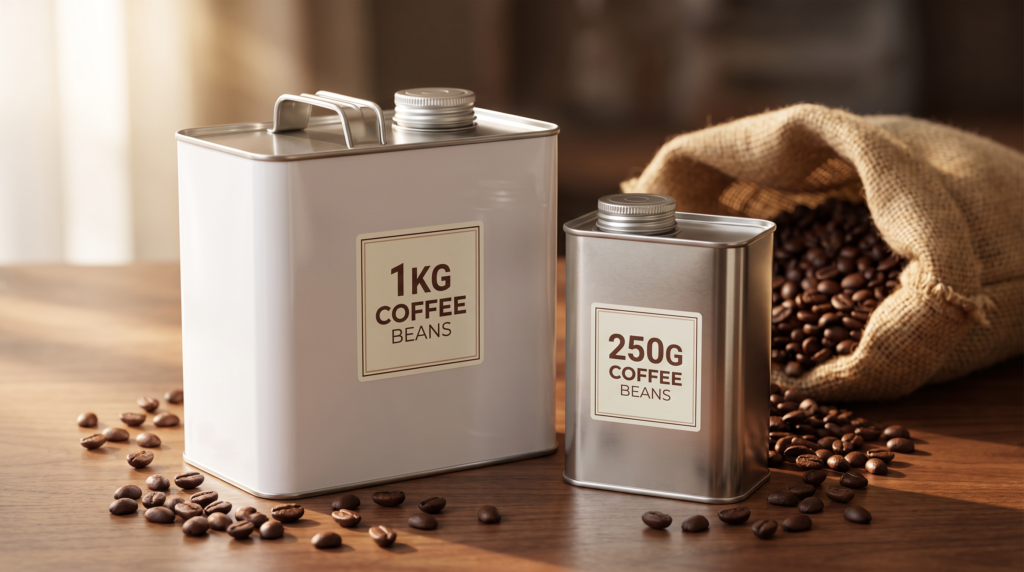
If you have ever pulled a fresh bag of single-origin coffee off a retail shelf in Tokyo, Berlin, or Dubai, you have probably noticed the same thing we did: the most premium SKUs are no longer in stand-up pouches. They are in tin cans. Coffee in a metal tin is a quiet signal that the roaster is positioning for shelf presence, gift value, and flavor protection — not just shipping weight.
Over the past two years we have seen a steady shift in the inquiries we receive. Specialty roasters in Eastern Europe, the Middle East, and Southeast Asia are asking us to quote 250g and 1kg rectangular F-Style tin cans for whole bean coffee — often as part of a private-label program for a local cafe chain or supermarket brand. Some are first-timers entering retail. Others are moving away from pouches because their customers keep complaining about stale beans two weeks after opening.
This guide is the field-tested version of what we have learned across those projects. It covers how to choose between 250g and 1g sizes, which features actually matter for fresh coffee, and what to ask your supplier before you place a PO. It is written for roasters, importers, and private-label brand owners who want a tin that is built for coffee, not just a generic food can with a sticker on it.
Quick note on specifications. Pricing for tin cans depends on order quantity, print complexity, lid type, and destination port. We deliberately do not publish specific FOB numbers in this article — every quote is built around the buyer's actual spec sheet. If you want a number, send us your spec and we will reply within 12 hours.
Why More Coffee Brands Are Choosing Tin Cans Over Pouches
Stand-up pouches with a one-way valve have been the default for specialty coffee for nearly two decades. They are cheap, light, and ship flat. So why are more brands switching to tin cans?
1. Shelf presence. A printed tin can on a retail shelf looks heavier, more premium, and more "gift-able" than a flat pouch. For a 250g retail SKU at a $12-$18 price point, that perception matters.
2. Reusability. Customers keep the tin. Many use it for kitchen storage after the coffee is gone. The brand stays in the kitchen for years. A pouch goes in the trash the moment it is empty.
3. Light and oxygen protection. Tinplate is fully opaque. Pouches — even the multi-layer ones — allow some light transmission. For coffees that are sensitive to light-driven staling (especially fruity African origins and light Scandinavian roasts), this matters more than people think.
4. Degassing compatibility. A coffee tin can be fitted with an optional one-way degassing valve as a small plastic insert pressed into the lid, separate from the main screw opening. This gives the same CO2-release benefit as a high-end pouch valve, while keeping the rest of the can fully sealed. The valve is removable — some customers prefer a fully sealed lid for certain SKUs.
5. Sustainability story. Tinplate is infinitely recyclable and has a higher recycling rate globally than multi-layer plastic pouches. For brands with an ESG or sustainability narrative, the can is a cleaner story to tell.
The trade-off, of course, is unit cost and shipping density. A 250g tin is heavier and bulkier than a 250g pouch, so your per-unit cost is higher and a 20'GP holds fewer units. For most specialty roasters, the premium positioning makes that trade worth it. For commodity-grade coffee, it does not.
The 4 Must-Have Features in a Coffee Bean Tin Can
Not all "tin cans" are equal. Here are the four features that actually matter for fresh roasted coffee — and the questions to ask your supplier about each one.
1. Screw Lid with Plastic Inner Plug + Optional One-Way Valve
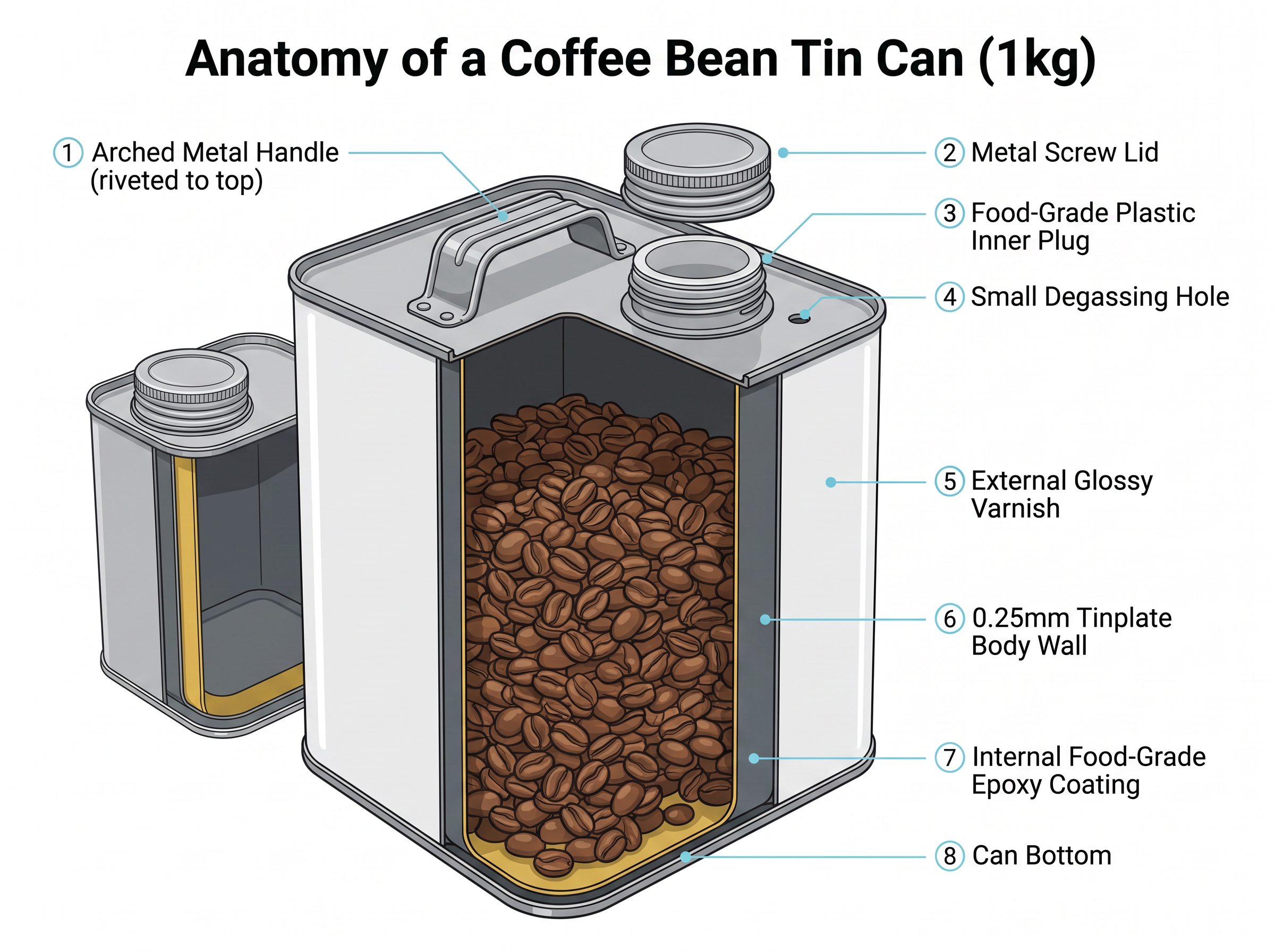
The lid system on a 250g or 1kg coffee tin is a screw lid (螺旋盖) with a plastic inner plug seated against the can mouth, plus an optional one-way degassing valve (出气孔) pressed into the lid as a separate small plastic insert. Here is why each part matters — and which ones are optional.
Screw lid. A metal threaded cap that screws down onto the can mouth. The thread is rolled into the can's top curl during forming — not welded or glued — so the seal surface is continuous metal. The lid is reusable, meaning the customer can open and re-close the tin many times without losing seal quality.
Plastic inner plug. A food-grade PE or PP plug that sits inside the screw cap and presses against the can mouth when the cap is tightened. This is the actual airtight seal. The metal-on-metal screw thread alone does not give a hermetic seal — you need the soft plastic plug to compensate for the slight irregularities in the rolled thread.
Two practical points on the inner plug:
- The plastic must be food-contact grade (PE or PP, virgin resin). Recycled plastic plugs will off-gas and can taint the coffee.
- The plug diameter is sized to the can's mouth opening: 32mm for 250g, 70mm for 1kg. We will get to that distinction in the next section.
Optional one-way degassing valve (出气孔). A small plastic insert that is pressed into a secondary opening on the lid, separate from the main screw cap. It is structurally similar to the one-way valve you see on a stand-up coffee pouch — a small circular plastic disk with a silicone or Goretex-style membrane that lets CO2 escape one way but blocks oxygen and moisture from coming in. It is optional — the can ships with or without the valve installed depending on the customer's preference.
When is the valve needed, and when is it not?
- Needed: Your coffee is freshly roasted (within 7-14 days of canning) and goes through a long shipping cycle or sits on a retail shelf. Without a vent, the can will balloon or the cap will pop as CO2 builds.
- Not needed: Your coffee is pre-degassed before canning (some roasters hold the beans for 2+ weeks before sealing), or your supply chain is short — e.g., roast, can, and ship within a few days.
- Decorative SKUs / gift tins: If the tin is being sold as a container for non-coffee contents (tea, biscuits, sugar, candy) or for very long shelf life of already-stable coffee, you can skip the valve.
When you ask your supplier, ask specifically: "Do you supply the tin with the one-way valve pre-installed, or is it sold separately and I install it at filling time?" Most Chinese factories will install the valve during lid production if you confirm at PO stage. Installation at filling time is also possible but adds a small manual step to your packing line.
2. Food-Grade Internal Coating
The inside of the can is in direct contact with coffee oils. Plain tinplate (unlined) is not food safe for long-term contact with coffee. The coffee will pick up a metallic taste, and over time the tinplate can corrode from the acidic coffee oils.
The standard for coffee tins is a food-grade epoxy or epoxy-phenolic coating (often called a "gold lacquer" because of the pale yellow color it produces after curing). This coating is applied at 6-10 g/m², then baked at 180-200°C for 10-15 minutes.
Two practical questions to ask your supplier:
- "What is the exact coating specification — material, weight, bake temperature?" This tells you whether they are using a recognized food-contact coating system or a generic substitute.
- "Do you have a food-contact compliance certificate?" For exports to the EU, US, Japan, and most regulated markets, you will need documentation (FDA, EU 1935/2004, or LFGB depending on the destination).
For the outside of the can, the most common finish is a glossy clear varnish over the printed surface. This protects the print from scuffing during shipping and gives a bright retail appearance. Matte varnish is also available for a softer, premium look — but expect a small print-process adjustment if you switch between finishes.
3. Mouth Opening, Handle, and Overall Lid Geometry
A coffee tin's lid geometry is not the same across the 250g and 1kg sizes. There are three things that change — and they are linked to how the customer actually uses the can.
Mouth opening diameter. This is the inner diameter of the screw lid opening, which determines what can pass through:
| Size | Mouth opening | Why this size |
|---|---|---|
| 250g | 32mm | Sized for a coffee scoop or small measuring spoon. Customers scoop beans directly out of the tin. |
| 1kg | 70mm | Sized so a hand or larger scoop can reach in. Customers may pour beans into a grinder hopper directly. |
The 1kg opening is more than double the 250g opening by area. This is intentional — a 32mm opening would make a 1kg tin annoying to use day-to-day, and a 70mm opening would let 250g beans spill out during a single scoop.
Handle. A 1kg tin carries an arched metal handle (拱形铁提手) riveted to the top of the can, designed for one-handed carrying. A 250g tin has no handle — the 116×60×135mm body is small enough to grip comfortably with one hand, and the handle would be visual clutter at retail size.
If your product line includes both sizes, this is actually a useful design cue: the visible handle on the 1kg is an instant signal to the customer that this is the larger / value size, even before they read the label.
Lid assembly layout. On the 1kg, the layout on the top of the can has the arched metal handle as the main visual feature of the lid. The screw lid (main opening) and the optional one-way degassing valve are both positioned on the right side of the handle (when viewed from the front of the can), with the screw lid toward the center and the small degassing hole toward the outer edge of the lid. On the 250g (no handle), the lid assembly is centered. This does not affect the seal, but it matters for your artwork layout — you will want to confirm with your supplier which side of the handle the screw lid and valve land on before finalizing your label design.
4. Tinplate Grade and Thickness
For 250g and 1kg rectangular F-Style coffee tins, the standard tinplate specification in the Chinese export market is:
- Tinplate grade: MR (or SPCC for cheaper variants) per ASTM A623
- Thickness: 0.23-0.25mm is typical for the body; 0.25-0.28mm for the lid and bottom
- Tin coating weight: E2.8/2.8 (2.8 g/m² per side) for normal food contact
Do not confuse this with 5-gallon (20L) steel pails. Those are 0.32-0.38mm thick because they need to handle stacking and rough handling. A 250g or 1kg coffee tin does not need that thickness — 0.25mm is the industry norm and gives the right balance of stiffness and formability.
If a supplier quotes you 0.30mm or 0.32mm tinplate for a 250g coffee tin, they are either upselling you on a heavier spec than you need, or they are using the same tooling line as 20L pails and the price is wrong. Ask for the spec sheet.
250g vs 1kg: How to Choose the Right Size
The decision between 250g and 1kg is not just about capacity. It is about target customer, unit economics, and shelf positioning. Here is a practical breakdown.
250g (Rectangular, ~116×60×135mm, 32mm mouth)
This is the most common retail size for specialty coffee in tins. Think: gift tin, single-origin launch SKU, supermarket "premium" shelf.
Profile:
- Consumes 250g of roasted coffee in roughly 1-2 weeks for a single household
- Positioned as a tasting size, a gift, or an entry point
- Fits a typical European shelf depth without overhang
- 32mm mouth sized for a coffee scoop — convenient for daily use
- No handle — the small body is easy to grip one-handed
- Higher packaging-to-coffee ratio — the tin weighs about the same empty as a 250g pouch of beans, but holds the same coffee
- Higher per-kg unit cost (typical FOB spread vs pouch is meaningful, but varies by spec)
Best for: retail single-origin launches, gift sets, supermarket premium SKUs, sampler programs.
1kg (Rectangular, ~178×110×155mm, 70mm mouth)
This is the wholesale / family / office size. Often sold as the "refill" SKU after a customer has tried the 250g.
Profile:
- Fits a typical office coffee consumption for 1-2 weeks
- Positioned as the value or "home" size
- Visually larger on shelf — works as a "hero" SKU next to 250g siblings
- 70mm mouth sized for a hand or larger scoop — direct pour into grinder hopper is possible
- Arched metal handle — one-handed carry for the larger mass
- Lower per-kg unit cost (economy of scale on the tin itself)
- Slightly longer production cycles — 1kg cans often share tooling with 2.5L pails in some factories, so check lead time separately
Best for: wholesale accounts, cafe bean sales, office subscription programs, home refill SKUs.
The Decision Tree
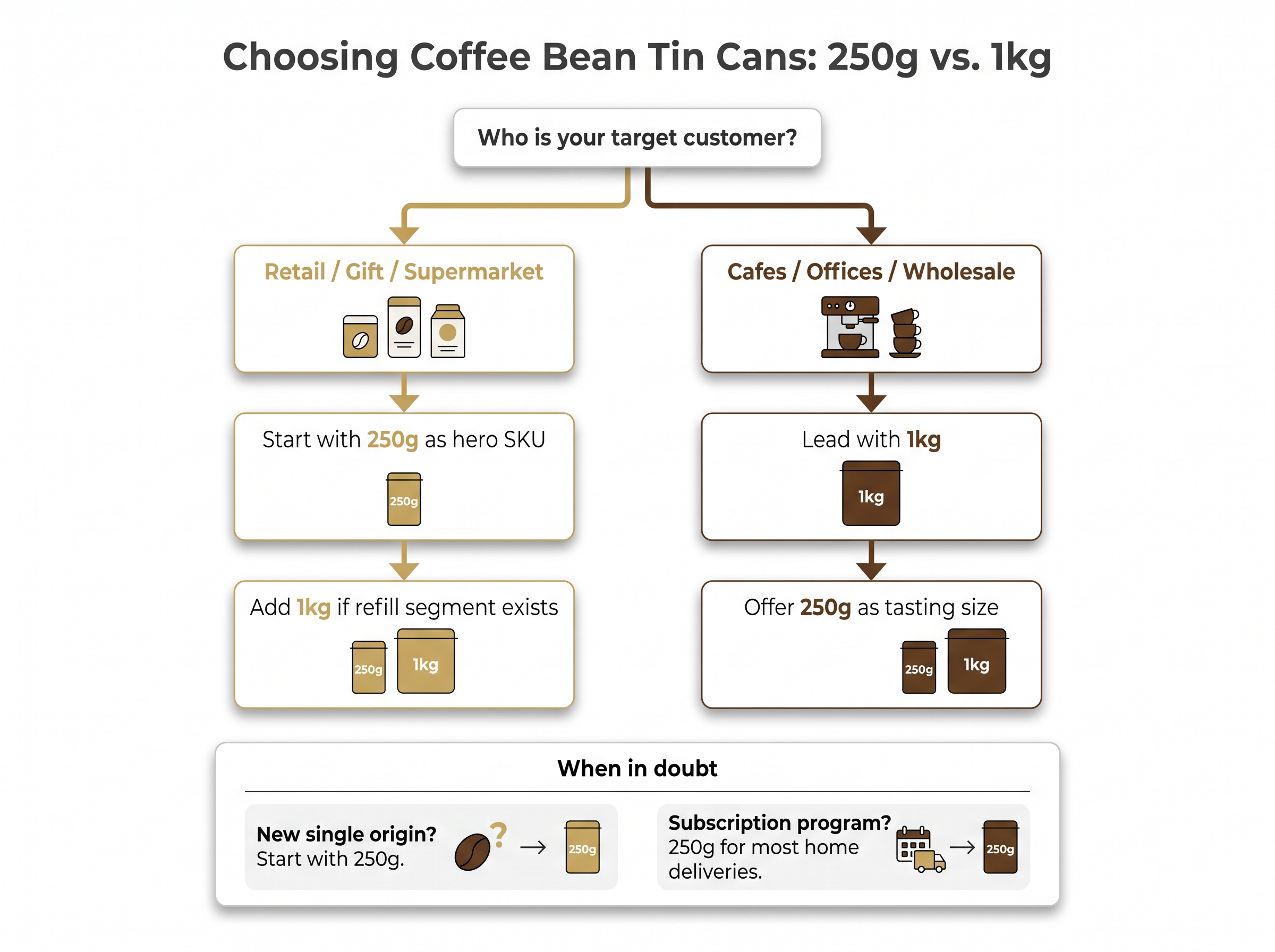
A simple way to think about it:
- Selling to retail consumers, gift market, or supermarkets? Start with 250g as your primary SKU. Add 1kg if you have a refill or home-use segment.
- Selling to cafes, offices, or wholesale accounts? Lead with 1kg. Offer 250g as a tasting/sample size.
- Launching a new single-origin for the first time? 250g is the lower-risk SKU. You can always add 1kg in the second production run.
- Building a subscription or coffee-of-the-month program? 250g fits most home delivery windows and price points. 1kg works if your customers are offices.
Common Tinplate Specs We Use for Coffee Tins
Based on the orders we have shipped in the past 18 months (including a recurring program to a Ukrainian importer supplying their "TASTE OF QUALITY" brand):
| Item | 250g | 1kg |
|---|---|---|
| Body dimensions (L×W×H) | 116×60×135mm | 178×110×155mm |
| Mouth opening (inner Ø) | 32mm | 70mm |
| Tinplate thickness (body) | 0.25mm | 0.25mm |
| Tinplate thickness (lid/bottom) | 0.25-0.28mm | 0.25-0.28mm |
| Internal coating | Food-grade epoxy (gold lacquer) | Food-grade epoxy (gold lacquer) |
| External finish | Glossy clear varnish over print | Glossy clear varnish over print |
| Lid type | Screw lid (metal threaded) | Screw lid (metal threaded) |
| Inner seal | Plastic inner plug (PE/PP, food-grade) | Plastic inner plug (PE/PP, food-grade) |
| One-way degassing valve (出气孔) | Optional plastic insert (default: installed) | Optional plastic insert (default: installed) |
| Handle | None | Arched metal handle (riveted) |
| CMYK-4 offset, custom design | CMYK-4 offset, custom design | |
| HS code (export) | 7310 29 90 00 | 7310 29 90 00 |
A few notes on this spec:
- 0.25mm body is correct for these sizes. If a supplier insists on 0.30mm or thicker, ask why. Thicker tinplate adds cost without real benefit at this size.
- Screw lid + inner plug is the seal, not the thread. The metal-to-metal thread does not give a hermetic seal on its own. The plastic inner plug is what makes the can airtight. If a supplier offers you a tin with a screw lid but no inner plug, walk away.
- The valve is optional — but only if your coffee is already degassed. Default production at our factory includes the one-way valve installed, because most of our customers fill with freshly roasted coffee. If your process pre-degasses the beans (2+ weeks hold before canning) or you are packaging something other than fresh-roasted coffee, ask for the valve to be omitted — it is a small cost saving per can.
- The 1kg handle is a real handle. It is riveted (not welded) and rated for 1kg+ of load. If your customer ever complains that the handle is loose, it is a rivet issue, not a design issue — get a sample to inspect before approving production.
Private Label, Custom Print, and Branding Options
Most specialty roasters who come to us are doing some form of private label — they want their own design on the can, not a generic blank. Here is what is realistic on a custom-printed coffee tin.
Print Method
CMYK-4 offset printing on tinplate is the industry standard. Your artwork is separated into four color plates (cyan, magenta, yellow, black) and printed onto the flat tinplate sheet before it is cut and formed into the can body.
What this means in practice:
- Photographic-quality images are achievable
- PMS (Pantone) spot colors are available but cost extra
- White underbase is typically required for any light color on bare tinplate — ask your supplier if this is in the quote
- Matte or glossy varnish is applied as a final layer over the print
- For the 1kg tin, leave the handle bracket area clear in your artwork — your supplier will tell you the keep-out zone after tooling layout
MOQ and Tooling
For a 250g or 1kg rectangular tin with custom print, the typical MOQ from Chinese factories is:
- Custom design: 5,000-10,000 pieces per SKU per size
- Plain (unprinted) tinplate: 1,000-2,000 pieces (cheaper, faster, useful for sampling or quick-turn SKUs)
- Re-orders: No new tooling needed if the design and size are unchanged. You only pay for the print plates on the first run.
If you are below 5,000 pieces, you have two options:
- Use a plain tin with a paper label or shrink sleeve applied locally
- Look for a factory that offers digital print on tinplate (newer technology, higher unit cost, viable down to 500-1,000 pieces)
Lead Time
For a custom-printed order:
- Sample run (3-5 physical samples): 10-15 days from artwork approval
- Production run (5,000-20,000 pieces): 30-40 days from sample approval and deposit
- Handle installation (1kg only): add 3-5 days for handle riveting and pull-test QA
For a plain tin without print:
- Production run: 15-20 days from deposit
What to Ask Your Supplier Before Placing an Order
A short checklist based on the questions that have surfaced most often across our coffee tin projects. Use this to qualify any factory before you commit.
- "Is the lid a screw lid with a food-grade plastic inner plug, or just a screw lid alone?" You need both. The plug is what makes the seal airtight.
- "What is the mouth opening diameter — and does the inner plug match that size exactly?" 32mm for 250g, 70mm for 1kg. A loose-fitting plug will leak.
- "Does the tin come with a one-way degassing valve pre-installed, or is the valve sold separately?" This affects how you handle filling. Pre-installed is simpler. Separate lets you skip the valve for non-fresh-coffee SKUs.
- "For the 1kg, is the handle riveted or welded? Is there a pull-test on every batch?" Riveted is correct. Pull-test should be 100% on a sampling basis.
- "What is the internal coating — material, weight per square meter, bake temperature?" Get a written spec sheet. "Food-grade" alone is not enough.
- "Do you have a food-contact certificate for the destination market?" FDA (US), EU 1935/2004 (Europe), LFGB (Germany), or a generic third-party lab report.
- "What is the print process — offset CMYK-4 with white underbase?" Confirm explicitly.
- "What is the tinplate grade and thickness — per ASTM A623?" MR grade, 0.25mm body, E2.8/2.8 tin coating is the standard.
- "Can you ship reference samples with my print on a similar size tin?" This is the only way to verify print color accuracy before committing to a full production run.
- "What is the production lead time from deposit to ex-factory?" And what is the buffer for handle installation and inner plug fitting?
Lead Time, MOQ, and Logistics for Coffee Tin Exports
For an export order of 5,000-20,000 coffee tins from a Chinese factory to a European, Middle Eastern, or North American port:
- Production: 30-40 days after sample approval and 30% deposit
- Handle installation (1kg only): included in the production cycle, add 3-5 days if not in-line
- Export documentation: 5-7 days (commercial invoice, packing list, certificate of origin, food-contact declaration)
- Sea freight (FOB Shanghai or Ningbo): 25-40 days depending on destination port
- Total cycle from deposit to your warehouse: 60-90 days
For FOB pricing, the tin factory will typically deliver to Shanghai or Ningbo port. If you want CIF or DAP pricing, ask your supplier to include freight in the quote — or use your own forwarder.
For smaller trial orders below 5,000 pieces, the lead time is closer to 20-25 days, but the unit cost is meaningfully higher (the same setup costs are amortized over fewer cans).
Common Mistakes Coffee Importers Make (And How to Avoid Them)
We have seen each of these at least once. Save yourself the trouble.
Mistake 1: Skipping the inner plastic plug to save cost. A metal screw lid alone does not give a hermetic seal. Without the plastic inner plug, your coffee will go stale within weeks of opening. The plug is not optional.
Mistake 2: Forgetting the one-way valve for fresh-roasted coffee. If the lid is sealed with no vent, your can will balloon or the cap will pop within days of filling with fresh-roasted coffee. The valve is optional in our spec, but only because some customers have non-fresh-coffee SKUs. If you are filling with freshly roasted beans and you skip the valve, you will have a problem on day 3.
Mistake 3: Specifying a slip lid or press-on lid for retail coffee. Some "metal tin" designs use a press-on friction lid, like a cookie tin. These are fine for dry goods but are not airtight enough for coffee. Always use a screw lid with an inner plug for coffee.
Mistake 4: Specifying the wrong coating. If the inside is plain tinplate (no coating), coffee will taste metallic within days. Always confirm the food-grade epoxy is in the spec and that the supplier has a written food-contact certificate.
Mistake 5: Treating the tin spec as interchangeable with a 20L pail spec. The thicknesses, tooling, and lid systems are different. A 250g coffee tin and a 20L pail are different products, even if they come from the same factory. Make sure the supplier is quoting you against the right reference.
Mistake 6: Not requesting a printed sample. Print color on tinplate is harder to verify than on paper. A digital mockup is not enough. Always request a physical sample on a similar tin before approving production artwork.
Mistake 7: Ignoring the destination market's labeling rules. Different markets require different label content. The EU wants allergen and lot information. The US wants FDA-compliant nutrition facts for any "ready to drink" claim. Japan has specific recycling marks. Tell your supplier where the tin is going, and they will tell you what label content is mandatory.
Conclusion
A 250g or 1kg coffee bean tin is not the same product as a generic food can. It needs a screw lid with a food-grade plastic inner plug, a food-grade internal coating, and — if you are filling with fresh-roasted coffee — a one-way degassing valve pressed into the lid. The valve is optional in our standard spec, but is installed by default for fresh coffee orders. The 1kg carries an arched metal handle; the 250g does not. The 250g has a 32mm mouth sized for a coffee scoop; the 1kg has a 70mm mouth sized for hand access. Both share the same tinplate spec, just at different dimensions.
The most expensive mistakes in this category are not the unit price — they are the spec mistakes that force you to scrap a production run or recall a retail batch. Spend the time upfront on the spec sheet, the food-contact documentation, and the physical sample. The cans themselves are a commodity; the reliability of the supplier is not.
If you are sizing a coffee tin program and want a sample, a printed mockup, or a quote on your spec, send us your spec sheet and we will reply within 12 hours. For most 250g and 1kg coffee tin projects, the bottleneck is the sample approval cycle — not the production capacity.
Related Reads
- Tinplate Thickness for Metal Cans: 0.28mm, 0.32mm, and 0.38mm — How to Choose — the thickness guide specifically for larger cans and pails, where the spec is different.
- UN Packaging Code Explained: 1A1, 1A2, 1H1, 1H2 — if your coffee tin needs to ship as a dangerous goods outer package, this is the UN code reference.
- 5 Gallon Metal Bucket for Paint: The Complete Buyer's Guide for 2026 — the same buying discipline applied to a much larger container.
- What Really Causes Leaks and Spoilage in Food-Grade Metal Buckets? — the failure mode analysis, useful if you are scaling up from a small tin to a larger food-grade container.
- How to Test Metal Bucket Compatibility Before Mass Production — the testing protocol we use internally before any new food-grade production run.