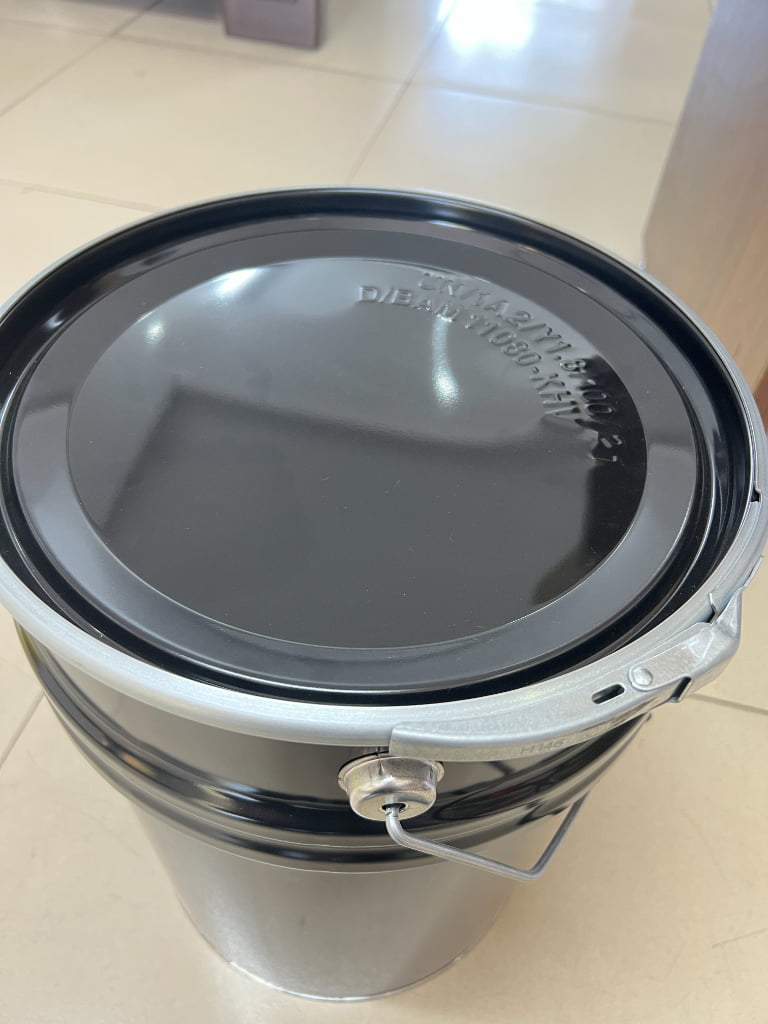
UN Packaging Code Explained: 1A1, 1A2, 1H1, 1H2 and What Buyers Should Know
Every UN-rated steel pail or drum has a code stamped on it that looks cryptic at first: "1A1" or "1A2" or "1H1" or "1H2." These four-character codes tell you exactly what the container is made of, how it's constructed, and what it's rated to carry. After supplying UN-certified steel pails from our Suzhou factory to chemical exporters in 20+ countries since 2014, here's the field-tested guide to reading these codes and using them to verify your supplier's claims.
The Anatomy of a UN Packaging Code
A UN packaging code is a four-character alphanumeric identifier that follows the format "Type-Material-Construction" with one optional character at the end for packing group. Let me break down each position:
- Position 1 (type): A single digit (1, 2, or 3) indicating the container type
- Position 2 (material): A letter (A, B, C, D, F, G, H, L, M, N, P) indicating what the container is made of
- Position 3 (construction): A single digit (1 or 2) indicating whether the head is removable or not
- Position 4 (packing group): Optional letter (X, Y, or Z) indicating the packing group performance level
For steel pails, the codes you'll see 95% of the time are 1A1 and 1A2. Let's decode what they mean.
The Most Common Codes for Steel Pails and Drums
| Code | Type | Material | Construction | Common use |
|---|---|---|---|---|
| 1A1 | Drum (1) | Steel (A) | Removable head (1) | 200L+ steel drums with removable lid (most common for bulk chemicals) |
| 1A2 | Drum (1) | Steel (A) | Non-removable head (2) | 200L+ steel drums with sealed top (often used for Class 1 explosives) |
| 1B1 | Drum (1) | Aluminum (B) | Removable head (1) | 200L+ aluminum drums for sensitive chemicals (less common, more expensive) |
| 1H1 | Drum (1) | Plastic (H) | Removable head (1) | 200L+ plastic drums (HDPE, often for non-hazardous liquids) |
| 3A1 | Jerrican (3) | Steel (A) | Removable head (1) | Smaller (5L-60L) rectangular steel jerricans (less common in international trade) |
| 1A1 Y | Drum (1) | Steel (A) | Removable head (1) | Packing group II/III performance (medium to low hazard) |
| 1A1 X | Drum (1) | Steel (A) | Removable head (1) | Packing group I/II/III performance (high hazard, most stringent) |
The packing group suffix (X, Y, Z) is critical for dangerous goods classification:
- X = tested and approved for Packing Groups I, II, and III (the strictest, covers high-hazard materials like Class 3 flammable liquids with low flash points)
- Y = tested and approved for Packing Groups II and III (medium-hazard materials like most paints, adhesives, and Class 8 corrosives)
- Z = tested and approved for Packing Group III only (low-hazard materials)
If your PO says "1A1" without a packing group letter, the default is Y in most jurisdictions. Always specify the packing group you need in the PO to avoid ambiguity.
What 1A1 vs 1A2 Means for Your 5-Gallon Steel Pail
Wait—5-gallon (20L) steel pails have a different code system. The codes above (1A1, 1A2) apply to 200L+ drums under the UN system. For 20L steel pails, the equivalent is typically classified as "non-bulk packaging" with a different marking format.
For 20L steel pails carrying dangerous goods, you'll typically see:
- "UN 1A1 Y/..." or "UN 1A1 X/..." on the pail marking
- The "Y" or "X" is the packing group rating
- The rest of the marking includes the specific gravity or gross mass tested, the year of manufacture, and the state or authority that issued the certification
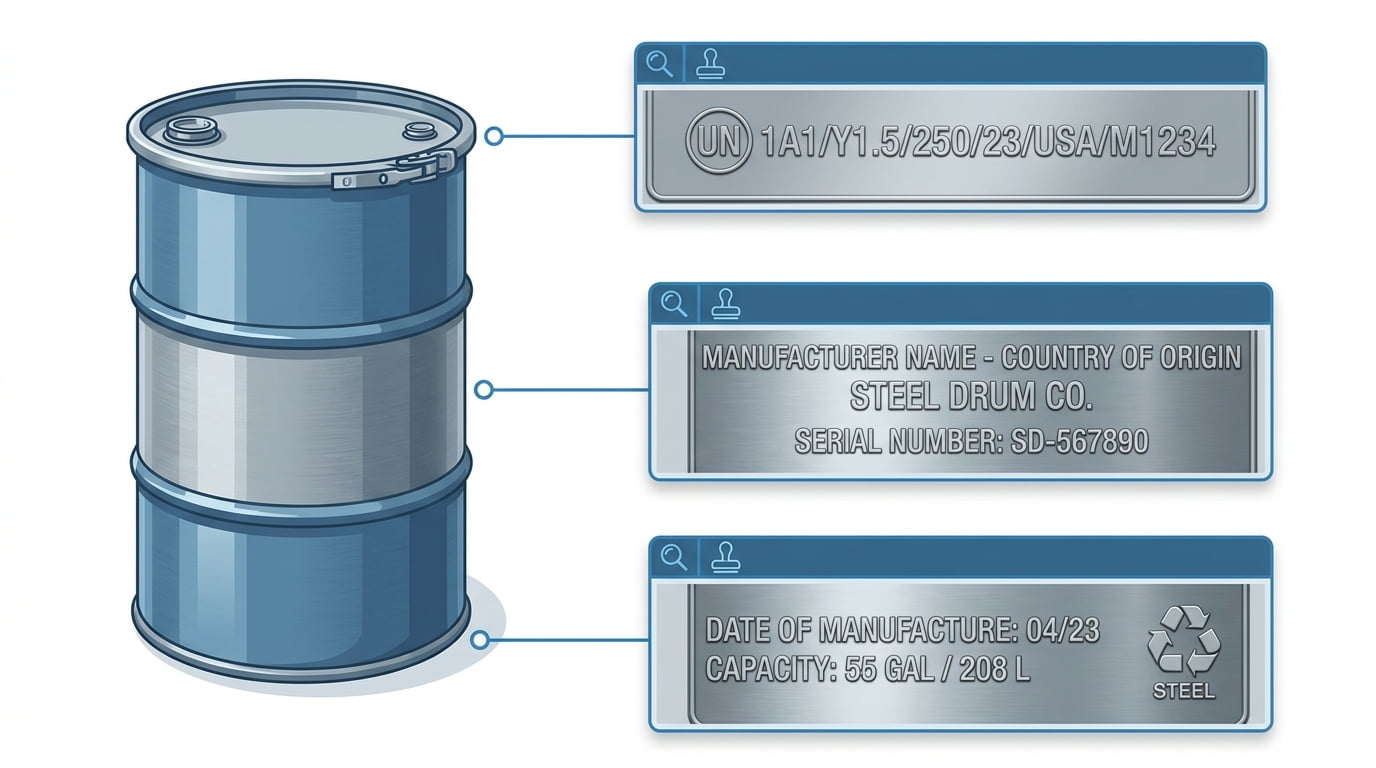
A complete UN marking on a 20L steel pail looks like this:
UN 1A1 Y/1.4/250/26/UN/AA1234This decodes as:
- UN = United Nations designation
- 1A1 = Steel drum, removable head
- Y = Packing Group II/III
- 1.4 = Specific gravity of tested liquid (1.4 g/cm³, the maximum for this certification)
- 250 = Hydrostatic test pressure in kPa
- 26 = Year of manufacture (2026)
- CN = Country of approval (or could be USA for America, DE for Germany, etc.)
- AA1234 = Manufacturer's registered mark and serial
If your 20L steel pail's marking doesn't include specific gravity, hydrostatic pressure, year, and approval state, the certification is incomplete or fake. Always verify the full marking before accepting UN-rated pails.
How to Verify a UN Certification Is Real
Three verification steps that take 10 minutes and can save you from accepting counterfeit or incomplete certifications:
Step 1: Check the marking format matches UN Model Regulations. The marking must include all six elements: UN symbol, packaging code, packing group, specific gravity or mass, hydrostatic pressure, and year of manufacture. If any element is missing, ask why.
Step 2: Verify the approval state and manufacturer's mark. The state that issued the approval (USA, CN, DE) must have a registered certification body that issued the approval. The manufacturer's mark should match the factory that's actually producing the pail. Cross-reference with the approval certificate your supplier provides.
Step 3: Request the actual test report. Every UN-certified pail must have passed four performance tests: drop test, leakproofness test, hydrostatic pressure test, and stacking test. The test report should be dated within the last 12 months and should reference the specific pail design (dimensions, thickness, closure type) you're buying.
A common scam in the industry: factories stamp "UN" on pails without actually obtaining certification, or they obtain certification for one design and apply it to a different design. The marking looks legitimate but the pails haven't been tested.
When You Don't Need UN Certification
UN certification is mandatory for dangerous goods transport (Class 1 explosives, Class 3 flammable liquids, Class 6.1 toxic substances, Class 8 corrosives, etc.) when shipped across international borders by air, sea, or in many cases by road.
UN certification is NOT required for:
- Water-based latex paint (Class 3 only if flash point <60°C, most latex doesn't qualify)
- Architectural paints shipped by road within one country
- Most food and beverage products (different regulatory framework, FDA/EU food contact)
- Products that don't meet any dangerous goods classification criteria
- Empty pails being shipped for cleaning/refilling (UN applies to filled pails in most cases)
If your product doesn't classify as dangerous goods, don't pay the UN premium. We see buyers overpaying per pail for UN ratings they don't legally need. Run your product's UN classification test (or have a hazmat consultant do it) before committing to UN-rated pails. The actual premium varies by quantity and certification body—contact us for a side-by-side quote.
What the 4 Performance Tests Actually Check
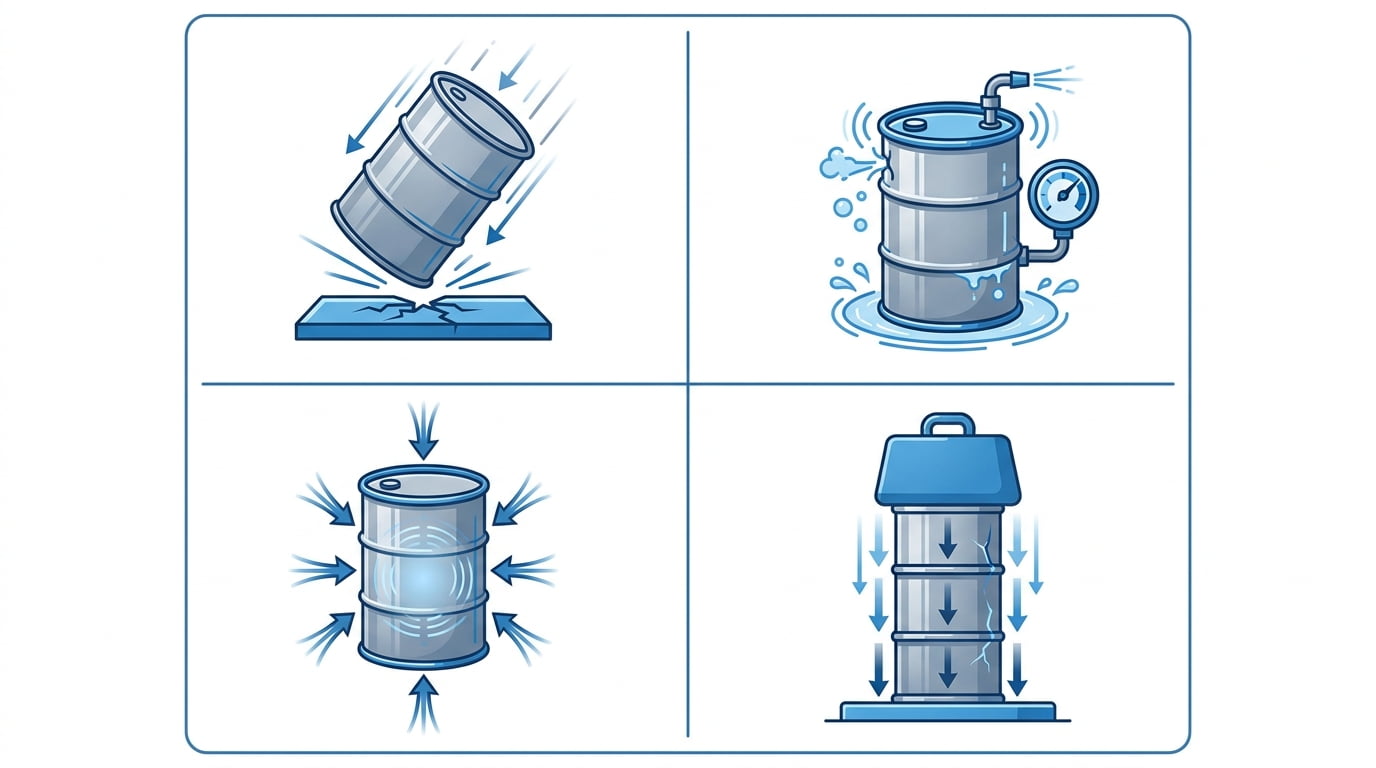
Every UN-certified pail has passed these four tests, documented in the manufacturer's test report:
-
Drop test (1.2m to 1.8m depending on packing group): The pail is filled with test liquid and dropped from a specified height onto a rigid surface. Pass criteria: no leakage, no rupture.
-
Leakproofness test: The pail is filled and pressurized to 20 kPa (or higher depending on spec) for 5-10 minutes. Pass criteria: no pressure drop, no visible leaks at seams or closures.
-
Hydrostatic pressure test: The pail is pressurized to 250 kPa (or specified pressure) for 5 minutes. Pass criteria: no rupture, no permanent deformation exceeding spec.
-
Stacking test: A weighted load is placed on top of the pail (typically equivalent to 3 meters of stacked product) for 24-168 hours. Pass criteria: no buckling, no lid failure, no seam separation.
The packing group rating determines test severity:
- Packing Group I (X-rated): Most stringent. Drop test at 1.8m. Hydrostatic test at 250 kPa.
- Packing Group II (Y-rated): Medium. Drop test at 1.2m. Hydrostatic test at 100 kPa.
- Packing Group III (Z-rated): Least stringent. Drop test at 0.8m. Hydrostatic test at 100 kPa.
For most paint, coating, and adhesive applications, Y-rated (Packing Group II) is sufficient. X-rated is reserved for serious hazards like acetone, methanol, and Class 6.1 toxic materials.
Common UN Marking Mistakes to Avoid in Your PO
When specifying UN pails in your purchase order, include these four items to avoid certification disputes:
- Packaging code with packing group letter (e.g., "UN 1A1 Y") not just "1A1"
- Specific gravity or gross mass tested (e.g., "tested at 1.4 g/cm³ specific gravity" or "tested at 25 kg gross mass")
- Year of manufacture requirement (specify "current year" or a specific year)
- Approval state and manufacturer mark (e.g., "approved by CN/State Administration for Market Regulation, manufacturer mark XYZ123")
Without these four, the certification is incomplete and your shipment may be rejected at port of entry or by the carrier.
Conclusion
Reading a UN packaging code is simpler than it looks once you understand the four-character format: type, material, construction, and packing group. The "1A1" or "1A2" tells you immediately what the container is and how it's rated.
The three things to verify before accepting UN-rated pails:
- Full marking includes all six elements (UN symbol, code, packing group, specific gravity, year, approval state)
- Test report dated within 12 months, referencing your specific pail design
- Manufacturer's mark matches the actual producing factory
If you're not sure whether your product needs UN certification or what packing group to specify, send us your product's MSDS and we'll help you determine the right spec—most inquiries get a response within 12 hours.