It is mid-August 2026. European chemical, paint, and coatings buyers are finalising Q4 procurement budgets. North American buyers are running holiday-season production planning. Middle East and African importers are stockpiling ahead of year-end shipping congestion. The question on every purchasing manager's desk this month is the same: what is tinplate going to cost in H2 2026, and when should I commit to a forward order?
We cannot give you a single number. The honest answer is a range of scenarios, driven by a small set of variables you can monitor yourself. This guide does three things:
- Reviews what actually happened to tinplate, tin, steel, and EU carbon costs in H1 2026 (verifiable public data)
- Sets out three plausible scenarios for H2 2026 with the triggers that distinguish them
- Gives you a five-step procurement playbook for chemical can buyers specifically — paint pails, coatings containers, adhesive cans, lubricant containers, and the smaller industrial formats
All price references in this article are drawn from public market sources (LME settlement prices, Mysteel daily indices, made-in-china.com public quotations, and the EU Commission CBAM certificate price publication). They are reference points for planning, not offers. Actual contract pricing is set per order based on quantity, specification, destination, and Incoterms. A full disclaimer appears at the end.
H1 2026: What Actually Happened
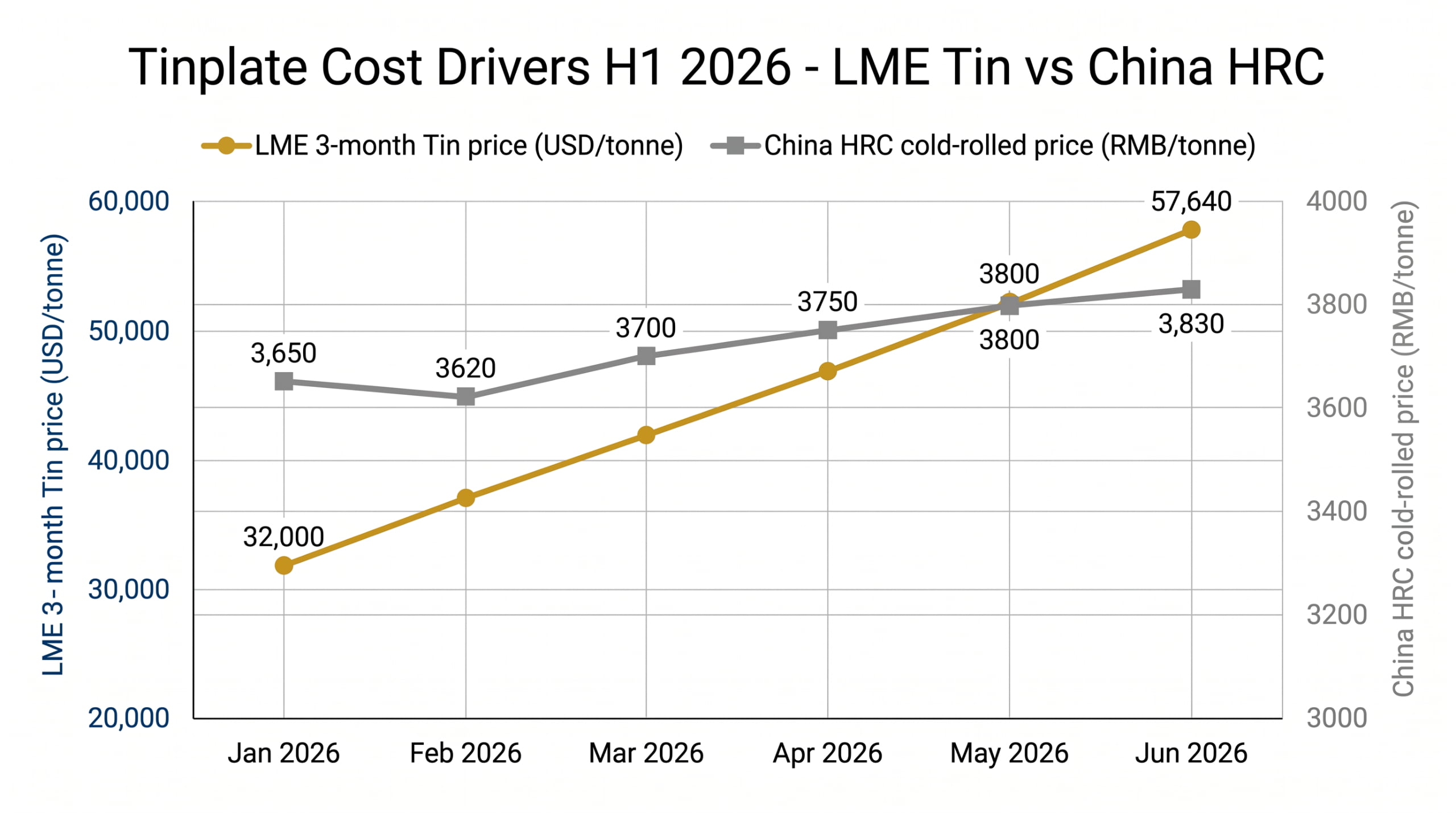
Four separate cost drivers moved in H1 2026, and they did not all move in the same direction. Understanding the composition is the only way to make sense of the net effect on your tinplate landed cost.
Driver 1: LME Tin Price — Significantly Higher Year-on-Year
LME 3-month tin traded at USD 57,640/tonne on 2 June 2026 (LME settlement, public record). For context, the 2025 annual average for LME tin was approximately USD 31,500-32,500/tonne. The H1 2026 average sits meaningfully above 2025 levels.
The cause is well-documented across LME commentary and trade press: structural supply tightness from Indonesia (the world's largest exporter) following export permit disruptions and stricter downstream processing rules, combined with sustained demand from the electronics soldering segment and from lithium battery anode tape applications. Tin is no longer a packaging-only metal. Its role in EV and consumer electronics supply chains now drives price independently of food can and chemical can demand.
What this means for tinplate: the tin coating on electrolytic tinplate (ETP) represents a small but visible portion of finished product cost. Standard ETP at 2.8/2.8 g/m² tin coating contains roughly 11-12 kg of tin per tonne of tinplate. At LME 57,640 USD/tonne, the tin input alone is approximately USD 670-690/tonne of tinplate, compared to approximately USD 380/tonne at 2025 average prices. That is a structural step-change in the input cost.
Driver 2: Chinese HRC and Cold-Rolled Steel — Stable to Soft
The Chinese steel market was under significant pressure in H1 2026. According to Mysteel and CISA data published in Q2 2026:
- China's black metal smelting and rolling processing industry recorded a Q1 2026 loss of approximately 3.34 billion RMB, reversing a year-ago profit
- CISA major member companies' steel-only profit was just 1.03 billion RMB, with a main-business sales margin of 0.1%
- Hot-rolled common steel price index was down approximately 4.2% year-on-year
- Cost-to-revenue ratio reached 96.0%, with average per-tonne loss of approximately 13 RMB
Cold-rolled and coated steel (the input for tinplate) tracked the broader market. Mysteel's daily index for 1.2mm cold-rolled coil in major Chinese markets was approximately 3,830 RMB/tonne (USD 530-540/tonne) in early June 2026, broadly stable with seasonal softness.
What this means for tinplate: the steel substrate component of tinplate cost is currently near a cyclical floor, which partially offsets the tin-driven cost increase.
Driver 3: EU CBAM — Material New Cost for European-Bound Shipments
The EU Carbon Border Adjustment Mechanism entered its definitive regime on 1 January 2026. The first published CBAM certificate price for Q1 2026 was EUR 75.36 per tonne of CO2 (Commission publication, 7 April 2026). For hot-rolled steel, the embedded carbon defaults range from approximately 1.8 to 3.2 tonnes CO2 per tonne of steel, depending on whether the producer uses integrated blast furnace route or electric arc furnace route.
For a Chinese-origin tinplate shipment entering the EU, the CBAM cost at the default value is approximately EUR 135-240 per tonne of steel content in 2026. At 0.25mm tinplate weighing roughly 2.0 kg per standard 5-gallon pail, the per-can CBAM surcharge on a 20L steel pail is meaningful, even after the 2.5% phase-in factor that applies in 2026.
For the chemical can buyer specifically, the practical implications are:
- The cost exists whether you see it on the invoice or not. The CBAM certificate is purchased by the EU importer, but it is passed through in the form of price pressure on the supply contract. EU buyers are now actively asking Chinese suppliers for embedded emissions data.
- Producers with lower-carbon processes have a structural advantage. Electric arc furnace (EAF) routes using high recycled content carry lower embedded carbon defaults than blast furnace basic oxygen (BF-BOF) routes. The supplier's process matters for your landed cost.
- The phase-in ramps quickly. 2026 is 2.5% of CBAM cost, 2027 is 5%, 2028 is 10%, 2029 is 22.5%, 2030 is 48.5%, 2031 is 61%, 2032 is 73%, 2033 is 86%, 2034 is 100%. What costs a chemical can buyer EUR 4-6 per pail in 2026 will cost EUR 8-12 by 2028, and EUR 150-180 per tonne by 2030.
ING Economics forecast the EU ETS (and therefore CBAM-linked) carbon price to average around EUR 83/tonne CO2 across 2026, with Bloomberg New Energy Finance projecting EUR 149/tonne by 2030.
Driver 4: Chinese Export Logistics and Ocean Freight
H1 2026 saw relative stability in container freight rates on the major Asia-Europe and Asia-North America lanes, following the post-2024 normalization. Average 40-foot container rates on Shanghai-Rotterdam held within a USD 2,200-3,400 range through H1 2026, well below the 2021-2022 peak but above 2019 pre-pandemic levels. This is a moderate tailwind for landed cost stability, not a major driver.
Net Effect on Tinplate Landed Cost (Reference Ranges)
For prime-grade ETP tinplate (2.8/2.8 coating, MR-grade base, 0.25-0.30mm gauge, suitable for paint and chemical cans), the public reference range observed on major Chinese B2B sourcing platforms in mid-2026 sits approximately between USD 700 and USD 1,150 per tonne ex-works China, depending on specification, order quantity, and producer tier. For context, the equivalent range in H1 2025 was approximately USD 620-900 per tonne. The increase is driven primarily by LME tin, partially offset by softer Chinese steel substrate.
These are public market reference ranges for orientation only. They are not offers and not historical transaction prices. Your actual landed cost depends on tin coating weight, base steel grade, order volume, Incoterm, and the specific producer's process route.
H2 2026: Three Scenarios
Forecasting commodity prices is not a science. What we can do is identify the variables that matter, set out the three most likely paths those variables can take, and flag the early indicators that would tell you which path you are on.
The Three Variables That Matter Most
- LME tin price: Above or below USD 50,000/tonne through Q3-Q4 2026
- Chinese steel mill discipline: Whether production discipline holds and HRC remains range-bound, or whether the loss-making pressure triggers a capacity cut that supports prices
- EU CBAM enforcement intensity: Whether customs authorities in Germany, Italy, and Netherlands begin systematic detention of non-compliant tinplate shipments
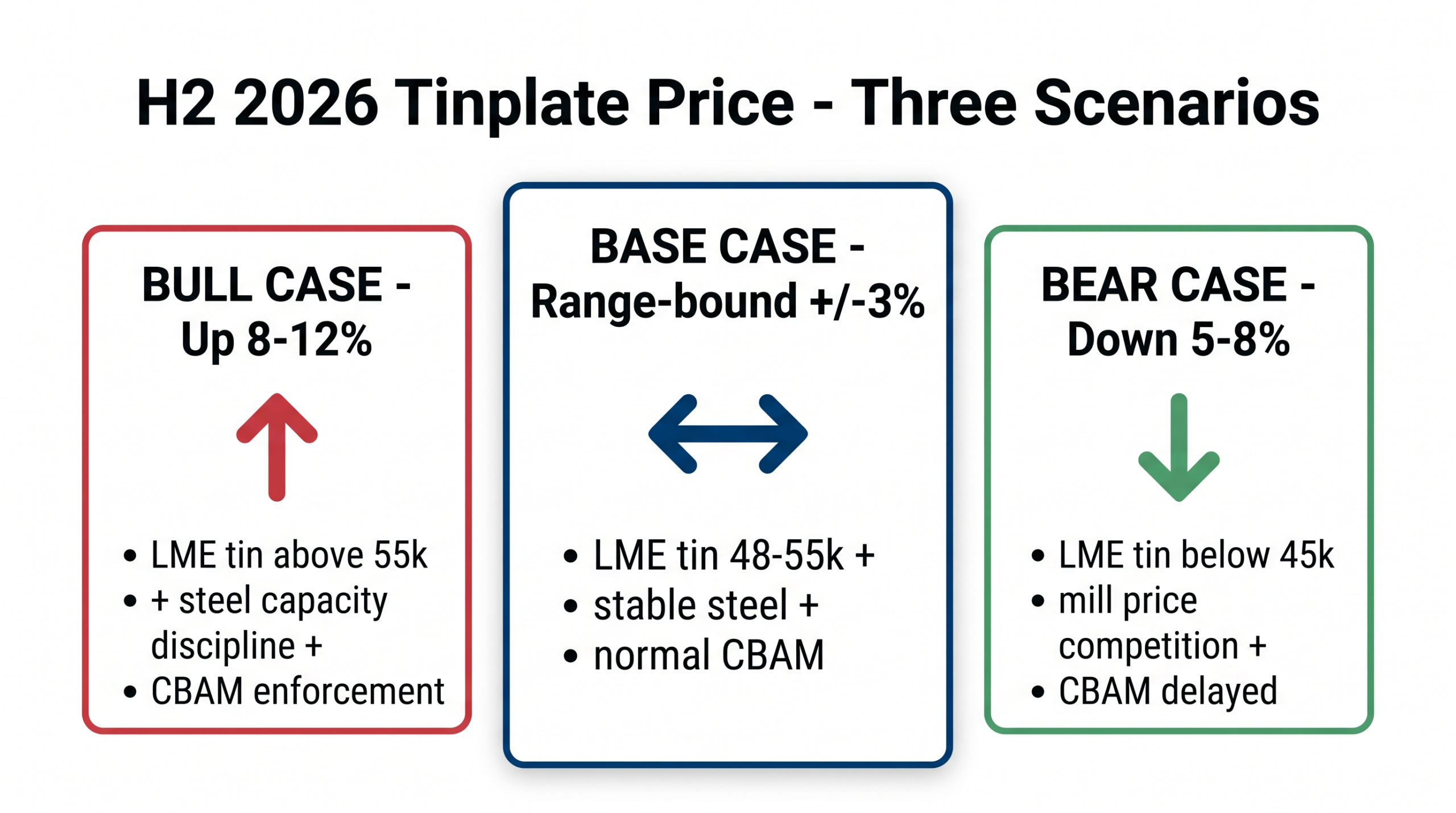
Scenario A: Bull Case — H2 Tinplate Up 8-12%
LME tin holds above USD 55,000/tonne on continued Indonesian supply tightness and sustained EV battery demand. Chinese steel mills begin meaningful capacity discipline after Q2 2026 losses, lifting HRC 3-5% in Q3. EU CBAM enforcement tightens, with a handful of high-profile detentions at Hamburg and Rotterdam customs in September-October, prompting EU buyers to accelerate supplier consolidation toward compliant producers.
Trigger signals to monitor: LME tin weekly close above USD 58,000; Mysteel weekly capacity utilization among Chinese tinplate mills falling below 70%; any EU customs announcement of CBAM enforcement statistics for H2 2026.
Implication for chemical can buyers: lock 60-70% of H2 2026 needs by mid-September. Accept the higher cost as the new baseline. The 8-12% increase will compound further in 2027 if LME tin remains elevated.
Scenario B: Base Case — H2 Tinplate Range-Bound, +/- 3%
LME tin drifts between USD 48,000-55,000/tonne, with the supply tightness easing modestly as Indonesian export rules stabilize. Chinese steel mills maintain current discipline levels, with HRC in the 3,600-3,900 RMB/tonne range. CBAM enforcement progresses but no major detentions; the cost is absorbed into normal supply contracts.
Trigger signals to monitor: LME tin weekly close in the 48-55k range; Chinese steel mill monthly profit data showing modest improvement; EU Commission quarterly CBAM report showing high compliance rates.
Implication for chemical can buyers: split orders 50/50 between Q3 and Q4 procurement, locking prices on a quarterly basis with an indexed adjustment clause for tin. This is the lowest-risk path for most buyers.
Scenario C: Bear Case — H2 Tinplate Down 5-8%
LME tin breaks below USD 45,000/tonne on improved Indonesian supply and softer electronics demand. Chinese steel mill losses trigger price competition for export volume, with HRC falling below 3,500 RMB/tonne. CBAM enforcement is delayed or softened by EU political pressure on member states.
Trigger signals to monitor: LME tin weekly close below USD 45,000; major Indonesian tin producer announcements of normalized exports; EU member state (especially Germany) public pushback on CBAM implementation timeline.
Implication for chemical can buyers: spot-buy rather than forward-commit, take advantage of monthly price dips, and re-negotiate annual contracts in Q1 2027 to lock any structural decrease.
Which Scenario Is Most Likely?
Our read, with the humility appropriate to forecasting: Scenario B (base case) is the highest probability outcome for H2 2026, with a meaningful tail risk of Scenario A on tin supply. The bear case requires a specific combination of LME tin collapse and EU political reversal that seems less likely given current supply and policy signals.
What Chemical Can Buyers Should Do Now: A Five-Step Playbook
Generic procurement advice is useless for chemical can buyers. Your product mix has specific cost drivers that generic "tinplate price" articles miss. Here is what we recommend for the H2 2026 procurement cycle.
Step 1: Audit Your Tin Coating Weight
Most chemical cans (paint pails, coatings containers, adhesive cans, lubricant containers) use either 2.8/2.8 g/m² tin coating (standard ETP) or TFS (tin-free steel, chrome-coated). The LME tin-driven cost step-change hits 2.8/2.8 ETP directly. TFS is not affected by LME tin.
If your product specifications allow, evaluate TFS for non-visible surfaces and reserve ETP for visible/external surfaces. The cost saving on a 20L paint pail is typically in the 3-5% range. Talk to your supplier about whether your current specs can be split this way.
Step 2: Understand the Tin Surcharge Mechanism
Most Chinese tinplate mills and packaging converters operate a tin surcharge tied to LME 3-month tin. The mechanism varies: some adjust monthly, some quarterly, some have a 30-60 day lag. Ask your supplier for the exact mechanism in writing. Then build it into your own pricing model so you are not surprised by mid-contract price adjustments.
A well-structured tin surcharge is your friend in a rising market and a fair allocation of risk. A poorly structured one (large lag, unilateral adjustment) is a hidden margin transfer.
Step 3: Lock the Steel Substrate, Float the Tin
The steel substrate component (roughly 60-65% of finished tinplate cost) is currently near a cyclical floor in China. If you believe the base case or bull case, lock 50-70% of your H2 substrate needs with your supplier at current levels. The tin component is best left indexed to LME with the same mechanism your supplier uses. This split locking is the optimal hedging approach for a buyer who is not a sophisticated commodity trader.
Step 4: Build CBAM Cost into Your Forward Pricing Now
If you are an EU-based buyer, your 2026 CBAM certificate purchase and 2027 declaration cycle are already locked in by the regulation. Build the CBAM cost into your forward contract pricing now, not as a year-end surprise. The 2026 phase-in is 2.5%, but the trajectory is steep. A supplier who can show you their embedded emissions data (lower than the EU default) is a supplier you want to keep. A supplier who refuses to share the data is a supplier whose cost you will pay at the default rate.
Step 5: Diversify Tinplate Sources Strategically
A single-supplier strategy was fine in 2024. In 2026, with LME tin volatile, Chinese steel under structural pressure, and EU CBAM reshaping trade flows, a single-source exposure is a real risk. We recommend maintaining at least two qualified suppliers — ideally one in China and one in another Asian tinplate-producing country (India, South Korea, Japan). The qualification process takes 3-6 months, so start now if you have not already.
What This Means for Your Order Book
If you are a chemical can buyer running H2 2026 procurement right now, the practical decisions are:
-
For September-December 2026 delivery: Lock 50-60% of needs with a base case price expectation. Build in a tin surcharge clause with the same LME reference your supplier uses. CBAM cost on EU-bound shipments should be passed through transparently.
-
For January-March 2027 delivery: Defer commitment until late September 2026 when the H2 supply picture is clearer. Watch the LME tin weekly close and the Chinese steel mill monthly profit data as your decision triggers.
-
For annual contract negotiations (Q1 2027): Use the 2026 actual cost experience to negotiate a 2027 framework. Demand CBAM cost transparency from your supplier. Push for indexed pricing on tin, fixed pricing on steel substrate, and a clear force majeure clause that does not include ordinary commodity volatility.
The chemical can market is structurally tight on capacity, structurally loose on price discovery. Buyers who treat tinplate procurement as a quarterly tactical exercise will out-perform buyers who treat it as an annual fixed-price negotiation.
How We Work With Chemical Can Buyers
At Suzhou Jinqiao Packaging, we are a 40-person metal packaging manufacturer in Suzhou, China. We produce 5-gallon steel pails, 20L industrial pails, lever-lid paint cans, 1L F-Style oblong cans, and a range of custom metal packaging for the chemical, paint, coatings, and adhesives industries.
For chemical can buyers planning H2 2026 and 2027 procurement, we offer:
- Indexed pricing structure with transparent LME tin reference and capped monthly adjustment
- Annual volume framework agreements with quarterly price reviews tied to verifiable public market indices
- Embedded carbon data disclosure for EU-bound shipments, including mill-of-origin process route and recycled content
- Multi-base-stock options including standard ETP, TFS, and differential coating weights
- Tinplate substrate sourcing from Baosteel with documented SGS heavy-metals and composition data
For a current quotation on 5-gallon steel pails, 20L industrial pails, lever-lid paint cans, or custom chemical packaging, contact us via the form on our contact page. For an H2 2026 procurement framework discussion, message us on WhatsApp (+86 178 2667 5627) or email joey@szjqpack.com.
Important Disclaimer on Pricing References
All price references in this article — LME tin, Chinese HRC, CBAM certificate price, made-in-china.com public quotation ranges — are public market reference data sourced from third-party publications. They are provided for general industry context and procurement planning only. They are not offers, not historical transaction prices, and not price forecasts for any specific contract.
Actual tinplate and finished metal packaging prices are set per order based on specification (tin coating weight, base steel grade, gauge, finish), order quantity, Incoterm, destination market, and current mill and converter capacity utilization. Public market reference data and the producer-level actual cost basis can diverge significantly, particularly in periods of mill discipline or disruption.
For a current quotation tailored to your specific chemical can requirements, please contact Suzhou Jinqiao Packaging directly. We provide per-order pricing with full specification transparency, indexed adjustment mechanisms, and CBAM cost disclosure for EU-bound shipments.
Sources and Further Reading
- LME settlement price data: London Metal Exchange daily reports
- Chinese steel market data: Mysteel daily and weekly indices, CISA monthly bulletins
- EU CBAM certificate price: European Commission CBAM website, Q1 2026 certificate price publication dated 7 April 2026
- Indonesian tin supply context: Reuters and Fastmarkets reporting on export permit and downstream processing rule changes
- ING Economics EU ETS forecast 2026, BloombergNEF EU ETS 2030 forecast
For related articles on jqbuckets.com, see our guides on tinplate thickness for metal cans, the EU PPWR packaging regulation 2025/40, and the UN packaging code system for dangerous goods packaging. Updated 2026-08-14 with H1 2026 actual data and the H2 2026 three-scenario view.
Talk to Us About Your H2 2026 Tinplate Procurement
If you are a chemical, paint, coatings, or adhesives buyer planning your H2 2026 tinplate and metal packaging procurement, we would like to hear from you. We do not publish our pricing publicly (each order is quoted based on your specific specification, quantity, and Incoterm), but we will give you a real quotation within 48 hours of receiving your inquiry.
Suzhou Jinqiao Packaging Container Co., Ltd has been exporting metal cans, steel pails, and chemical packaging to 30+ countries since 2008. Our H2 2026 capacity for 5-gallon steel pails, 20L industrial pails, lever-lid paint cans, and 1L F-Style oblong cans is available with 6-8 week lead times for standard specifications.
Reach out via the form on our contact page, or message us on WhatsApp (+86 178 2667 5627). For an indexed pricing framework proposal for H2 2026 procurement, email joey@szjqpack.com directly with your expected annual volume and primary specifications.
The H2 2026 procurement window is the right one to lock in a multi-quarter framework rather than spot-buying each month. The buyers who act in August-September will be the ones with stable input costs through year-end. The ones who wait for clarity will pay for that clarity in either higher prices or supply disruption.