If your factory ships tin cans, steel pails, or aluminum containers into the European Union, the 2026-08-12 deadline for EU Regulation 2025/40 (the Packaging and Packaging Waste Regulation, or PPWR) is no longer a future problem. It is a customs-line problem.
By the time you finish reading this sentence, a competitor who started compliance work in Q1 2026 has likely already shipped their first EU-compliant container under the new regime. The question for everyone else is no longer “should we comply?” but “how do we comply fast enough to keep our European customers?”
This guide is written for one specific audience: Chinese metal packaging exporters and the European buyers who source from them. We will not waste your time with general sustainability talk. Instead, you will get:
- The four mandatory test categories under PPWR and exactly which apply to metal packaging
- Why tinplate and steel are structurally favored by the regulation (and where they are not)
- A step-by-step compliance roadmap you can run between now and 2026-08-12
- The real costs and the real penalties, including the 4% global revenue exposure most exporters underestimate
- How our own factory is positioned on each of the four tests, and what we can hand you in a Declaration of Conformity
We have been digging through the regulation text, Commission guidance, and the implementing acts that have been published since the February 2025 publication. Where industry practice has not yet crystallized, we say so. Where a fact is verified, we tell you the source.
Let’s start with the timeline, because that is what determines the order of your work.
The 2026-08-12 Cliff: What Actually Changes
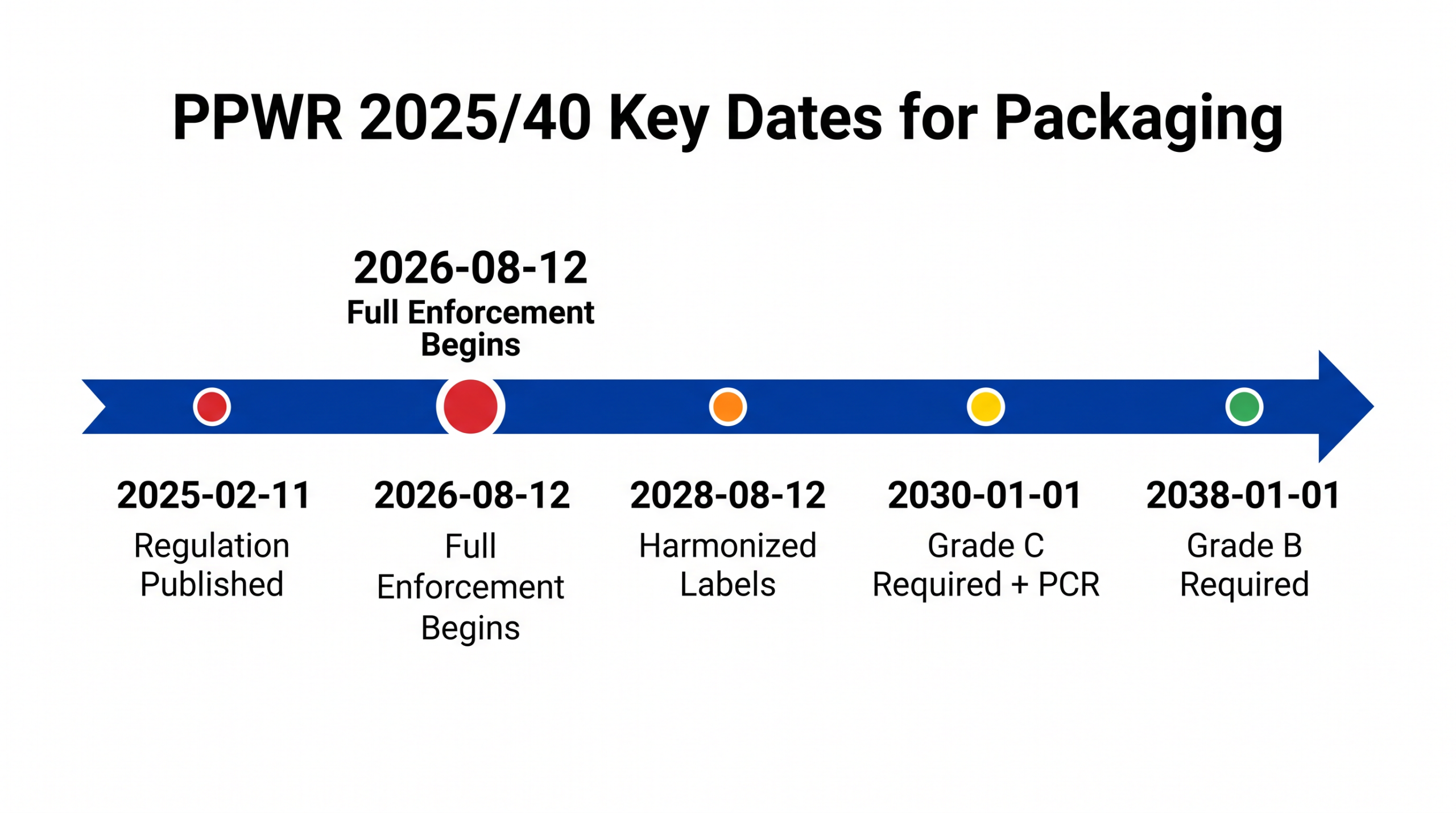
EU Regulation 2025/40 was published in the Official Journal of the EU on 2025-02-11. It entered into force 20 days later. However, most of the substantive obligations only bite on 2026-08-12, eighteen months after publication. That is the cliff.
On that date:
- The 1994/62/EC Packaging Directive stops applying. Every test report, every Declaration of Conformity, and every EPR registration that was issued under the old directive becomes legally insufficient. New paperwork under PPWR is required.
- Heavy metals restrictions (Article 5) become enforceable on all packaging entering the EU market, regardless of where it was manufactured. This is the test that catches most exporters by surprise, because it was actually binding from 2025-02-11 but is now being actively enforced at customs.
- PFAS limits for food-contact packaging become mandatory. Three thresholds, all in ppb and ppm.
- Recyclability assessment becomes a market-access requirement. From 2030, only A/B/C grade packaging can be sold. From 2038, only A/B.
- EPR registration must already be in place in every EU member state where your product is sold. If you sell in Germany and France, you need two separate registrations, two separate PRO (Producer Responsibility Organisation) contracts, and two sets of eco-modulation fees.
Penalty exposure is up to 4% of global annual turnover under the new regulation (the figure widely cited in industry guidance materials, with the exact cap depending on the implementing acts each member state adopts). Customs can detain goods. Online marketplaces — Amazon, eBay, Temu, Shein — are now liable for non-compliant listings and have already begun systematic takedowns.
For a mid-sized Chinese metal packaging exporter with 8 million EUR annual revenue, the realistic worst-case exposure is roughly 320,000 EUR in fines on a single serious non-compliance event, plus the cost of every shipment held at Rotterdam or Hamburg for a week.
The Four Mandatory Tests: A Practical Breakdown
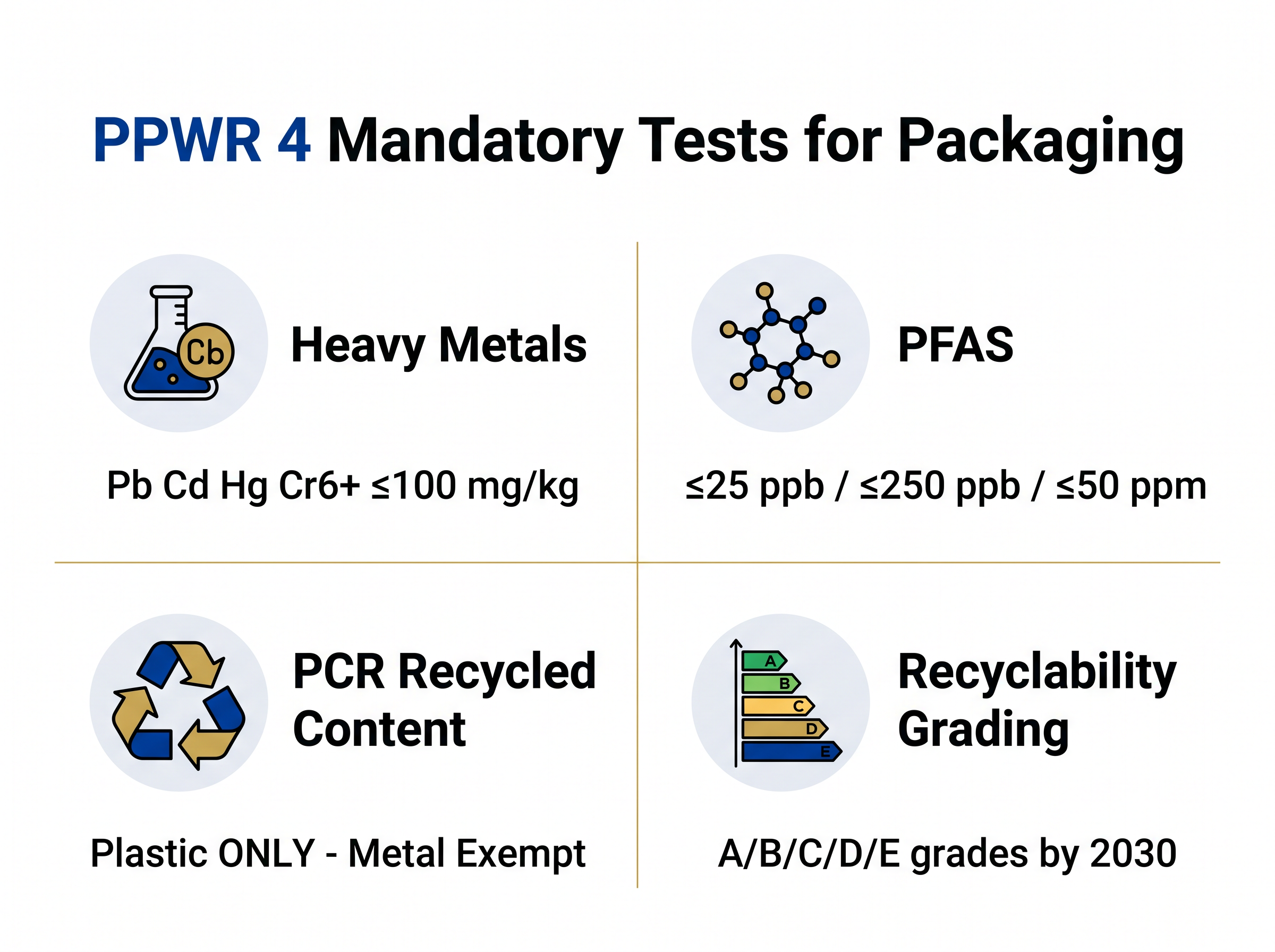
PPWR organizes compliance around four test categories. Not all four apply to all packaging. Below is the operational interpretation that matters for your shipment.
Test 1: Heavy Metals (Pb, Cd, Hg, Cr VI) — Applies to ALL Packaging
Threshold: Sum of lead, cadmium, mercury, and hexavalent chromium ≤ 100 mg/kg (ppm) per homogeneous material.
This is the test that catches most first-time exporters. The 100 mg/kg limit is not averaged across the whole can. It is measured separately on:
- The tinplate substrate
- The internal epoxy or phenolic coating
- The external coating or varnish
- The lithographic ink
- Any adhesive used in handle attachment or seam welding
- Plastic components (handles, gaskets, degassing valves, plastic inner plugs)
Why the per-homogeneous-material rule matters: A pail might test 60 mg/kg when the whole can is ground up, but if the rubber gasket alone tests 240 mg/kg, the can fails. You must test each layer separately.
Test methods: EN 1122 (cadmium), EN 12497 / EN 12498 (mercury), and ICP-based methods under ISO 11885 or equivalent for the full panel. Most EU-accredited labs in Shanghai, Suzhou, Shenzhen, and Hong Kong can run the full panel in 5-7 working days for around 800-1,500 EUR.
Status: Already in effect since 2025-02-11. Customs enforcement has been patchy but is tightening. Reports from Q2 2026 indicate increased detention of imported metal packaging at Hamburg and Antwerp customs for failure to provide homogeneous-material-level test reports.
For a typical food-grade epoxy-coated tinplate can from a Suzhou factory, this test is almost always a pass. Tinplate is fundamentally an iron-tin alloy with a total heavy-metal content well under 10 mg/kg. The variables are the ink and the gasket.
Test 2: PFAS — Applies to Food-Contact Packaging Only
Thresholds (all three must be met for compliance):
- Single non-polymeric PFAS ≤ 25 ppb
- Sum of all non-polymeric PFAS ≤ 250 ppb
- Total fluorine (TF) including polymeric PFAS ≤ 50 ppm (mg/kg)
Status: Mandatory from 2026-08-12.
Three-step screening procedure recommended by EU implementing guidance:
- Total fluorine screen first. If TF ≤ 50 ppm, you are compliant — no further testing needed. Cost: roughly 200-400 EUR per sample, 3-5 day turnaround.
- If TF > 50 ppm, distinguish organic vs inorganic fluorine. Inorganic fluorine (from fluoride salts, not PFAS) is exempt. If organic fluorine < 50 ppm, you are still compliant.
- If organic fluorine > 50 ppm, run targeted LC-MS/MS quantification of specific PFAS compounds against the 25 ppb and 250 ppb thresholds.
What this means for metal packaging exporters:
- Coffee tins, tea tins, food cans, infant formula cans, edible oil cans — these are food-contact. You must do the PFAS screen.
- Paint cans, chemical pails, industrial coatings containers, lubricant containers — these are not food-contact in the regulatory sense. PFAS thresholds do not apply directly, but Article 5 heavy-metal limits still do, and some member states are tightening this under national law.
- Pharmaceutical and medical packaging — different rules under EU 10/2011 and the Medical Device Regulation; PPWR is layered on top, not in place of these.
For a factory using standard bisphenol-A-free epoxy-phenolic internal coatings (the gold/yellow food-grade lacquer used for coffee, fish, and edible oil packaging), PFAS testing is typically a pass. The PFAS risk in metal packaging historically comes from:
- PTFE release coatings (used on some baking pan liners — not relevant for pails)
- Fluorosurfactant-treated paper labels (relevant if you use a paper label on a metal can)
- Certain inks with PFAS-modified pigments
- Imported tinplate with non-disclosed surface treatments
If you are a Chinese metal packaging exporter and you have not yet audited your tinplate supplier and your ink supplier for PFAS, do it this week. This is the single highest-risk variable in the entire regulation for our product category.
Test 3: Recycled Content (PCR) — Does NOT Apply to Metal Packaging
Status: Phased in from 2030-01-01. Applies to plastic packaging only.
The PCR (post-consumer recycled content) targets under Article 7 apply exclusively to plastic packaging:
- 2030: 30% PCR for contact-sensitive PET beverage bottles
- Phased targets for other plastic packaging categories
- Calculation and verification methodology to be set by Commission delegated act by 2026-12-31
Metal packaging is exempt from PCR targets. This is the single most important strategic fact in this entire regulation for any Chinese metal packaging exporter.
Compare to a Chinese plastic packaging exporter: by 2030, they will be required to source a defined percentage of post-consumer recycled plastic, document the chain of custody, and have the percentage verified by an accredited body. The recycled plastic market is tight, prices are volatile, and most Chinese recyclate still fails EU food-contact migration standards.
A Chinese metal packaging exporter faces no such obligation. Tinplate is already made from 25-35% recycled steel content in the basic oxygen furnace process used by most Chinese mills. The recycling rate is structurally high. We compete on this.
This is the first of three structural advantages that metal packaging has under PPWR.
Test 4: Recyclability Grading — Metal Wins on Mono-Material, Loses on Multi-Component
Status: 2030-01-01: minimum grade C. 2038-01-01: minimum grade B. Grade thresholds based on Design for Recycling criteria established by JRC (Joint Research Centre).
The grading scale:
- Grade A: recycling rate ≥ 95% in practice, easily sorted, no material losses
- Grade B: recycling rate ≥ 80%, sortable with standard equipment
- Grade C: recycling rate ≥ 70%, requires adjustment to existing recycling streams
- Grade D: recycling rate < 70% or significant contamination of recycling stream
- Grade E: not recyclable through any established infrastructure
For a typical tinplate can from a Suzhou factory:
- Pure tinplate (body + tinplate lid + food-grade epoxy interior + clear varnish exterior) = Grade A or high B in most JRC assessments
- Tinplate with plastic handle (PP or PE) = Grade B (PP handle is removed by eddy current in standard sorting)
- Tinplate with plastic handle + plastic degassing valve + plastic gasket = Grade B to C depending on valve design
- Tinplate with multi-layer laminate body (rare in cans, common in some specialty containers) = Grade C to D
The failure mode is multi-materiality, not the metal itself. A pail with a metal body, a metal handle, a rubber gasket, a plastic spout, and a paper label is a recycling stream nightmare. A pail that is all metal, with the handle attached by welding or riveting (no plastic intermediary), is a recycler favorite.
This is the second structural advantage for metal packaging — and the design rule you should be optimizing for in every EU-bound product from today onward.
What PPWR Means for a Coffee Tin, a Paint Pail, and a 20L Bucket
Three representative products, three different compliance profiles.
Coffee Bean Tin (250g, F-Style, food contact)
| Test | Required? | Risk | Action |
|---|---|---|---|
| Heavy metals (homogeneous) | Yes | Low | Test in next shipment cycle |
| PFAS screen | Yes | Medium | Audit ink, coating, label suppliers |
| PCR % | No | None | None |
| Recyclability grade | Yes (by 2030) | Low | Maintain mono-material design |
| EPR registration | Yes | Medium | Register in every EU country of sale |
| DoC + technical documentation | Yes | Low | Prepare from your existing QA file |
Verdict for a Suzhou factory’s standard F-Style coffee tin: a 4-6 week compliance program covers all the substantive work. Most of it is supplier audits and paperwork, not new product development.
5-Gallon Steel Paint Bucket (20L, lever lid, not food contact)
| Test | Required? | Risk | Action |
|---|---|---|---|
| Heavy metals (homogeneous) | Yes | Low | Standard EN 1122 panel |
| PFAS | No (not food contact) | Low | Optional screening recommended |
| PCR % | No | None | None |
| Recyclability grade | Yes (by 2030) | Low-Medium | Watch the handle, gasket, lid |
| EPR registration | Yes | Medium | Same as above |
| DoC + technical documentation | Yes | Low | Straightforward |
Verdict: Even easier than coffee tin. The lever lid and wire handle are typically all-metal; if you use a plastic gasket, document the polymer and ensure it is detachable in shredding.
20L Open-Head Industrial Pail (chemical container, not food contact)
This is where the recyclability grade gets interesting. Industrial pails are often the worst-designed products from a recycling perspective:
- Metal body
- Metal bail handle (good)
- Plastic spout or pour fitting (bad)
- Paper label with adhesive (bad if not water-soluble adhesive)
- Internal coating (depends on chemistry)
- Closure ring or clamp (usually OK if metal)
Action: Audit your standard 20L pail. Identify any non-metal components. For each, ask: is it removable? Is it sortable? Is the polymer commonly recycled in the EU? If any answer is no, redesign now. You have four years before the 2030 grade C threshold, but the redesign cycle on industrial packaging can be 12-18 months once you add customer approvals.
The Compliance Roadmap: 8 Steps from Today to 2026-08-12
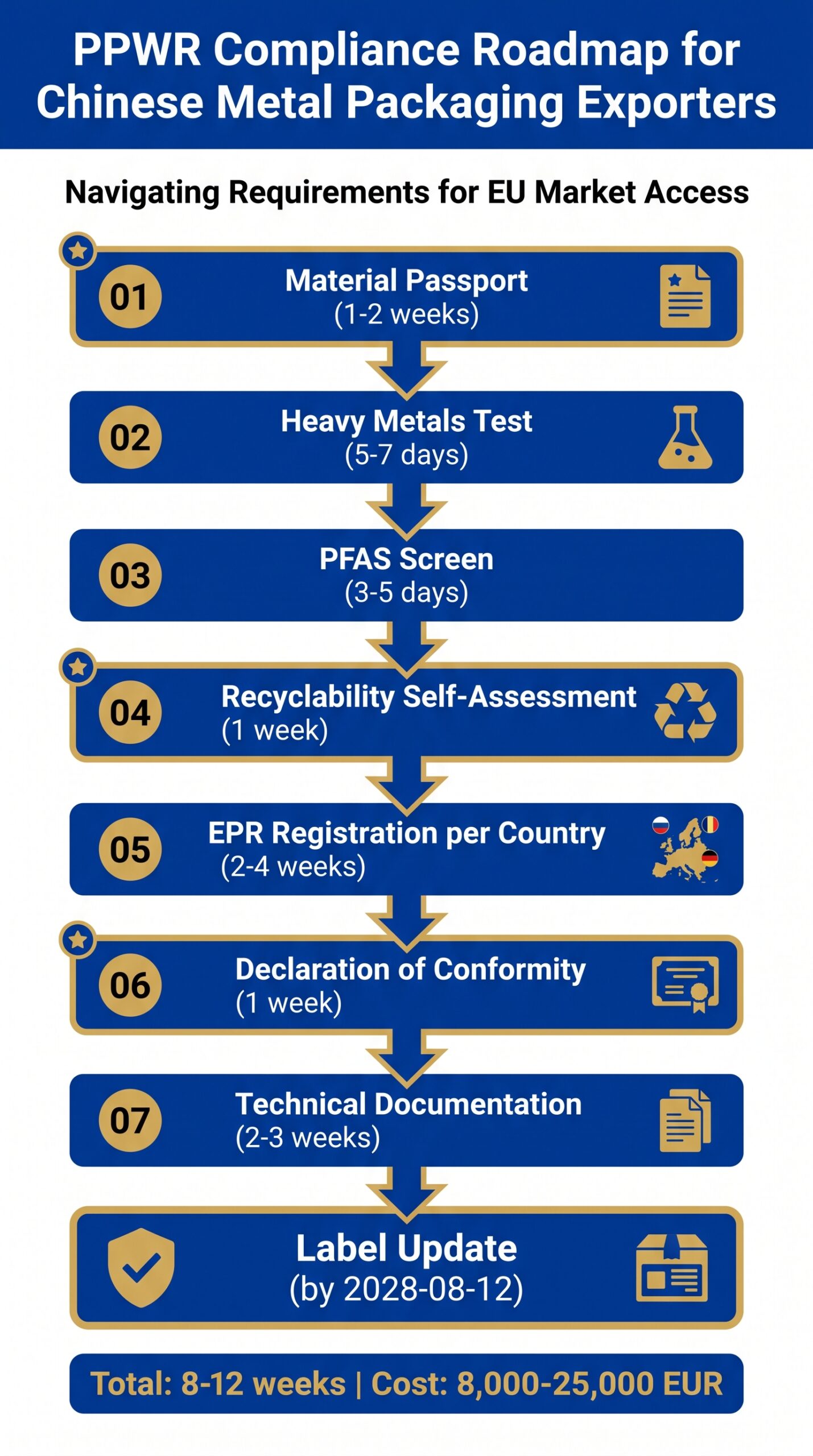
The regulation is dense. The work to comply is not. Here is the sequence we recommend, with rough time estimates.
Step 1: Material Passport Compilation (1-2 weeks)
Pull together from your existing QA file:
- Tinplate supplier and grade (e.g., Baosteel MR-grade, 0.25mm)
- Internal coating chemistry (e.g., BPA-NI epoxy-phenolic, gold lacquer)
- External coating chemistry (e.g., clear polyester varnish)
- Ink supplier and chemistry
- Adhesive supplier and chemistry (used in handles, gaskets, label attachment)
- Any plastic components with their polymer type and supplier
You probably have 70% of this already. The gap is usually in the polymer-component-level data on plastic handles, gaskets, and degassing valves.
Step 2: Heavy Metals Testing (5-7 working days lab time)
Submit each homogeneous material separately. A standard 5-material panel (body, internal coating, external coating, ink, adhesive) plus any plastic components runs about 2,000-3,500 EUR total at an ISO 17025-accredited lab in China (SGS Shanghai, Intertek Suzhou, TUV Rheinland Shanghai, Bureau Veritas Shenzhen are the common choices).
If you pass on the first run, you are good for 12 months under PPWR provided your suppliers do not change.
Step 3: PFAS Screening (3-5 working days lab time, if applicable)
For food-contact products only. Submit internal coating, external coating, and any paper labels. Roughly 600-1,200 EUR for the three-step screen.
Step 4: Recyclability Self-Assessment (1 week)
Use the JRC Design for Recycling guidelines (publicly available) and self-assess. For products that are clearly mono-material tinplate, this is 2 hours of work. For products with multiple polymer components, run a more detailed assessment or hire a consultant.
Step 5: EPR Registration per EU Country of Sale (2-4 weeks per country)
You will need:
- An EU authorized representative (for non-EU manufacturers). Cost: 800-2,000 EUR per country per year through agencies like Landbell, Interseroh, or take-e-back.
- A PRO (Producer Responsibility Organisation) contract per country
- Eco-modulation fee payment (varies, typically 50-500 EUR per ton of packaging placed on market)
Realistic annual EPR cost for a mid-sized Chinese metal packaging exporter selling in 4-5 EU countries: 5,000-15,000 EUR.
Step 6: Declaration of Conformity (DoC) Preparation (1 week)
Required under Article 38. Format follows the standard EN ISO/IEC 17050. Must include:
- Your name and address (or your EU authorized rep’s)
- Product identification
- Reference to the relevant PPWR articles
- List of harmonized standards applied
- Date and signature
- Statement of responsibility
Step 7: Technical Documentation (2-3 weeks)
Required under Article 39. Must be retained for 10 years after last product placed on market. Contents:
- General description of the packaging
- Design and manufacturing drawings
- Material passport (Step 1)
- Test reports (Steps 2-3)
- Recyclability assessment (Step 4)
- EPR registration evidence (Step 5)
- List of harmonized standards applied
- Copies of the DoC
Step 8: Label Update (by 2028-08-12)
PPWR mandates harmonized packaging labels by 2028-08-12. For metal packaging, the key labels are:
- Material composition (e.g., “Steel > 95%, Epoxy coating < 5%”)
- Recyclability grade (A/B/C/D/E)
- Deposit return scheme participation (where applicable)
- Reusability information (if applicable)
- QR code or digital link to extended producer information
The label format is still being finalized in the implementing acts. Watch for the Delegated Regulation expected Q4 2026.
Total realistic timeline for a mid-sized Chinese metal packaging exporter already selling in the EU: 8-12 weeks. Cost: 8,000-25,000 EUR all-in (testing, EPR registration, authorized rep fees, internal labor). This is the price of doing business in the EU post-2026-08-12.
The Penalty Math
PPWR enforcement is delegated to national market surveillance authorities. The penalty framework is roughly:
- Non-compliance with administrative obligations (DoC, TD, EPR registration): 50,000-500,000 EUR per infraction
- Placing non-compliant packaging on market: 100,000-1,000,000 EUR per shipment
- Serious or repeated violations: Up to 4% of global annual turnover
- Plus: Customs detention, product recall, marketplace delisting, reputational damage
A single detained shipment at Hamburg can cost 30,000-80,000 EUR in demurrage, storage, return logistics, and customer relationship damage — independent of any fine.
Most expensive risk: The 4% global turnover penalty is the headline, but the practical risk is the customs hold. Every week your goods sit at Rotterdam, your customer is sourcing from a competitor. Once a buyer diversifies away from you, you typically do not get them back.
Why Metal Packaging Is Structurally Favored
We have mentioned this three times. Let us make it explicit, because it matters for your business strategy.
Structural Advantage 1: Mono-Material Recyclability
Tinplate is fundamentally a single-material package. The base substrate is steel with a thin tin coating. In EU recycling infrastructure, tinplate is sorted by eddy current separation, then melted in basic oxygen or electric arc furnaces. The recycling rate of steel packaging in the EU is over 80% — among the highest of any packaging material.
Compare to a multi-layer plastic package, which often fails Design for Recycling criteria because the layers cannot be separated economically. Metal packaging is not in this category. The substrate always recycles.
Structural Advantage 2: No PCR Burden
Plastic packaging faces mandatory recycled-content targets from 2030. Metal does not. The recycled content of your tinplate is already 25-35% by default from the steel-making process. You do not need to source post-consumer recycled material separately.
This means your input cost is not exposed to the recycled-plastic price volatility that has hit the market since 2023. While your plastic-packaging competitors are paying premiums for food-grade PCR and struggling to find supply, your tinplate cost is stable.
Structural Advantage 3: No Single-Use Plastic Phase-Out
PPWR bans specific single-use plastic items from 2030 (small hotel amenity bottles, single-use condiment packets, ultralight plastic bags, certain fruit and vegetable packaging). None of these bans affect metal packaging. A 250ml aluminum beverage can, a 5L steel paint pail, a 1L F-Style olive oil tin — none of these are on the phase-out list.
Plastic packaging exporters in the categories hit by these bans will be looking for substitute materials. Metal is the natural substitute. There is a commercial opportunity here, not just a compliance one.
Where Metal Packaging Has Disadvantages
Honesty matters. Here is where the regulation is harder for metal.
Multi-Component Designs
A coffee tin with a metal body, plastic inner plug, and plastic one-way degassing valve is more complex to recycle than a simple tin can. The valve is small and could be lost in the recycling stream, but it is also typically a different polymer from the body. Sorting facilities can handle it, but the recyclability grade may drop from A to B.
Action: For EU-bound products, prefer designs where all non-metal components are the same polymer family (e.g., all PE/PP) and are mechanically removable. If the valve must stay, consider a metal-bodied valve or a single-material bio-based plug.
Internal Coatings and Migration
Food-grade internal coatings (epoxy, phenolic, BPA-NI variants) are an active area of regulatory attention. The PFAS screen under PPWR is one piece of this. EU 10/2011 (the plastics food contact regulation) applies to plastic packaging and is referenced in PPWR. For metal packaging with internal coating, the relevant framework is the CEF Guide (Council of Europe guidelines on metals and alloys used in food contact materials) and national regulations in some member states (Germany’s BfR, Italy’s DM 21-03-1973).
If you have not yet migrated to BPA-NI (BPA Non-Intent) coatings, do it now. EU buyers are already specifying this, and PPWR increases the pressure.
Label Adhesives
Paper labels with permanent adhesives can contaminate the steel recycling stream. Water-soluble or alkali-soluble adhesives are preferred. This is a small change but matters at scale.
What We Are Doing at Our Factory (Joey’s Compliance Position)
We will be transparent: we are not a 1,000-person multinational with a dedicated regulatory team. We are a 40-person factory in Suzhou with a strong QA function and 20+ years of metal packaging experience. Here is what we have done so far, and what we will hand to any EU customer who asks.
Already in Place
- Tinplate supply chain audit: Our primary tinplate supplier (Baosteel) provides full material composition and SGS test reports on heavy metals for every batch. We archive these for 10 years.
- Internal coating specification: All food-contact internal coatings are BPA-NI epoxy-phenolic (gold/yellow lacquer). Declaration of compliance with EU 10/2011, FDA 21 CFR 175.300, and German BfR recommendations on file.
- External coating: Polyester or acrylic clear varnish, no PFAS.
- Ink: Vegetable-oil-based offset inks from a major supplier (Toyo Ink or equivalent). PFAS-free certification on file.
- Plastic components: All plastic components (handles, gaskets, degassing valves) sourced from named suppliers with material data sheets on file.
Completing by 2026-08-12
- Independent heavy metals test report from an EU-accredited lab (SGS Shanghai), valid 12 months, ready for any EU customer upon request.
- PFAS screening report for our food-contact product lines (coffee tins, food cans, F-Style olive oil tins).
- Recyclability self-assessment for our top 20 SKUs, using JRC Design for Recycling methodology.
- EU authorized representative contract through take-e-back, covering Germany, France, Italy, Netherlands, and Spain.
- EPR registration in each of those five countries.
- Standard Declaration of Conformity template under PPWR, ready to issue per shipment or per product family.
- Technical documentation file per product family, retained for 10 years.
What This Means for Our Customers
If you are an EU-based buyer sourcing from us, you will receive:
- A standard PPWR Declaration of Conformity, in English, with our Suzhou Jinqiao letterhead, on request with every EU shipment
- The heavy metals test report (current within 12 months)
- The PFAS screen report for food-contact products
- Confirmation of EPR registration in your country
- Material passport with full composition disclosure
- Recyclability grade (typically A or B) for the specific product
This is what compliance looks like in our category. It is not optional, and it is not a competitive moat — it is a market access requirement. Any Chinese metal packaging exporter who is not offering this to you in August 2026 is not yet a viable supplier under PPWR.
What You Should Do This Week
If you are a European buyer reading this, here is your short list:
- Email your current Chinese metal packaging suppliers today. Ask for their PPWR compliance status. Ask specifically: heavy metals test report per homogeneous material, PFAS screen for food-contact, EPR registration in your country, recyclability grade.
- If they cannot answer, your risk is now. Find a supplier who can. The 2026-08-12 deadline is the customs-line cliff, not a soft target.
- If you are re-sourcing, prioritize mono-material tinplate and steel designs. Multi-component packaging is your future compliance problem.
- If you are a Chinese metal packaging exporter, the work above is not optional. Build the compliance file. Get the tests done. Register the EPR. Issue the DoC. The 4% global revenue penalty is not a marketing number.
FAQ: What Buyers Are Asking Us Right Now
Q: We use a multi-layer laminate for some of our specialty products. Is that banned?
Not yet. Under PPWR, multi-layer laminates fail the 2030 grade C threshold in most cases. They will not be banned outright in 2026, but they will be downgraded, and from 2030 they may need to carry a “D-grade: limited recyclability” label that hurts your market positioning. We recommend moving to mono-material designs now.
Q: Does this regulation apply to my samples and prototypes?
Samples shipped for testing or evaluation before commercial sale are generally not “placed on the market” and are not subject to PPWR. However, free promotional samples, gifts, and items shipped for end-user consumption are subject. When in doubt, comply.
Q: My current Chinese supplier is a trading company, not a factory. Who is responsible for the DoC?
Under PPWR, the entity placing the packaging on the EU market is the responsible party. If the trading company is the importer of record into the EU, they are responsible. If you (the EU buyer) are the importer of record, you are responsible. Either way, demand the technical documentation from the underlying factory. The trading company layer adds complexity but does not remove your obligation.
Q: What about used / refurbished metal packaging?
Used metal packaging re-entering the EU is subject to different rules under waste shipment regulations. PPWR focuses on packaging as first placed on the market. If you are importing used or refurbished packaging, consult a waste-shipment specialist.
Q: We are already ISO 9001 certified. Does that cover PPWR?
No. ISO 9001 is a quality management system. PPWR is a substantive product regulation. The two are complementary but distinct. You will need PPWR-specific test reports, DoCs, and EPR registrations in addition to your ISO certification.
Q: What is the cost of the test reports? How long are they valid?
For heavy metals: roughly 800-1,500 EUR per material panel, 12 months validity (provided suppliers do not change). For PFAS screen: 600-1,200 EUR for the three-step procedure, 12 months validity. Both must come from an ISO 17025-accredited lab.
Closing: The Window Is Open Right Now
The reason we wrote this article today, 2026-08-11, is the same reason you are reading it today: the regulation enters force tomorrow. From this date forward, every metal packaging shipment into the EU is on the clock.
The exporters who are ready will keep their customers. The exporters who are scrambling will lose them — not to fines, but to the next supplier who already has the paperwork. In our experience, a buyer who has to re-source a metal packaging supplier once does not re-source a second time. The cost of a customs hold is not a fine; it is a customer.
If you are a buyer and you are reading this on 2026-08-11, send this article to your Chinese metal packaging suppliers. Ask them which of the steps in our compliance roadmap they have completed. Their answer will tell you whether they are a viable supplier under the new regulation.
If you are a Chinese metal packaging exporter and you are reading this, the work is the same. Build the file. Run the tests. Register the EPR. Issue the DoC. The buyers are not going to wait.
Tinplate and steel are structurally favored by this regulation. Mono-material design, no PCR burden, and a recycling stream that already exists across the EU. We are not worried about the regulation itself. We are worried about the suppliers who are not ready, because they give Chinese metal packaging a reputation we do not want to share.
Talk to Us About EU-Compliant Metal Packaging
If you are an EU-based buyer sourcing metal packaging and you need a supplier who can hand you a complete PPWR compliance file by 2026-08-12, we are ready to talk.
Suzhou Jinqiao Packaging Container Co., Ltd has been exporting metal cans, steel pails, and F-Style oblong containers to 30+ countries since 2008. We are not the biggest factory you will find. We are a 40-person team in Suzhou that has spent the last six months building the PPWR file, line by line, so that we can be the supplier you do not have to worry about.
Reach out via the form on our contact page, or message us on WhatsApp (+86 178 2667 5627) for a PPWR compliance pack: heavy metals test report, PFAS screen, recyclability assessment, and Declaration of Conformity template. We will get it to you within 48 hours.
The deadline is tomorrow. The conversation can start now.
This article is part of our EU compliance series for metal packaging buyers. For related reading, see our guides on tinplate thickness for metal cans, the UN packaging code system for dangerous goods, and the F-Style oblong can specification standard. Updated 2026-08-11 to reflect the latest PPWR implementing guidance and our own factory compliance status.