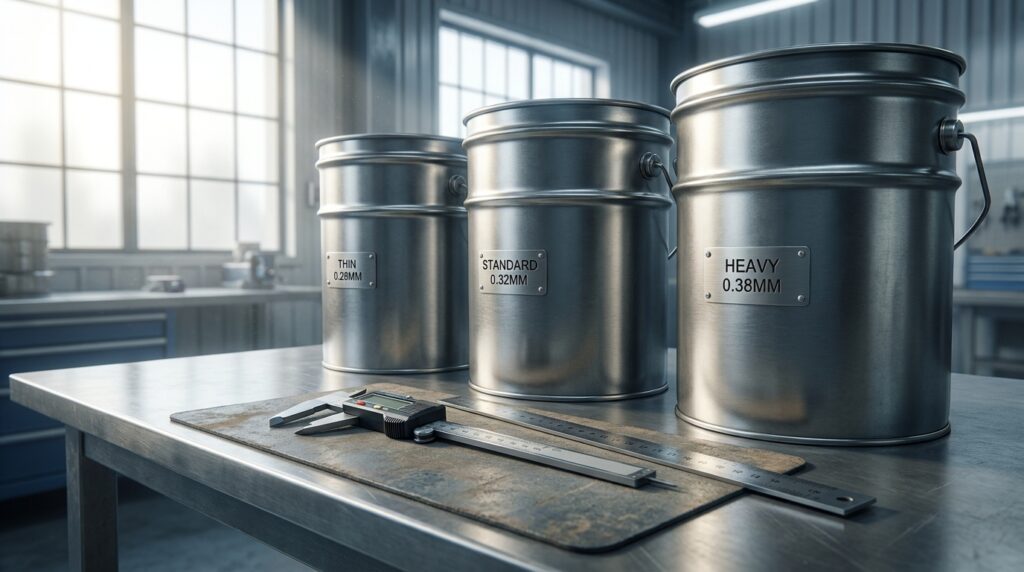
If you've ever received quotes from Chinese metal pail factories and seen thickness options like 0.28mm, 0.30mm, 0.32mm, 0.35mm, and 0.38mm, you may have wondered: which one is the industry standard, and which signals a quality-versus-cost tradeoff? After supplying steel pails from our Suzhou factory to chemical, paint, and food brands in 30+ countries since 2014, here's the field-tested guide to picking the right thickness without overpaying or under-specifying.

Why Tinplate Thickness Matters More Than You Think
Tinplate thickness affects five things in your metal packaging: structural rigidity, dent resistance during shipping, internal coating integrity, vacuum/pressure tolerance, and cost per unit. Get it wrong in either direction, and you pay for it in customer complaints, product loss, or wasted budget.
The three most common buyer mistakes:
- Choosing "thin tin" (0.28-0.30mm) to save on unit cost. A 0.28mm pail may look identical to a 0.32mm pail when new, but it dents in shipping, deforms under stacking pressure, and fails vibration tests at 1.2m drop heights. We've replaced pails for two clients in 2025 alone who started at "thin tin" and moved to 0.32mm after a single shipment of dented goods.
- Choosing the thickest option "to be safe." A 0.38mm pail adds material cost without proportional benefit for most products. The extra rigidity only matters for 25L+ drums, UN-rated dangerous goods containers, or products that store for 18+ months.
- Not specifying thickness in the PO at all. This is the most expensive mistake. If your PO says "20L steel pail, lock ring, gold lacquer" without a thickness spec, the factory will quote the cheapest acceptable option—which may be 0.28-0.30mm depending on their tinplate stock. Always write the thickness into the contract.
The 3 Industry-Standard Thicknesses for 20L Steel Pails
Here's the thickness guide we use when quoting from our Suzhou factory:
| Thickness | Industry positioning | Common applications | Typical contents |
|---|---|---|---|
| 0.28-0.30mm | "Thin tin" (we don't make these) | Decorative cans, small (≤5L) retail tins, low-cost domestic market | Spices, dry foods, candles, small retail |
| 0.32mm | Industry B2B standard, our default | 20L (5-gallon) steel pails for export, 18L square pails, food-grade cans | Latex paint, edible oil, coffee, light chemicals, food products |
| 0.35mm | Heavy-duty upgrade (we make these) | 20L+ pails with extra stacking strength, food-grade cans with 24+ month shelf life | Industrial coatings, retort-processed food, lubricants |
| 0.38mm | Maximum strength (we make these) | 25L drums, UN-rated dangerous goods containers, military-grade packaging | Solvent-based alkyd paints, hazardous chemicals, Class 3 flammables |
The single most-requested thickness in our export orders is 0.32mm. It covers about 70% of the 20L (5-gallon) steel pail market and is the global default for water-based latex paint, edible oil, and most food applications in B2B export trade.
Why 0.32mm and not 0.25mm? The 0.25mm "standard" is more common in small retail cans (≤1L) and in some North American mass-market packaging where lighter pails are acceptable. For 20L export-grade pails, 0.32mm is the established B2B standard because it provides the structural rigidity needed for international shipping, stacking in warehouses, and the heavy fill weights of industrial products.
How Tinplate Thickness Is Measured and Specified
Tinplate thickness in the metal packaging industry is measured in millimeters (mm) and refers to the total sheet thickness before forming, not after. After stamping, drawing, and seaming, the actual thickness at any point on the can may be slightly different (typically 0.01-0.02mm variation due to work hardening), but the nominal spec is the pre-forming thickness.
Three common thickness designation systems you'll encounter:
- Decimal millimeters (most common in international trade): 0.32mm, 0.35mm, 0.38mm. This is what 95% of Chinese factories use in their quotes.
- Gauge numbers (older US system): 30-gauge ≈ 0.30mm, 28-gauge ≈ 0.32mm, 26-gauge ≈ 0.38mm. Some legacy US buyers still use this. Convert to mm before quoting.
- Temper designations (T1-T5, DR7-DR9): These refer to the mechanical properties (hardness, ductility), not the thickness. T1 is softest, T5 is hardest. DR7-DR9 is for double-reduced tinplate used in can ends. Don't confuse temper with thickness—they're different parameters.
In your PO, write the thickness in decimal mm: "Tinplate 0.32mm ± 0.01mm, T2 temper, electrolytic tin coating 2.8/2.8 g/m²."
What Happens When You Buy the Wrong Thickness
Here are three real cases from our 2024-2025 export data:
Case 1: South American paint brand, 2024. Ordered "thin tin" 0.30mm pails for an alkyd enamel line at 22kg fill weight. Six months into storage, the bottom of the pails started bowing outward under the weight of the stacked product. The 0.30mm bottom plate couldn't hold the hydrostatic pressure over time. We replaced with 0.32mm, problem solved. Lesson: heavy fill weights need at least 0.32mm bottom plates.
Case 2: Polish food brand, 2025. A competitor offered 0.38mm pails at premium pricing for a 2kg coffee line. The pails worked perfectly, but the brand couldn't compete on shelf price against competitors selling the same coffee in 0.32mm pails at 6-8% lower cost. They switched back to 0.32mm, no quality complaints from retail customers. Lesson: thicker isn't always better if it prices you out of the market.
Case 3: Indian chemical exporter, 2024. PO didn't specify thickness, just said "20L steel pail." Factory quoted 0.30mm at lowest price. Pails arrived dented, lid seaming inconsistent, internal coating showed micro-cracks at the weld seam. The brand had to scrap 30% of the first shipment. Lesson: always specify thickness in writing—and 0.32mm is the safe B2B default.
Cost Considerations Between Thicknesses
The cost of tinplate correlates directly with thickness. Going from 0.32mm to 0.35mm typically adds 5-7% to the tinplate material cost, and 0.38mm adds 10-12% compared to 0.32mm baseline. These percentages translate into small absolute differences per pail but become meaningful across large orders.
The cost premium for going from 0.32mm to 0.35mm is small and often worth it for heavy fill weights or long shipping cycles. Going to 0.38mm is justified for 25L drums, UN-rated dangerous goods, or products stored 18+ months.
For 18L pails and 25L drums, the cost premium for 0.35mm vs 0.30mm is larger in absolute terms (because there's more tinplate per container), but the structural case for thicker tinplate is also stronger (because the larger surface area is more prone to denting).
For specific pricing on your order quantity, request a quote with your specs—we factor in volume, destination, and payment terms to give you accurate landed cost numbers.
How to Specify the Right Thickness in Your PO
A complete tinplate spec in your PO should include:
- Thickness in mm (decimal, with tolerance, e.g., "0.32mm ± 0.01mm")
- Temper (T1-T5, depending on your forming needs—T2/T3 for most pails)
- Tin coating weight (e.g., 2.8/2.8 g/m² for standard electrolytic tinplate)
- Surface finish (stone finish, bright finish, matte)
- Mill source (Tata, JFE, Baosteel, HBIS are the most common for export-grade)
For UN-rated dangerous goods pails, the spec is stricter: thickness must meet UN performance test requirements, which typically means 0.35mm minimum for 18L+ steel pails carrying Class 3 (flammable) or Class 8 (corrosive) goods.
For food-grade cans with 18+ month shelf life, 0.32mm is the standard for most applications; 0.35mm is the safer choice for products that may sit in distribution warehouses for 24+ months before reaching consumers.
Conclusion
Choosing the right tinplate thickness is a 30-second decision that affects your product quality for the next 3-5 years. The wrong choice either costs you 8% more than necessary or creates a stream of customer complaints that costs far more.
The simple rule for 20L steel pails:
- 0.32mm is the B2B export standard. Use this for water-based paint, food, edible oil, light chemicals, and most export-grade applications.
- 0.35mm for heavy fill weights (over 22kg) or 24+ month shelf life.
- 0.38mm for 25L drums, UN-rated dangerous goods, or military-grade packaging.
- Avoid 0.28-0.30mm "thin tin" unless you're making small retail cans or domestic-market low-cost products.
If you're not sure which thickness fits your product, send us your product spec sheet and we'll recommend the right spec—most inquiries get a response within 12 hours.
Related Reads
- What Is UN Rated Packaging for Chemicals? A Practical Guide for Buyers
- How to Test Metal Bucket Compatibility Before Mass Production
- 5 Gallon Metal Bucket for Paint: The Complete Buyer's Guide for 2026
- What Really Causes Leaks and Spoilage in Food-Grade Metal Buckets?
<!--[googlesitekit-end-of-content]-->