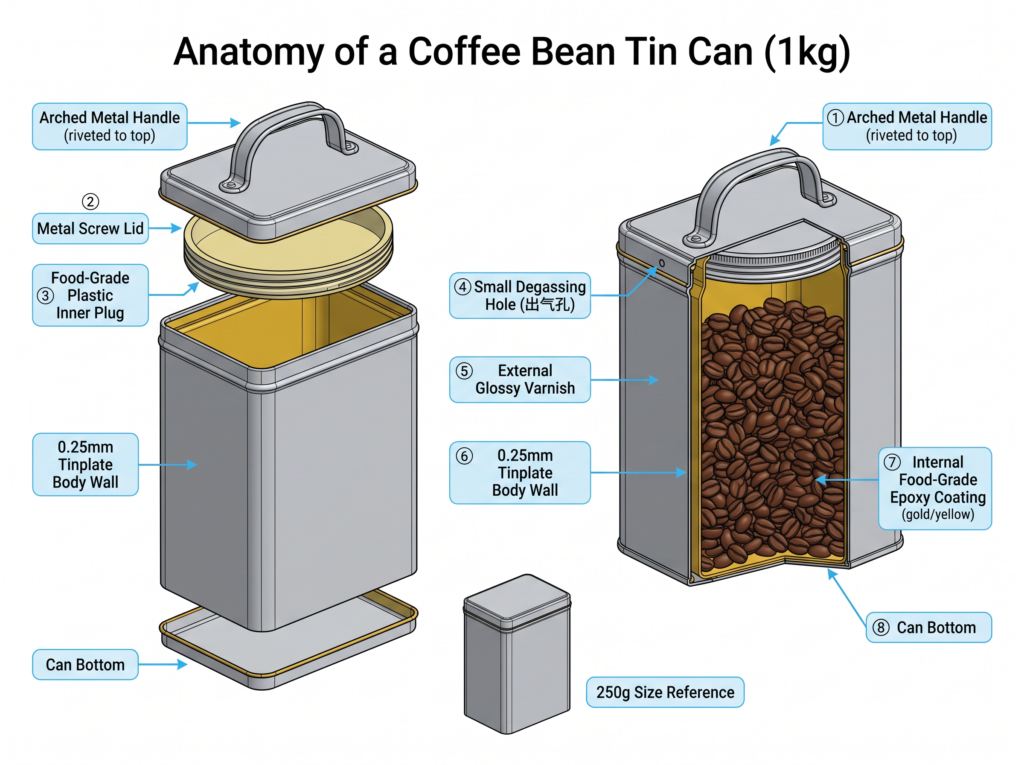
The F-Style oblong can is one of the most recognizable metal packaging formats in the world, sitting on shelves of olive oil shops in Italy, chemical warehouses in Germany, and paint stores in Brazil. It is the rectangular tin can with a flat top, sloped shoulder, and often an integrated arched handle. It looks simple, but every dimension and material choice is governed by decades of filling-line compatibility, regulatory compliance, and consumer handling patterns.
If you are a B2B buyer sourcing 1L, 2L, or 4L F-Style cans for olive oil, edible oil, motor oil, lubricants, or industrial chemicals, this guide will give you the full spec checklist and the most common failure modes we see from the buyer side.
All data here is from our factory experience in Suzhou (Suzhou Jinqiao Packaging, 40-person operation, exporting metal cans and chemical packaging to 30+ countries since 2008) and from the practical filling line feedback we collect from customers.
What Is an F-Style Can
F-Style cans are rectangular (oblong) tinplate containers with a flat top, sloped shoulders, and a flat bottom. The "F" in the name is historical, originating from American can manufacturing terminology in the early 20th century to distinguish the format from round cans. Today the format is used globally under many local names:
- F-Style can (most common international)
- F-style tin (UK, Australia)
- Oblong can (technical/literature)
- Rectangular can (loose usage)
- Flask can (some European markets)
- Oblong flask (Italian olive oil industry)
Common capacity range: 250ml to 5L, with 1L, 2L, and 4L being the most common production volumes.
The defining physical features are:
- Rectangular body (typically 1:2 width-to-length ratio)
- Sloped shoulder transitioning from the rectangular body to the top opening
- Top opening that is circular or oval, typically smaller than the body width
- Flat top suitable for press-fit or screw closure
- Optional arched metal handle integrated into the top shoulder
- Tinplate (ETP) body, typically 0.20-0.30mm
Why F-Style Won the Olive Oil Market
The F-Style format dominates the olive oil segment for a combination of reasons that are worth understanding if you are entering or scaling in this market.
Shelf stability: The flat base and rectangular footprint mean the can does not roll on retail shelves. A round 1L can rolls under the next shelf; an F-Style stays put.
Pouring control: The sloped shoulder leads to a small top opening that doubles as a pour spout. Consumers can pour a controlled stream without a separate spout insert.
Brand surface: The flat front and back faces are ideal for high-quality offset printing. Olive oil brands use the front face as the primary brand canvas, often with metallic background colors and embossed logos.
Stacking efficiency: F-Style cans stack more densely than round cans in shipping cases, reducing per-unit logistics cost. A 1L F-Style typically ships at 12-15 cans per case; a 1L round at 6-12 depending on the diameter.
Recyclability: Mono-material tinplate construction passes the strictest recyclability grading (A) under EU PPWR. Olive oil brands in the EU market rely on this for their sustainability messaging.
The format is not without disadvantages (more complex tooling, harder to clean between uses, less ergonomic for very large capacities), but for 250ml-2L, the trade-off is favorable. That is why almost every premium olive oil brand uses F-Style.
Standard Capacity Options and Dimensions
| Capacity | L × W × H (mm) | Top opening | Common use | Tinplate gauge |
|---|---|---|---|---|
| 250 ml | 95 × 50 × 110 | 32 mm | Specialty oils, single-serve food | 0.20-0.22 mm |
| 500 ml | 145 × 75 × 130 | 32 mm | Sauces, syrups, small oils | 0.20-0.22 mm |
| 1 L (standard) | 165 × 85 × 195 | 32 mm | Olive oil, edible oil (most common) | 0.22-0.25 mm |
| 1 L (tall) | 145 × 75 × 240 | 32 mm | Olive oil, slim retail format | 0.22-0.25 mm |
| 2 L | 220 × 110 × 220 | 42 mm | Olive oil, lubricants, motor oil | 0.25-0.28 mm |
| 4 L | 245 × 130 × 285 | 42 or 70 mm | Bulk olive oil, motor oil, restaurant | 0.28-0.30 mm |
F-Style cans are produced in a relatively narrow set of standard dimensions. Deviating from these dimensions means custom tooling, which is expensive and adds 8-12 weeks of lead time for the tool.
| Capacity | Typical L × W × H (mm) | Top opening | Common use |
|---|---|---|---|
| 250 ml | 95 × 50 × 110 | 32 mm | Specialty oils, single-serve food |
| 500 ml | 145 × 75 × 130 | 32 mm | Sauces, syrups, small oils |
| 1 L | 165 × 85 × 195 | 32 mm | Olive oil, edible oil (most common) |
| 1 L (tall) | 145 × 75 × 240 | 32 mm | Olive oil, slim retail format |
| 2 L | 220 × 110 × 220 | 42 mm | Olive oil, lubricants, motor oil |
| 4 L | 245 × 130 × 285 | 42 mm or 70 mm | Bulk olive oil, restaurant-size oil, motor oil |
The 32 mm top opening is the most common for 1L food applications because it accepts a standard 31.5 mm screw cap, which is a global standard for olive oil bottles and cans. The 70 mm opening on the 4L format accepts a press-fit plastic spout or pour spout, common in restaurant and food service packaging.
For chemical and lubricant applications, the 42 mm opening is more common because it accepts a wider spout or pour fitment.
Internal Coatings: The Most Critical Spec for F-Style Buyers
| Coating type | BPA status | Cure temp | Film weight | Best for | EU food grade |
|---|---|---|---|---|---|
| Epoxy-phenolic (gold lacquer) | Standard contains trace BPA. BPA-NI required for EU 2026+ | 200-210°C / 10-12 min | 6-8 g/m² | General food, olive oil, edible oil | Yes (BPA-NI version) |
| Phenolic (clear lacquer) | BPA-free | 180-190°C | 4-5 g/m² | Dry goods, some oils | Yes |
| Polyester (PET-like) | BPA-free | 180-200°C | 5-7 g/m² | Premium olive oil, baby food, sensitive flavors | Yes (preferred) |
| Phenolic-oleoresinous (chemical grade) | Not for food | 190-200°C | 6-8 g/m² | Motor oil, lubricants, hydrocarbons | No (industrial only) |
The internal coating of an F-Style can is where most product quality failures originate. Olive oil, motor oil, and industrial chemicals can all react with the underlying tinplate if the coating is wrong, leading to flavor tainting, corrosion, or product degradation.
The three most common internal coating systems for F-Style:
Epoxy-Phenolic (Gold Lacquer)
The traditional and most common internal coating for F-Style cans. Provides excellent adhesion, chemical resistance, and flexibility for stamping the sloped shoulder.
- Best for: General food applications, including olive oil, edible oils, tomato products
- BPA status: Standard epoxy-phenolic contains trace BPA. BPA-NI (BPA non-intent) versions are now industry standard for EU and US food applications
- Cure temperature: 200-210°C for 10-12 minutes
- Film weight: 6-8 g/m²
If you are sourcing F-Style cans for olive oil in the EU market in 2026 or later, you need BPA-NI epoxy-phenolic as the default, not as an upgrade. Most Italian and Spanish buyers will reject standard BPA-containing coatings.
Phenolic (Clear Lacquer)
The lighter-duty internal coating, typically a pale yellow or amber film. Used historically for dry products (powders, tablets) and for some oil applications.
- Best for: Dry goods, some oil applications where the epoxy version is over-engineered
- BPA status: Most phenolic coatings are BPA-free
- Cure temperature: 180-190°C
- Film weight: 4-5 g/m²
For olive oil specifically, phenolic alone is generally insufficient. The acid value of olive oil requires the higher chemical resistance of epoxy-phenolic.
Polyester (PET-like coating)
A newer BPA-free option gaining adoption in the EU for premium food and baby food applications. Better flavor neutrality than epoxy.
- Best for: Premium olive oil, baby food, sensitive flavors
- BPA status: BPA-free by formulation
- Cure temperature: 180-200°C
- Film weight: 5-7 g/m²
More expensive than epoxy-phenolic, but increasingly required by premium EU buyers. The 5-10% cost premium is offset by easier regulatory documentation.
For motor oil and lubricant applications, a fourth option exists: a phenolic-oleoresinous coating specifically designed for hydrocarbon resistance. This is not a food-grade coating and is not interchangeable with any of the above.
External Coatings and Printing
The external surface of an F-Style can typically has three layers:
- Base coat (white or clear) for adhesion and color uniformity
- Offset printed design (full-color graphics, brand name, regulatory info)
- Varnish top coat (gloss, matte, or textured finish)
For olive oil brands, the printing quality is the brand. Common requests:
- Metallic inks that let the tinplate show through
- Embossed brand logo (the front face can be embossed during stamping)
- Multi-color registration within 0.1 mm tolerance (challenging on tinplate, requires experienced printing house)
- Food-contact safe inks (low migration, EU compliance)
The tinplate gauge for F-Style bodies is typically 0.20-0.25 mm. The sloped shoulder requires the tinplate to have good formability; we recommend T-1 or T-2 temper (mill-annealed for deep draw).
For chemical and lubricant applications, external coating priorities are different:
- Solvent resistance for the varnish (motor oil cans are often stored with product on the outside)
- Scuff resistance for warehouse handling
- UV resistance if stored outdoors
Closure Options
The top opening of an F-Style can accepts several closure types. The right one depends on the product, the filling line, and the end-user experience.
Press-fit Plastic Cap
The most common closure for 1L and 2L olive oil. A 31.5 mm or 42 mm polypropylene or HDPE press-fit cap. No thread, no tool required to open.
- Cost: Lowest
- Tamper evidence: Achieved with a tear band or shrink band
- Reclosability: Good (press-fit twice or three times before seal degrades)
- Best for: 1L olive oil, retail food products
Screw Cap with Thread
Higher-end closure for premium olive oil, motor oil, and chemical applications. The tinplate top is rolled to form a thread, and a plastic or tin screw cap is applied.
- Cost: Higher (threading adds a stamping operation)
- Tamper evidence: Inherent in breakaway bridges
- Reclosability: Excellent
- Best for: Motor oil, lubricants, premium olive oil, chemicals
Pour Spout with Cap
For motor oil and some chemical applications, a press-fit pour spout that doubles as a measuring cup. Common in 4L and 5L F-Style.
- Cost: Highest (two-piece closure)
- Tamper evidence: Pull-tab or breakaway
- Reclosability: Good
- Best for: 4L motor oil, restaurant-size edible oil
Pump Dispenser (specialty)
For 1L-2L hand soap, lotions, and some specialty chemicals. A pump assembly is press-fit or screwed into the top opening.
- Cost: Specialty item
- Best for: Personal care, specialty chemicals
Most F-Style cans for olive oil use the press-fit cap because of cost and filling-line compatibility. Motor oil and chemical applications almost always use the screw cap.
Handle Options
F-Style cans are sometimes sold with a metal arched handle integrated into the top shoulder. The handle is a separate stamped tinplate component, often the same 0.20-0.25 mm gauge as the body, attached during the can assembly.
Common handle configurations:
- No handle: 1L and 2L olive oil, motor oil, lubricants (most common)
- Arched metal handle: 1L and 2L for retail consumer products where the can may be carried in one hand
- Plastic handle: 4L and 5L for restaurant and food service (heavier fills, more comfortable grip)
For 4L+ formats, the handle is essentially mandatory. The filled weight is 4-5 kg and a consumer cannot comfortably pour a 4L can without a handle.
For chemical applications, handles are less common. The can is typically stored on a shelf and the contents are pumped or decanted, not poured directly.
F-Style vs Round Can: When to Use Each
This is the most common B2B buyer question we get. The answer depends on the application priorities.
Choose F-Style when:
- Olive oil, edible oil, premium food product
- 250ml to 2L capacity
- Retail shelf stability matters
- Printing quality is brand-critical
- Recyclability grading must be A (mono-material tinplate)
- Filling line uses rectangular can handling
Choose round can when:
- Pressure resistance is critical (carbonated products, pressurized contents)
- Capacity > 5L (round is structurally better for large containers)
- Internal vacuum or modified atmosphere packaging (MAP) where circular seals perform better
- Filling line uses only round can handling
- Product viscosity makes the rectangular pour awkward (honey, syrup)
For the 1L-2L range where both formats are technically feasible, the choice is usually driven by brand image (F-Style = traditional/premium, round = modern/utilitarian) and filling line constraints (you cannot easily switch one line to the other).
Common Buyer Mistakes We See
After 18 years of exporting F-Style cans, the field return and complaint patterns are predictable. Here are the top issues, in order of frequency.
Wrong Internal Coating for Olive Oil with High Acid Value
Extra virgin olive oil with high polyphenol content (some Greek and Tuscan oils) can extract phenols from standard phenolic coatings, leaving a slight metallic or off-flavor. The fix is polyester internal coating for these applications. We see this issue about once per quarter from new buyers.
Sloped Shoulder Cracking
If the tinplate temper is too hard (T-3 or T-4 instead of T-1 or T-2), the sloped shoulder can crack during stamping or after filling. The crack is often invisible at the factory but appears weeks later as a slow leak. Solution: specify T-1 or T-2 temper in the procurement contract.
Thread Roll Defects on Screw Caps
The thread rolling process on the can top is sensitive to lubrication, tool wear, and steel gauge consistency. We have seen buyers receive cans where 3-5% of the threads are defective (cap does not engage fully). Always inspect a sample of 100+ cans before accepting a shipment.
Cap Fit Variation
The press-fit cap industry tolerance is 0.2-0.3 mm. If the can top opening is on the high end of the tolerance and the cap is on the low end, the cap falls off in the box. If both are on the opposite ends, the cap is too tight to install on a high-speed filling line. Always request the cap and can from the same supplier, tested together.
Offset Printing Registration Errors
Multi-color printing on tinplate requires a 4-color offset press specifically configured for metal. General commercial offset printers cannot achieve the 0.1 mm registration that brand work requires. Verify the printing house has metal-can-specific presses.
How to Spec Your F-Style Order
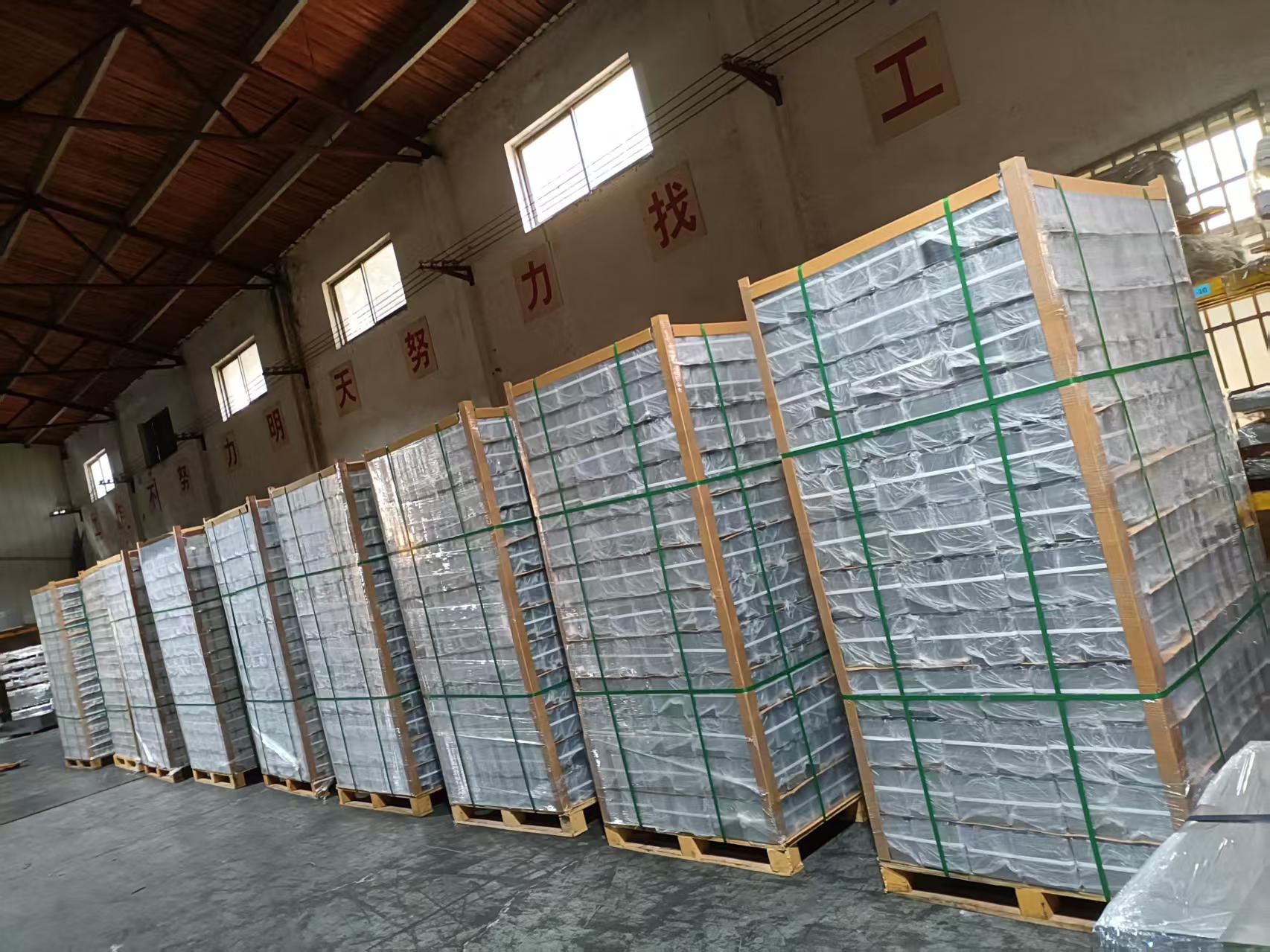
When you request a quotation from us or any supplier, the following information determines the spec and the price:
- Capacity (1L, 2L, 4L, or custom)
- Top opening diameter (32, 42, or 70 mm)
- Internal coating (BPA-NI epoxy-phenolic, polyester, phenolic, or chemical-grade)
- External finish (white base + 4-color offset + gloss varnish, or custom)
- Closure type (press-fit cap, screw cap, pour spout, or none for OEM buyers)
- Handle (no handle, metal arched, or plastic)
- Filling line specs (filling speed, capping torque, inkjet coder compatibility)
- Destination market (EU, US, South America, Middle East) — affects regulatory docs
- Order volume per SKU (affects tooling amortization)
- Required certifications (FDA 21 CFR 175.300, EU 10/2011, BPA-NI declaration, heavy metals test report)
With this information, we can quote FOB Shanghai within 48 hours. For a 4-color printed 1L olive oil F-Style with BPA-NI internal coating, a 50,000-unit MOQ is typical. Pricing varies significantly with order volume, surface decoration complexity, and current tinplate substrate pricing.
Why F-Style Is a Strong Format Under PPWR
For EU-bound olive oil and edible oil, F-Style tinplate cans are structurally favored by EU Regulation 2025/40 (PPWR). Three specific reasons:
-
Mono-material recyclability: A BPA-NI epoxy-phenolic or polyester coating is fully compatible with steel recycling. F-Style cans with proper coatings pass the recyclability grade A assessment under PPWR Article 6.
-
No PCR burden: PPWR's recycled content (PCR) requirement applies only to plastic packaging, not metal. F-Style tinplate cans are exempt from the 2030 PCR minimums.
-
Heavy metals compliance: With proper substrate and coating selection, F-Style cans easily meet the 100 mg/kg total heavy metals limit (Pb + Cd + Hg + Cr6+) under PPWR Article 5. We provide batch-level SGS or Intertek test reports for EU shipments.
This structural advantage means F-Style tinplate is a long-term format for the EU market, not threatened by the regulation.
How We Work with F-Style Buyers
At Suzhou Jinqiao Packaging, we produce 1L, 2L, and 4L F-Style cans for olive oil, edible oil, motor oil, and industrial chemical applications. Our typical order profile:
- 50,000 to 500,000 units per SKU
- 6-8 week production lead time for standard 1L
- 8-12 weeks for 4L or custom capacity
- FDA, EU 10/2011, and BPA-NI declarations on file
- Heavy metals test report per batch
- In-house offset printing for 1-6 color designs
- Sourcing for compatible caps and pour spouts
If you are a brand owner, an importer, or a private label buyer looking for a reliable F-Style can supplier in China, reach out via the form on our contact page. For technical discussions on coating chemistry, closure compatibility, or filling line integration, message us on WhatsApp (+86 178 2667 5627) or email joey@szjqpack.com.
For the full set of related articles on metal packaging selection, see our guides on:
- Coffee Bean Tin Cans: 250g vs 1kg
- 5 Gallon Metal Bucket for Paint: The Complete Buyer's Guide for 2026
- 5-Gallon Steel Pail Wire Handle: 3.5mm vs 3.8mm
- Tinplate Thickness for Metal Cans
- EU PPWR 2025/40 and Chinese Metal Packaging Exporters
- Tinplate Price Forecast H2 2026
- UN Packaging Code Explained
F-Style cans are a 100-year-old format that continues to win in olive oil, motor oil, and chemical markets because the form follows function. The right internal coating, the right closure, and the right printing house turn a simple tinplate rectangle into a brand-defining product.