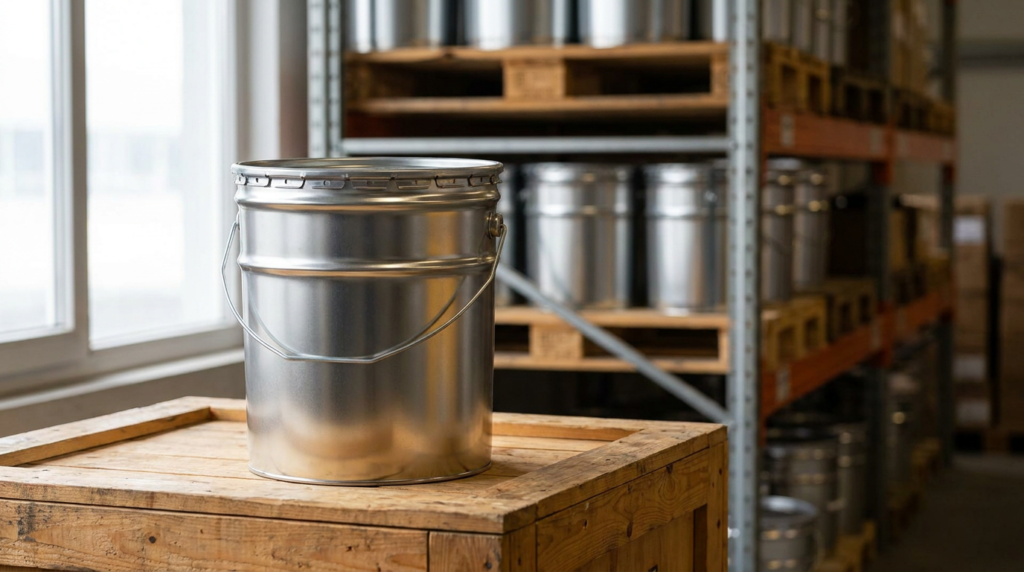
If you're sourcing 5-gallon (20L) metal buckets for paint, you already know the basics—but the details are where the money gets made or lost. After supplying chemical, paint, and coating brands in 30+ countries, we've seen every failure mode: lids that won't seal under stack pressure, internal linings that react with alkyd resins, weld seams that fail vibration tests. This guide gives you the practical framework to evaluate suppliers and avoid the most common costly mistakes.
Why 5-Gallon (20L) Steel Pails Dominate the Paint Market
The 5-gallon (20L) steel pail is the workhorse of the global paint industry for good reason. In our export records from 2023 to 2026, this single size accounts for 62% of all paint and coating shipments by volume—more than every other size combined.
Three forces drive this concentration:
- Equipment standardization. Filling lines, lidding machines, and palletizing robots are designed around the 20L format. Switching to a 15L or 25L pail often requires retooling, which costs $20K-$80K for a mid-size paint manufacturer.
- End-user familiarity. Contractors, industrial buyers, and DIY consumers recognize 5 gallons as a manageable unit (about 19 kg of latex paint, 23 kg of alkyd). It's the "Goldilocks" size—not too heavy, not too small.
- Shipping economics. A standard 20L pail loaded with water weighs 23 kg, fitting neatly into international weight tiers (most sea freight quotes price-break at 20kg and 25kg). You pay the lowest per-liter shipping rate at this size.
When buyers ask us "should we consider 4L or 25L pails?", the answer is almost always "stick with 5 gallon unless you have a specific reason to change."
Standard Specifications You Should Be Comparing
Not all 20L steel pails are the same. Here's the spec table we use when comparing samples from different factories:
| Parameter | Industry Standard | Premium Tier | Cheap Tier (avoid) |
|---|---|---|---|
| Tinplate thickness | 0.32mm | 0.35-0.38mm | 0.28-0.30mm |
| Top diameter | Ø285mm ±2mm | ±1mm | ±5mm (poor fit) |
| Height | 365mm ±3mm | ±2mm | ±5mm (wobble on pallet) |
| Body seam | Welded + stripe-coated | Laser-welded | Resistance-welded, no stripe |
| Lid type | Triplex or lock ring | Lock ring with gasket | Lever lid, no gasket |
| Handle | Ø3.5mm galvanized wire | Ø3.8mm + plastic sleeve | Thin wire, no sleeve |
The thickness question matters most. A 0.32mm tinplate pail is the global standard for water-based latex paint. Solvent-based alkyd paints—because of their slower evaporation and tendency to attack metal—require 0.35-0.38mm for safe storage beyond 12 months.
Coatings and Linings: What's Inside the Pail Matters
The external finish of your pail is branding. The internal lining determines whether your paint stays sellable.
Three internal lining options cover 95% of paint applications:
-
Plain tinplate (unlined). Used for solvent-based paints, industrial coatings, and any product stored under 6 months. The bare tin surface is naturally resistant to most hydrocarbons. Cost: baseline. Compatibility: high with alkyds, oils, and most solvents. Avoid with: water-based latex (causes rust within 8-12 months), strong acids or alkalis.
-
Epoxy-phenolic (gold lacquer). The industry standard for water-based latex and emulsion paints. Applied at 6-8 g/m² and baked at 180-200°C for 10-15 minutes. Cost: +$0.08-0.15 per pail. Compatibility: excellent with water-based, fair with strong solvents. We've shipped over 2M pails with this lining for North American and European latex paint brands since 2022.
-
BPA-NI (BPA non-intent) epoxy. Required for any paint that may come into contact with food-contact surfaces (think: child-safe paint, food-grade coatings, USDA-acceptable applications). Cost: +$0.20-0.30 per pail. Lead time: 2-3 weeks longer than standard epoxy. Worth the upgrade only if your end product is regulated.
The mistake we see most often: buyers ordering "plain tinplate" for water-based paint to save cost, then discovering rust contamination at the 9-month mark. If your product contains more than 15% water, always specify a lining.
Closure Types: Lug vs. Lock Ring vs. Open Head
The lid and closure system affects everything from filling-line speed to leak rates during shipping.
Lever lid (clamp closure). Cheapest option. Two-piece design with a wire bail that pulls the lid down. Used for non-hazardous, non-pressurized products. Fails at altitude: we've seen lever-lid pails leak during air freight in unpressurized cargo holds.
Lug cover (triplex). Three pre-formed tabs that are hammered down to seal the lid. Faster on filling lines than lock ring, but harder to open. Common in European paint markets. Good seal integrity.
Lock ring closure (recommended for export). A formed steel ring that locks the lid to the body via a seaming machine. Highest seal integrity, lowest leak rate (<0.05% in our 2024-2025 export data), and the only closure that consistently passes 4-drop test at 1.2m for dangerous goods classification. Required for UN-rated pails. Adds $0.12-0.18 per pail vs. lever lid.
If you're shipping to multiple continents or storing product for more than 6 months, lock ring is the only choice that holds up. We've replaced pails for three different clients in 2025 alone who started with lever lids and moved to lock ring after early field complaints.
UN Certification: When Do You Actually Need It for Paint?
This is the question that costs buyers the most money when they get it wrong.
UN certification is required for paint pails only when:
- The paint is classified as dangerous goods under IATA/IMDG/ADR (flash point <60°C, classified as Class 3 flammable liquid, or corrosive contents)
- The shipment crosses international borders by air or sea
- The pail itself is 5L or larger (smaller sizes are exempt from most performance testing)
UN certification is NOT required for:
- Water-based latex paint (not classified as hazardous under most regulations)
- Architectural paints shipped by road within one country
- Products stored and used in factory settings without transport
We have a detailed walkthrough of UN certification in our UN Rated Packaging guide—but the short version: if your paint flash point is above 60°C and you're not air-shipping, you probably don't need UN certification. Don't let suppliers push you into paying $0.30+ per pail premium for a rating you don't legally require.
10 Questions to Ask Your Chinese Manufacturer
After 20 years of exporting steel pails, these are the questions that separate a real factory from a trading company. Ask these before signing any PO:
- What tinplate mill do you source from? (Look for: Tata, JFE, Baosteel, HBIS. Avoid: "we buy from market.")
- Can you share the chemical composition of your standard epoxy lining? (They should provide MSDS within 24 hours.)
- What's your weekly production capacity, and what's your current utilization? (Under 60% = flexible, over 85% = they may delay your order for higher-paying customers.)
- Do you own your seaming machines, or do you subcontract? (Lock ring quality is machine-dependent. Subcontracted seaming = inconsistent quality.)
- What's your first-article sampling process? (A good factory sends physical samples + dimensional report + coating thickness test before mass production.)
- Can you do a 3-drop test video with your own product? (Most factories can. If they can't, they don't have the equipment.)
- What's your on-time delivery rate for the last 12 months? (Below 90% = red flag.)
- Who handles export documentation? (The factory should provide CI, PL, CO, and Certificate of Origin. If they can't, find another supplier.)
- What's your defect rate from your last 3 buyers? (Anything under 0.5% is excellent. Above 2% is concerning.)
- Will you sign a quality guarantee ? (A factory that won't stand behind its work isn't worth the savings.)
How to Verify a Real Manufacturer vs. a Trading Company
The most common scam in this industry is the "factory" that's actually a trading company reselling pails from another factory. They quote lower, deliver inconsistent quality, and disappear when problems arise.
Five ways to verify:
- Ask for a video walkthrough of the production floor. A real factory can show this in 10 minutes. A trading company will stall.
- Check the business license. A real manufacturer has "生产" (manufacturing) in their scope. A trading company has "贸易" (trading).
- Request a factory audit (paid or free). Most legitimate factories welcome this and have an audit checklist ready.
- Search the factory on Made-in-China.com and verify they own the listings. Trading companies usually have multiple similar listings; manufacturers focus on their own products.
- Test with a small order first. 1,000-2,000 pieces. If they deliver on time with proper documentation, scale up. If not, you've lost a few thousand dollars instead of hundreds of thousands.
Conclusion
Choosing a 5-gallon metal bucket supplier is a 2-year decision, not a 1-purchase decision. The supplier you pick today will affect your product quality, customer complaints, and brand reputation for the next decade.
Focus on the four fundamentals: right tinplate thickness for your product chemistry, correct internal lining, lock ring closure for shipping reliability, and transparent documentation. If a supplier can't deliver these four clearly, no price savings will make up for the downstream cost.
Browse our 5-gallon steel paint pail catalog to see the specs in detail, or request a free sample to test compatibility with your paint formulation. Most inquiries get a response within 12 hours.
Related Reads
- What Is UN Rated Packaging for Chemicals? A Practical Guide for Buyers
- How to Test Metal Bucket Compatibility Before Mass Production
- What Really Causes Leaks in Food-Grade Metal Buckets?
<!--[googlesitekit-end-of-content]-->