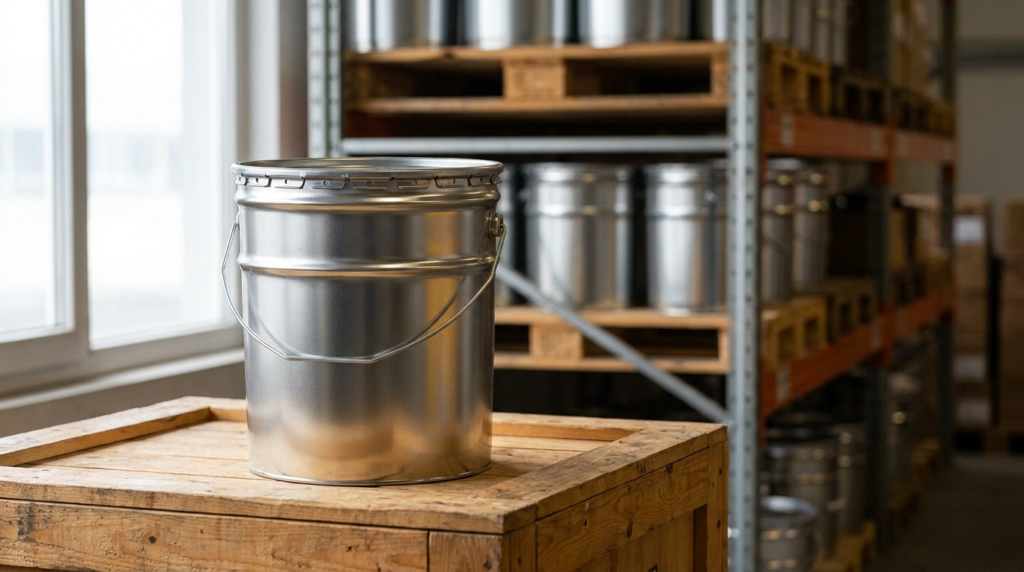
The 20L (5-gallon US) steel pail is the workhorse of industrial chemical packaging. Paints, coatings, adhesives, lubricants, construction chemicals, and food ingredients all ship in this format. But the moment you start specifying, the first decision you face is round or square. Both formats dominate the market, and both have legitimate advantages for specific applications.
The wrong choice costs real money. A round pail for a viscous adhesive costs you 8-12% in pallet density. A square pail for a high-pressure filling line costs you line speed and seal reliability. This guide walks through the design trade-offs and gives you a 6-question decision test that any B2B buyer can apply.
All data here is from our factory experience in Suzhou (Suzhou Jinqiao Packaging, 40-person operation, exporting 20L pails to 30+ countries since 2008) and from buyer feedback across hundreds of applications.
The Two Formats at a Glance
Round 20L pail: cylindrical body, circular cross-section, standard diameters 270-300 mm, height 320-380 mm depending on the capacity and lid type. Dominant in paint, coatings, and general chemical applications globally.
Square 20L pail: rectangular cross-section, typically 230 × 230 mm or 240 × 240 mm footprint, height 340-380 mm. More common in Europe for construction chemicals, tile adhesive, and certain food applications. Less common in North America.
Both formats are made from the same tinplate substrate (typically 0.30-0.35 mm for 20L), use the same lid options (lever lid, screw cap, crimped cover), and follow the same food-grade or chemical-grade internal coating standards.
The differences are in geometry, and geometry drives everything else.
Stacking and Pallet Density
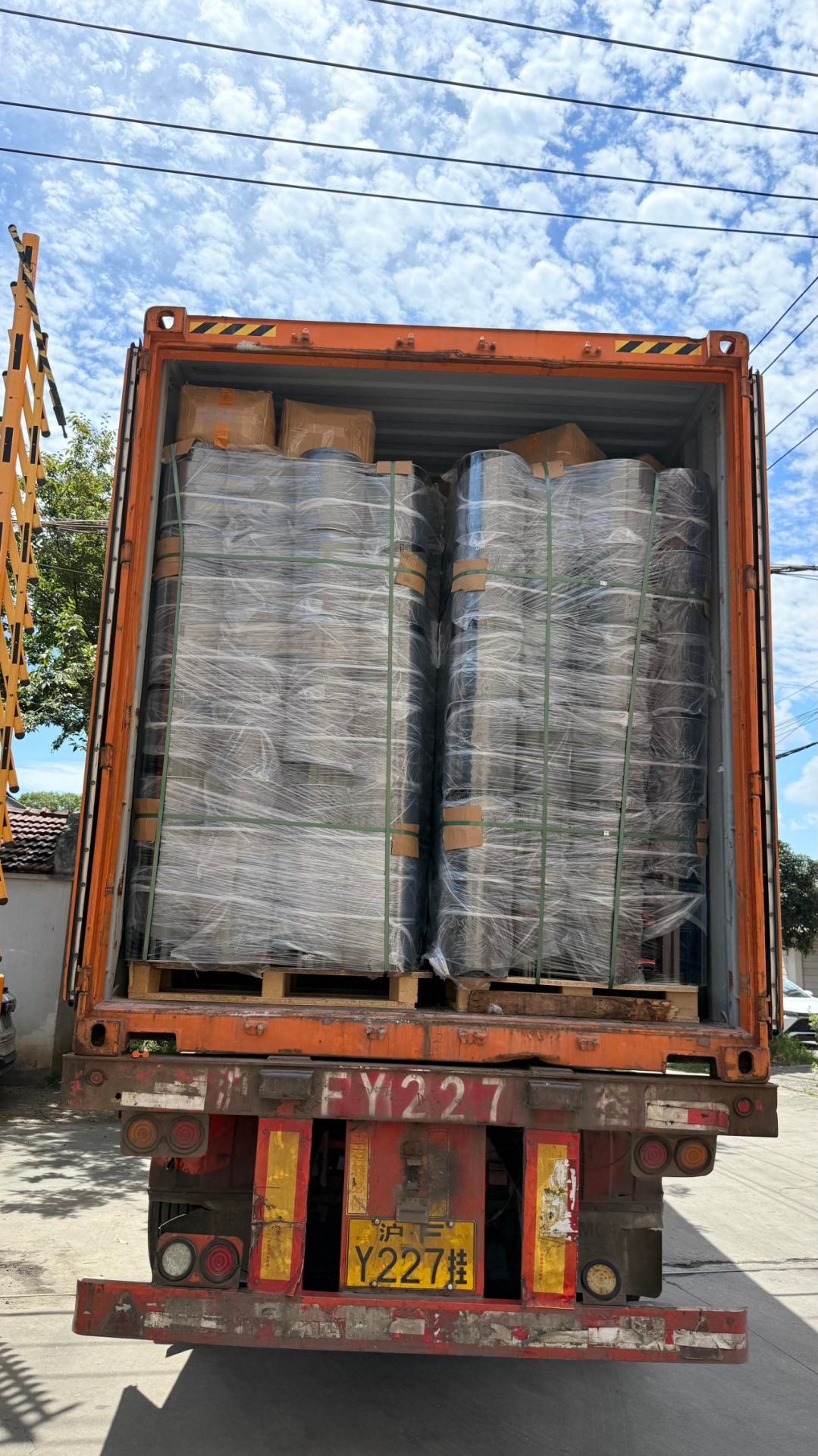
| Metric | Round 20L pail | Square 20L pail | Advantage |
|---|---|---|---|
| Pails per EUR pallet layer | 4 (2×2 grid) | 9 (3×3 grid) | Square +125% |
| Pails per pallet (3 layers) | 12 | 27 | Square +125% |
| Pallet footprint efficiency | 28% | 65% | Square +37 pts |
| Pails per 40ft FCL (67 m³) | ~3,800 | ~7,800 | Square +105% |
| Freight cost per pail | Baseline | 8-12% lower | Square |
| Empty pail return volume | Partial nesting | Full volume (no nesting) | Round |
| Warehouse floor space (10K pails) | 615 m² | 400 m² | Square -35% |
| Retail shelf stability | Rolls (annoying) | Stable (preferred for DIY) | Square |
This is the single biggest reason to choose square over round for industrial products.
A standard EUR pallet (1200 × 800 mm) can fit:
- 4 round 20L pails per layer (in a 2×2 grid)
- 9 square 20L pails per layer (in a 3×3 grid)
Per layer:
- 4 round pails × 0.30 m diameter = 28% pallet footprint efficiency
- 9 square pails × 0.24 m side = 65% pallet footprint efficiency
Over 3 layers with 75% pallet height utilization (typical for 380 mm pails on a 1200 mm pallet):
- Round: 12 pails per pallet
- Square: 27 pails per pallet
This is a 2.25× density advantage for square. In a 40-foot high cube container (67 m³ usable), the difference translates to:
- Round: ~3,800 pails per FCL
- Square: ~7,800 pails per FCL
For an industrial buyer shipping 200,000 pails per year, the freight savings from square can be 8-12% of the per-unit shipping cost. For a $4.00 pail, that is $0.32-0.48 saved per pail on freight alone. Over 200,000 units, $64,000-96,000 annual saving.
The catch: square pails do not nest, so empty pail return logistics are worse. For single-use pail programs, square wins on shipping economics. For returnable pail programs, the math depends on return trip economics.
Filling Line Compatibility
The filling line is where round and square pails differ most operationally. If you are integrating the pail into an existing filling line, this is your deciding factor.
Round pail filling lines:
- Higher speed (up to 60 pails per minute on rotary fillers)
- Better seal integrity on lever lid applications (uniform compression around circumference)
- More lid options (lever, screw, crimp all standard)
- Compatible with most existing fillers globally
Square pail filling lines:
- Slower (typically 20-40 pails per minute)
- More challenging for lever lid sealing (corners can leak if not perfectly formed)
- Screw cap and crimped cover are more reliable than lever
- Need specific square-pail handling equipment
If you are an industrial paint or coatings buyer with an existing 30-60 pails/minute rotary filler, switching to square means a new filler investment. For a 10,000 pail/month operation, that is hard to justify.
If you are a tile adhesive or grout buyer in Europe already running a square-pail line, switching to round would force a line redesign. Stay with square.
For greenfield filling operations (new facility, new line), the math is closer. The square density advantage can offset the line speed disadvantage if your shipping volumes are high.
Closure and Lid Performance
| Lid type | Round pail leak rate | Square pail leak rate | Best application |
|---|---|---|---|
| Lever lid (clamp ring) | ~0.05% (1 in 2,000) | ~0.15-0.30% (3-6 in 2,000) | Round preferred for paint, low viscosity |
| Screw cap (rolled thread) | ~0.02% (very reliable) | ~0.05% (reliable) | Both formats work; viscous products |
| Crimped cover (one-time) | ~0.01% (most reliable) | ~0.01% (most reliable) | UN dangerous goods, one-time use |
| Pump dispenser (specialty) | N/A | N/A | Specialty chemicals, soap |
The lid system is the most failure-prone part of any 20L pail, and round vs square handles the closure differently.
Lever lid (round pail): A metal ring with a gasket is crimped or clamped onto the pail top. The lever mechanism provides mechanical advantage for a tight seal. Round geometry gives uniform compression around the entire circumference, which means reliable gasket sealing even with small manufacturing tolerances. Leak rate at our factory for round lever-lid pails is approximately 0.05% (1 in 2,000).
Lever lid (square pail): Same mechanism, but the four corners of the pail top create stress concentration points. The lid must deform slightly to seal uniformly, which requires tighter manufacturing tolerances. Leak rate for square lever-lid pails is typically 0.15-0.30% (3-6 in 2,000) at well-run factories, and worse at lower-quality suppliers.
Screw cap (round pail): A threaded ring is rolled onto the pail top, and a plastic or metal cap screws on. Very reliable for viscous products that will be poured slowly. Slower to apply on filling line.
Screw cap (square pail): Same mechanism, slightly more challenging because the threads must be rolled onto a flat surface rather than a continuous curve. About 10% of the rolling tools designed for round pails will not work on square. Use a supplier with square-specific thread rolling equipment.
Crimped cover (round or square): A metal cover is crimped onto the pail top after filling. Most reliable seal, but requires a special crimping tool and is not reclosable. Common for dangerous goods and one-time-use products.
For chemical products that need a guaranteed seal (UN-rated dangerous goods, certain food applications), the round lever-lid pail remains the safest choice. For construction chemicals and adhesives where a small leak rate is acceptable and shipping density matters, the square pail with screw cap is the right trade-off.
Storage and Warehouse Behavior
How the pail behaves in a warehouse or on a retail shelf matters for some applications.
Round pail storage:
- Roll if knocked over (annoying in warehouse, dangerous on retail shelf)
- Easier to stack with simple plastic or metal dividers
- No corner pressure points when stacked (uniform load distribution)
- Better behavior under vacuum (round cans resist external pressure collapse better)
Square pail storage:
- Do not roll (good for retail shelf stability)
- Save 35-50% warehouse floor space vs round at same capacity
- Corner stacking can create pressure points if the corner is not perfectly formed
- Slightly more vulnerable to vacuum collapse than round (corners flex under external pressure)
For products stored at high altitude (mountain warehouses, air freight) or shipped by air (unpressurized cargo hold), the round pail is more reliable for pressure differential. For warehouse storage and retail display, square is better.
Internal Volume vs External Dimensions
A 20L nominal capacity is achieved with different actual dimensions depending on the format. Here is the rough comparison:
| Format | External dimensions (mm) | Internal volume | Footprint area |
|---|---|---|---|
| Round 20L | Ø280 × 360 | 21.0 L | 615 cm² |
| Square 20L | 230 × 230 × 380 | 20.5 L | 529 cm² |
| Square 20L (wide) | 245 × 245 × 340 | 20.0 L | 600 cm² |
The wide square format is the most volume-efficient (similar footprint to round, with the shipping advantage of square stacking). The narrow square format saves more pallet space but has a taller profile that some filling lines struggle with.
For product density calculations:
- 20L of water = 20 kg
- 20L of paint (typical 1.2-1.4 g/cm³) = 24-28 kg
- 20L of tile adhesive (1.6-1.8 g/cm³) = 32-36 kg
- 20L of motor oil (0.85-0.95 g/cm³) = 17-19 kg
If your product is over 30 kg per pail, both formats work, but the round pail's structural strength under heavy load is better. If under 25 kg per pail, the square pail's pallet density advantage becomes more important.
Application Fit: When Round Wins
Round 20L pail is the right choice for:
- Paint and architectural coatings: The dominant format globally, especially in North America, UK, and Australia. Filling lines are designed for round. Lever-lid reliability matters for product freshness.
- General industrial chemicals: Where UN certification is needed, the round format has more precedent and tested designs.
- High-viscosity adhesives and sealants: The lever lid provides mechanical advantage that helps close against viscous product pressure.
- Dangerous goods (UN rated): Most UN certification tests have been performed on round pails. Specifying UN on square is possible but adds testing cost.
- Food ingredients (commercial): Round pails are more common in commercial kitchens, food service, and bulk ingredient handling.
- Pressurized or vacuum-sensitive products: Round cans resist external pressure differential better.
Application Fit: When Square Wins
Square 20L pail is the right choice for:
- Tile adhesive, grout, and cementitious construction chemicals: The European market uses square almost exclusively for these products. Filling lines are square-specific.
- Dry powder products: Cement, plaster, joint compound. Square pails are easier to scoop from (the corner helps with measuring).
- Products that need shelf stability: Retail DIY products in supermarkets and hardware stores are increasingly square for the shelf-stability reason.
- High-density liquids where shipping cost matters: If you ship 50+ containers per year of 20L pails, the square density advantage pays for any filling line compromise.
- Warehouse-optimized operations: If you are paying for warehouse space, the 35-50% space savings from square matters.
Six-Question Decision Test
Run through this test before specifying a 20L pail format:
Question 1: What is your existing filling line?
If you have a rotary round-pail filler running at 30+ pails per minute, stick with round. The line speed and seal quality are not worth sacrificing for shipping density.
If you have a square-pail filler or are building a new line, square is a strong option.
Question 2: What is your annual shipping volume?
If you ship more than 200,000 pails per year by FCL, the square density advantage can save $50,000-100,000+ per year in freight. Below 50,000 pails per year, the savings are not worth the filling line trade-off.
Question 3: Is your product viscous or pressure-sensitive?
If your product is over 10,000 cP (thick paste, heavy gel) or requires UN dangerous goods certification, round with lever lid is the safer choice. The mechanical advantage of the lever plus the uniform compression of round geometry is more forgiving.
If your product is below 5,000 cP and is not UN rated, both formats work. Square with screw cap is fine.
Question 4: Does your product need shelf stability or retail display?
If yes (DIY retail, hardware store), square is better. If no (industrial, food service, warehouse), round is better.
Question 5: Do you have returnable pail logistics?
If yes, you need to factor in the return trip. Square pails do not nest, so return shipping is 2.25× more volume per unit. Round pails nest partially (with the lid inverted) and return more efficiently.
If no, single-use square pails maximize outbound shipping savings.
Question 6: What is your regulatory environment?
For food products in the EU, both formats are equally compliant with EU 10/2011 and EU PPWR 2025/40. For UN dangerous goods, round has more precedent. For US FDA food contact, both are equally compliant under 21 CFR 175.300.
The answers to questions 1, 2, and 3 are usually dispositive. The remaining questions refine the choice but rarely flip it.
Common Buyer Mistakes We See
After 18 years of exporting 20L pails in both formats, here are the most common mistakes from buyers who chose the wrong format.
Choosing Round for Tile Adhesive (Europe)
We regularly receive RFQs from European tile adhesive buyers who are trying to use round pails because that is what their existing line was set up for. The market for tile adhesive in Europe is 90%+ square pails, and retail customers expect square. Round pails create retail friction. The buyer usually converts to square within 2 years.
Choosing Square for Premium Architectural Paint (North America)
The opposite mistake. A premium paint brand in the US or UK trying to differentiate with square pails for the "modern look" finds that the filling line cost and seal reliability drag down the launch. Round remains the dominant format for premium paint in North America and UK.
Ignoring the Lid System
A buyer specs a 20L square pail with a lever lid for a viscous adhesive. The lever does not have enough mechanical advantage to close against 50,000 cP product. The result is a 3-5% leak rate in the field. The fix is a screw cap or crimped cover, not the format.
Specifying Tinplate Gauge Too Thin
A buyer specs a 0.28 mm tinplate body for a 32 kg filled weight (tile adhesive, 1.6 g/cm³) to save 5% on cost. The pail buckles in the warehouse. For 20L pails over 28 kg filled weight, the body should be 0.32 mm or thicker, regardless of format.
How to Spec Your 20L Pail Order
When you contact us for a quotation, the following information determines the spec and the price:
- Filled product (paint, adhesive, chemical, food)
- Product density (kg/L) and total filled weight
- Filling line specs (existing line type, target speed, cap style)
- Annual volume and packaging format preference (round or square)
- Lid type (lever, screw, crimp, pump)
- Handle (no handle, metal wire, plastic — see our 5-Gallon Wire Handle guide for 3.5mm vs 3.8mm)
- Internal coating (BPA-NI epoxy-phenolic, polyester, chemical-grade phenolic-oleoresinous)
- Destination market (EU, US, Middle East, Asia-Pacific) — affects regulatory requirements
- Storage environment (indoor warehouse, outdoor, cold chain, high altitude)
- UN certification required (Y/N, if Y, what UN packaging group)
With this information, we can quote FOB Shanghai within 48 hours. For a standard 20L round pail with lever lid and BPA-NI internal coating, a 30,000-unit MOQ is typical.
Why Both Formats Are Structurally Favored by PPWR
For EU-bound pails, both round and square tinplate formats are structurally favored by EU Regulation 2025/40 (PPWR):
- Mono-material recyclability: Tinplate body + BPA-NI coating passes recyclability grade A
- No PCR burden: PPWR's PCR requirement applies to plastic only, not metal
- Heavy metals compliance: Easily meets 100 mg/kg total limit with proper substrate selection
The format choice does not affect PPWR compliance. Both round and square 20L tinplate pails are long-term viable in the EU market.
Related Reading
For more depth on related topics, see our other guides:
- 5 Gallon Metal Bucket for Paint
- 5-Gallon Steel Pail Wire Handle: 3.5mm vs 3.8mm
- F-Style Oblong Cans: The Olive Oil and Chemical Industry Standard
- Tinplate Thickness for Metal Cans
- UN Packaging Code Explained
- EU PPWR 2025/40 Compliance Guide
- Coffee Bean Tin Cans: 250g vs 1kg
Talk to Us About Your 20L Pail Spec
If you are a chemical, paint, coatings, adhesive, or food ingredient buyer sourcing 20L pails from China, we can recommend the right format, gauge, coating, and lid system within 48 hours of your inquiry. We produce both round and square formats, with the same quality system and the same lead time.
Suzhou Jinqiao Packaging Container Co., Ltd has been manufacturing metal cans, steel pails, and chemical packaging in Suzhou, China since 2008. Our 20L pail capacity is 200,000 units per month with 6-8 week lead times for standard specs.
Reach out via the form on our contact page, or message us on WhatsApp (+86 178 2667 5627). For technical discussions on filling line integration, lid selection, or coating compatibility, email joey@szjqpack.com with your product type, filled weight, and target market.
The right format is the format your filling line, supply chain, and end customer actually need. Get it right the first time, and you will not be the buyer who has to convert your whole line in 18 months.