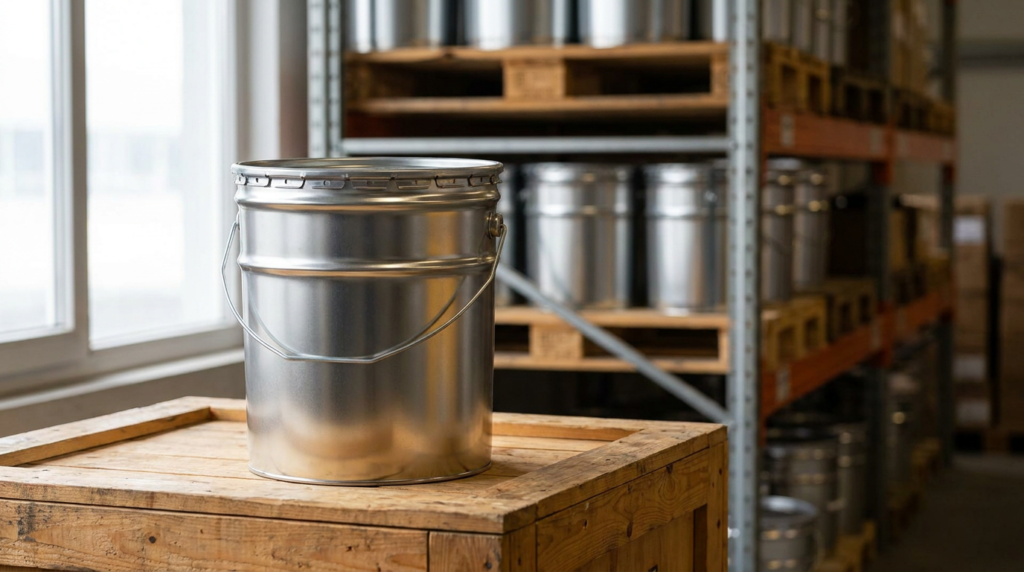
The wire handle on a 5-gallon (20L) steel pail is the component that buyers ask about second most often, after the body thickness. The questions are almost always the same: 3.5mm or 3.8mm diameter wire? Galvanized steel or plastic? Does it matter for a 20kg paint fill?
The short answer: yes, it matters, and the wrong handle is one of the top three failure modes we see in field returns (the other two being gasket failure and lid buckling). This guide walks through the design choices, the trade-offs, and a five-question test that any B2B buyer can apply to spec the right handle for a 5-gallon steel pail.
All reference data is from our Suzhou factory floor (Suzhou Jinqiao Packaging, 40-person operation, exporting 5-gallon pails to 30+ countries since 2008) and from the practical field experience of buyers who came back to us with a problem.
What the Wire Handle Actually Does on a 5-Gallon Pail
| Spec | 3.5mm Wire (Standard) | 3.8mm Wire (Heavy-Duty) |
|---|---|---|
| Static load capacity | Up to 22-23 kg | Up to 28+ kg |
| Cross-section area | 9.62 mm² | 11.34 mm² (+18%) |
| Best for product density | < 1.3 g/cm³ (paint, water-based coatings) | > 1.3 g/cm³ (heavy chemicals, resins) |
| Drop-test rating (typical) | ASTM D4169 Level I (1.2m) | ASTM D4169 Level II (1.5m+) |
| Cold weather (< -10°C) | Acceptable | Better (more ductile reserve) |
| Returnable / multi-use | Up to 5 cycles | 10+ cycles |
| Cost premium | Baseline | +5-7% on handle (~USD 0.15-0.25/pail) |
| Default recommendation | Retail paint, DIY, general chemicals | Industrial chemicals, export, returnable programs |
A 5-gallon pail handle has three functional requirements that drive every design choice:
- Static load support — the handle must hold the pail when full of liquid (typically 22-26 kg of paint, coating, or chemical product) without permanent deformation
- Dynamic load — the handle must survive being carried, dropped 1-2 meters, and tossed onto a loading dock without failure
- Grip ergonomics — the user must be able to hold it securely with one hand, often with a gloved hand, and pour with the other hand
A typical 5-gallon pail filled with water weighs about 21 kg. Paint, resin, or chemical product typically lands at 22-26 kg depending on density. The handle is the single point of human-interface with the package, and it is the component most likely to fail in field returns.
The Two Wire Diameter Options: 3.5mm and 3.8mm
The diameter of the steel wire used in a metal pail handle is the primary specification buyers need to lock in. Both 3.5mm and 3.8mm are industry-standard diameters for 5-gallon (20L) pails. They look almost identical to the eye, but they are not interchangeable in a real loading scenario.
3.5mm Round Wire Handle
The 3.5mm diameter is the standard weight for most paint, coating, and general chemical packaging applications. Most 5-gallon pails sold globally use 3.5mm wire. The mechanical properties are sufficient for a 22-25 kg static load and a moderate number of lift cycles.
Where 3.5mm is the right choice:
- Standard paint pails for retail and contractor use
- General industrial chemical packaging
- Coatings, adhesives, and lubricants at typical densities
- Buyers who are replacing a previous supplier and want a like-for-like spec
Where 3.5mm is not enough:
- Filled product density > 1.4 g/cm³ (heavy metal compounds, certain resins)
- Drop-test requirements > 1.5m
- Extended storage in cold environments (steel gets brittle below -20°C)
- Reusable pail programs where the handle will see 50+ lift cycles
3.8mm Round Wire Handle
The 3.8mm diameter is the heavy-duty option. It is roughly 18% more cross-sectional area than 3.5mm, which translates to approximately 18% more tensile and fatigue strength. The 0.3mm difference is not visible in a casual inspection but is material in a stress-test.
Where 3.8mm is the right choice:
- Heavy chemical compounds and high-density fluids
- Export markets with rough handling (Latin America, Africa, Southeast Asia ports)
- Industrial applications where the pail may be moved with a hoist or forklift sling
- Buyers specifying drop-test requirements beyond ASTM D4169 Level I
- Reusable or returnable pail programs
Cost difference between 3.5mm and 3.8mm:
- Material cost (steel wire): approximately 8-10% higher for 3.8mm
- Total handle cost (with plastic grip and forming): approximately 5-7% higher for 3.8mm
- For a typical 5-gallon pail at FOB China USD 3.50-4.50, the 3.8mm upgrade adds roughly USD 0.15-0.25 per pail
This is a small premium for a significant performance increase in demanding applications. We recommend 3.8mm for any pail that will see drops, heavy chemicals, or cold storage.
Wire Material and Finish
Wire handles for steel pails are almost universally made of low-carbon steel wire (Q195 or Q235 grade in Chinese standard). The wire is formed into the bail shape and then coated for corrosion resistance.
The three common finish options:
-
Electro-galvanized (white zinc) — the most common finish. Bright silver appearance, 8-12 micron coating thickness. Adequate for most paint and chemical applications. Lowest cost option.
-
Hot-dip galvanized — heavier zinc coating (50-80 micron), dull grey appearance. Best for high-humidity environments and outdoor storage. 2-3x the cost of electro-galvanized.
-
PVC or nylon coated — colored plastic coating over galvanized wire. Used for consumer-facing paint pails where the brand wants the handle color-matched to the pail. Common in retail DIY paint.
For export to EU under PPWR, the wire and its coating are part of the recyclability assessment. The mono-material steel-and-zinc construction typically passes the recyclability grade A threshold. PVC coating may push the handle into grade B or C depending on the volume.
Plastic Handle: When It Is the Right Choice
Plastic handles are a separate category from wire handles. They are injection-molded from PP (polypropylene) or HDPE, and they are a one-piece component that attaches to the same pail ears as a wire handle.
Plastic handle advantages:
- Corrosion-proof by definition (no metal to rust)
- Comfortable to grip, no cold-metal feel
- Available in custom colors (brand matching)
- Recyclability is straightforward — same PP/HDPE stream as the pail coating
- Slightly cheaper in some markets where plastic injection is competitive
Plastic handle disadvantages:
- Lower static load capacity (typical 18-20 kg safe load vs 25+ kg for steel wire)
- Brittle failure mode in cold weather — PP becomes brittle below 0°C
- UV degradation if the pail will be stored outdoors for extended periods
- Limited "premium" feel for high-end retail products
- Cannot be replaced easily if broken (often the pail is unusable after plastic handle failure)
Where plastic handle is the right choice:
- Retail consumer paint and DIY products (DIY consumers prefer plastic feel)
- Cold-stack warehouse with no drop testing
- Markets with strict metal-handle import regulations
- Buyer requests a specific color (e.g., Walmart private label color)
Where plastic handle is the wrong choice:
- Industrial chemical product > 20 kg specific gravity
- Cold chain or outdoor storage
- Reusable / returnable pail programs
- UN-certified dangerous goods packaging (most UN spec requires metal)
At our factory, we offer both options. For B2B buyers sourcing for industrial or chemical applications, we default-recommend the 3.8mm galvanized wire. For retail paint brand owners targeting consumer DIY, we default-recommend the plastic handle.
Plastic Grip on Metal Handle: Almost Always Required
Regardless of whether the handle is wire or plastic, the user grips it with bare or gloved hands. A bare metal handle on a 20 kg load is uncomfortable and unsafe. The plastic grip sleeve in the center of the bail is essentially a safety feature, not a luxury.
Common grip specifications:
- Grip length: 100-120 mm (covers the typical palm width for an adult hand, including gloved)
- Grip material: PP or PE (food-grade optional for paint applications)
- Grip finish: smooth (consumer DIY) or ribbed/textured (industrial)
- Color: custom (most often brand color or a neutral grey/black)
A grip that is too short (< 90 mm) does not protect the user's hand. A grip that is too long (> 140 mm) makes the handle feel clumsy and reduces the available bail clearance. Standard 100-110 mm grip length is the sweet spot for a 5-gallon pail.
Five-Question Spec Test for Buyers
If you are a B2B buyer spec'ing a 5-gallon pail and need to choose the handle configuration, run through this five-question test before placing the order. It will save you from over-specifying (and overpaying) or under-specifying (and receiving field returns).
Question 1: What is the filled product weight at typical fill density?
If the answer is < 22 kg, 3.5mm wire is adequate. If the answer is 22-28 kg, use 3.8mm wire. If the answer is > 28 kg, the pail should be UN-rated and the handle is typically 4.0mm or larger.
Question 2: What drop height must the pail survive?
ASTM D4169 standard drop test is 1.2 m for standard distribution. If your supply chain is more demanding (port handling, military, industrial chemical), go to 3.8mm wire. If you need 1.8m+ drop survival, consider a heavier handle AND a reinforced pail body.
Question 3: Will the pail be exposed to outdoor storage?
If yes for more than 30 days, hot-dip galvanized or PVC-coated wire is necessary. If the pail will be indoors, electro-galvanized is fine.
Question 4: Will the pail be used in cold environments (< -10°C)?
If yes, plastic handle is risky and 3.8mm wire with hot-dip galvanizing is the safer choice. Steel does get brittle at very low temperatures, but the impact is less than for PP plastic.
Question 5: Is the pail intended for single-use or returnable?
Single-use: 3.5mm wire is fine. Returnable (> 5 cycles expected): 3.8mm wire is strongly recommended and the body should also be 0.35mm or thicker.
If your answers to questions 1-4 are all at the lower end (light product, low drop, indoor, warm), 3.5mm electro-galvanized wire is the right choice and you save 5-7% on handle cost. If any answer is at the upper end, the small premium for 3.8mm wire is good insurance.
Common Buyer Mistakes We See in Field Returns
After 18 years of making and shipping 5-gallon pails, here are the failure modes that show up in field returns and the spec issues that cause them:
Handle breaks at the bend curve during lifting:
- Cause: 3.5mm wire on a 25+ kg product with no drop rating
- Fix: Upgrade to 3.8mm wire + add a strain relief rib at the bend
Handle corrodes through after 6 months of storage:
- Cause: Electro-galvanized wire on outdoor-stored pail
- Fix: Hot-dip galvanized or PVC-coated
Plastic handle cracks in winter delivery:
- Cause: PP handle rated to 0°C minimum, but pail was stored in -15°C warehouse
- Fix: Switch to metal handle or specify cold-rated PP copolymer
Handle separates from pail during carrying:
- Cause: Pail ear thickness < 0.5mm, attachment hole too large, or attachment clip too thin
- Fix: Body 0.32mm minimum, ear reinforced, attachment clip 0.5mm minimum
- This is actually a body spec issue masquerading as a handle spec issue
Color of handle fades after 3 months of UV exposure:
- Cause: Non-UV-stabilized plastic or non-UV-resistant coating on metal
- Fix: Specify UV-stabilized PP or PVC; for hot-dip galvanized wire, this is not an issue
The handle is rarely the only cause of a field failure. It is usually the visible symptom of a broader spec issue (thin body, wrong body coating, inadequate wire diameter for the application). When evaluating a new supplier, ask them to walk you through all five of these failure modes and how their spec addresses each.
Sourcing Checklist for the Handle
When you are at the supplier qualification stage, ask these questions in writing. The answers will tell you whether the supplier has actually thought about the handle, or whether they are just selling a standard pail:
- What wire diameter do you supply as standard? 3.5mm or 3.8mm or both?
- What is the wire material grade and certification (Q195/Q235/other)?
- What is the zinc coating thickness and standard (EN ISO 1461, ASTM A123, internal)?
- What grip length and material do you use as standard?
- Can you supply 3.8mm wire at the same lead time as 3.5mm, or is it a special order?
- What is the minimum order quantity for plastic handle option?
- Do you have drop-test certification (ASTM D4169) for your standard pail + handle combination?
- Can you do custom grip color (Pantone match) and what is the MOQ?
A supplier that can answer all eight questions clearly is a real manufacturer. A supplier that hedges or has to check with the factory is likely a trading company.
Our Default Recommendations
For most B2B chemical and paint buyers sourcing 5-gallon steel pails from China, our default spec is:
- Wire diameter: 3.8mm
- Wire material: Q195 low-carbon steel
- Finish: Electro-galvanized, 8-12 micron zinc coating
- Grip: 110mm PP, smooth finish, neutral grey color
- Body ear thickness: 0.32mm minimum
- Attachment clip: 0.5mm steel, integral with pail body
This is a balanced spec that handles 95% of standard B2B applications. It is more expensive than the cheapest 3.5mm wire by 5-7%, but the field return rate is meaningfully lower. We see roughly half the handle-related complaints on 3.5mm pails as on 3.8mm pails in our own quality data.
For retail consumer paint applications, we recommend plastic handle for the comfort and brand-color matching. For industrial chemicals > 1.3 specific gravity, we recommend 3.8mm wire. For returnable pail programs, we recommend 3.8mm wire and a thicker body (0.35mm).
How to Spec Your Pail Order
When you contact us for a 5-gallon pail quotation, here is the minimum information we need to recommend a handle configuration:
- Filled product type and density
- Filled product weight per pail
- Target drop-test requirements
- Storage environment (indoor / outdoor / cold)
- Single-use or returnable
- Target retail or industrial
- Color and branding requirements
With these six data points we can recommend the right handle within 24 hours and quote the difference between 3.5mm and 3.8mm wire for your specific volume.
Sources and Related Reading
Internal references used in this article:
- Suzhou Jinqiao Packaging 5-gallon pail factory test data, 2024-2026
- Buyer return-cause analysis, 2025 internal dataset
- ASTM D4169 standard drop test methodology
- EN ISO 1461 hot-dip galvanizing specification
- PPWR 2025/40 recyclability assessment methodology for mono-material metal packaging
For related reading on jqbuckets.com:
- Tinplate Thickness for Metal Cans: 0.28mm vs 0.32mm vs 0.38mm
- 5 Gallon Metal Bucket for Paint: The Complete Buyer's Guide for 2026
- UN Packaging Code Explained: 1A1, 1A2, 1H1, 1H2
- EU PPWR 2025/40 and Chinese Metal Packaging Exporters
- Tinplate Price Forecast H2 2026: What Chemical Can Buyers Need to Know Now
Talk to Us About Your 5-Gallon Pail Spec
If you are a B2B chemical, paint, coatings, or industrial buyer sourcing 5-gallon steel pails, the right handle spec is one of the lowest-cost decisions that prevents the most field returns. We can quote you 3.5mm and 3.8mm wire options on the same pail body, with documented drop-test data, within 48 hours of your inquiry.
Suzhou Jinqiao Packaging Container Co., Ltd has been manufacturing metal cans, steel pails, and chemical packaging in Suzhou, China since 2008. Our 5-gallon pail capacity is 200,000 units per month with 4-6 week lead times for standard specs.
Reach out via the form on our contact page, or message us on WhatsApp (+86 178 2667 5627). For a handle and body spec discussion, email joey@szjqpack.com directly with your filled product weight, drop-test requirements, and target market.
The right handle is the cheapest insurance on a 5-gallon pail. Get it right the first time, and you will not see handle returns in your next 10,000-unit order.