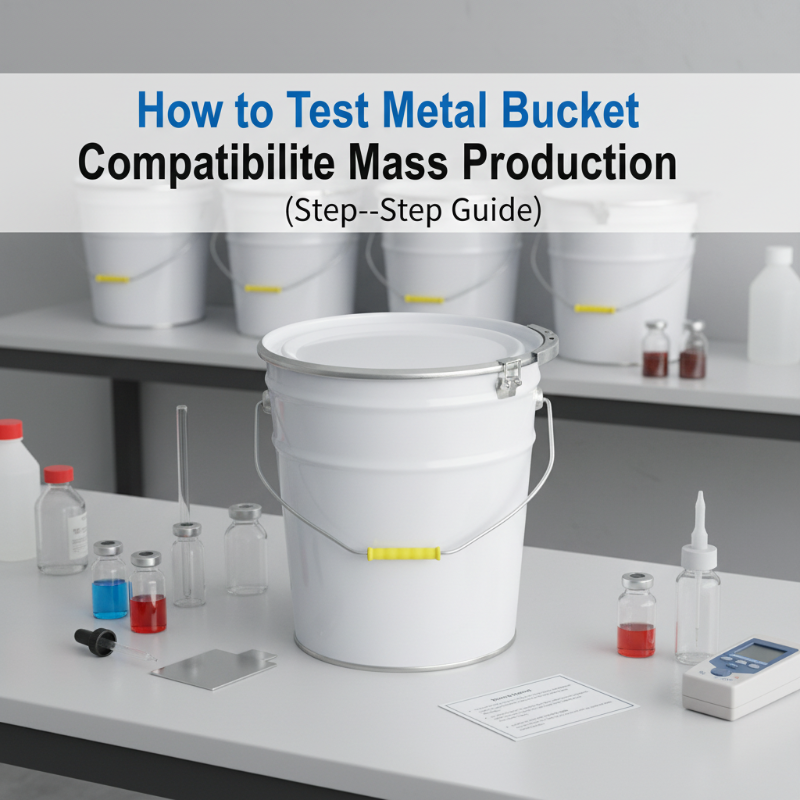
Packaging failures don’t usually come from poor materials. They happen because compatibility testing was skipped[^1]. A bucket that looks perfect today can fail weeks later under real-world conditions.
To ensure your metal buckets perform reliably, you must validate their compatibility with your product before mass production. This process prevents leaks, corrosion, and other failures[^2] that lead to costly recalls.
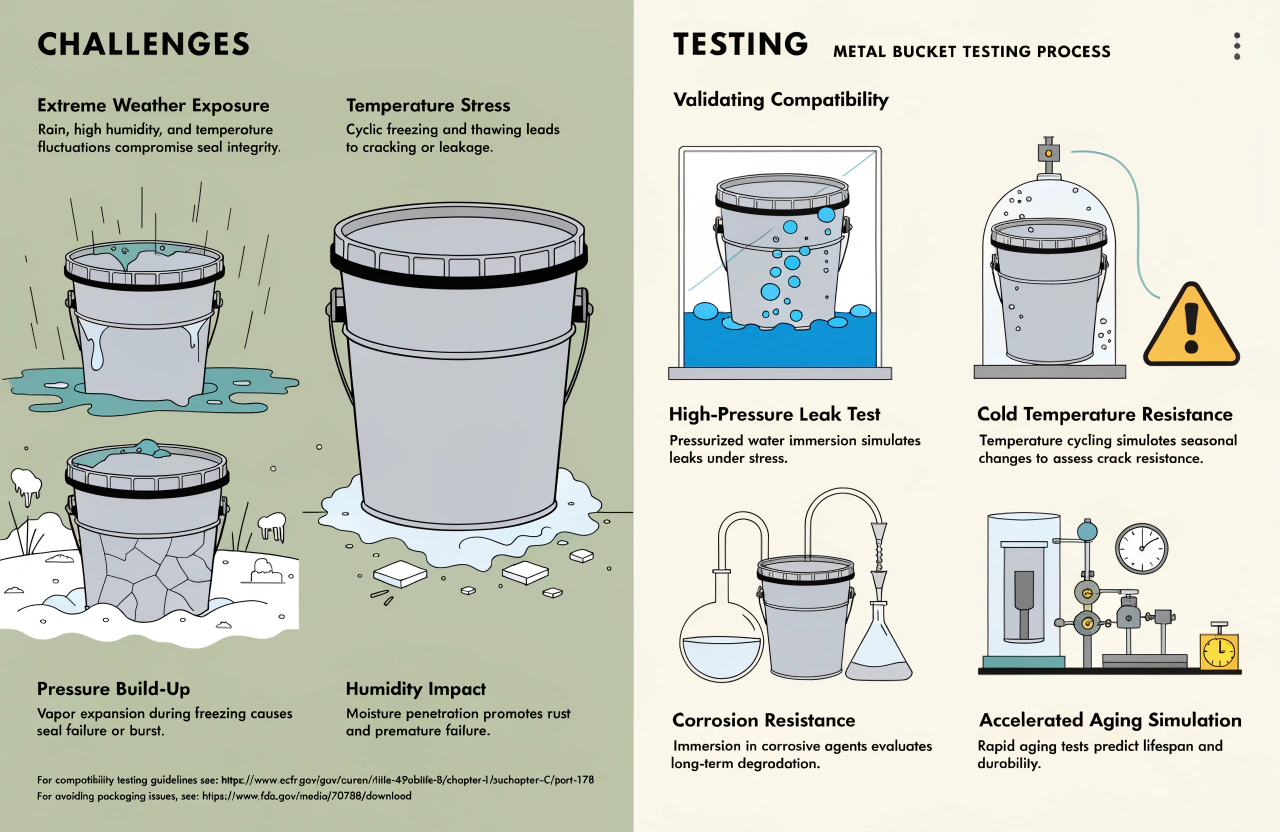
Many overlook compatibility testing, but it’s not optional. Let’s explore why and how professionals test metal buckets before committing to large-scale orders.
Why Compatibility Testing Is Not Optional?
Imagine this: you’ve ordered thousands of metal buckets, only to find they fail after filling. Coatings blister, seams leak, or products develop off-flavors. Fixing these problems after production has started isn’t just expensive—it’s often impossible.
The most common issues that arise when testing is skipped include:
- Coating softening or blistering[^3]
- Internal corrosion[^4]
- Off-flavors (for food products)[^5]
- Micro-leakage at seams
- Deformation from pressure
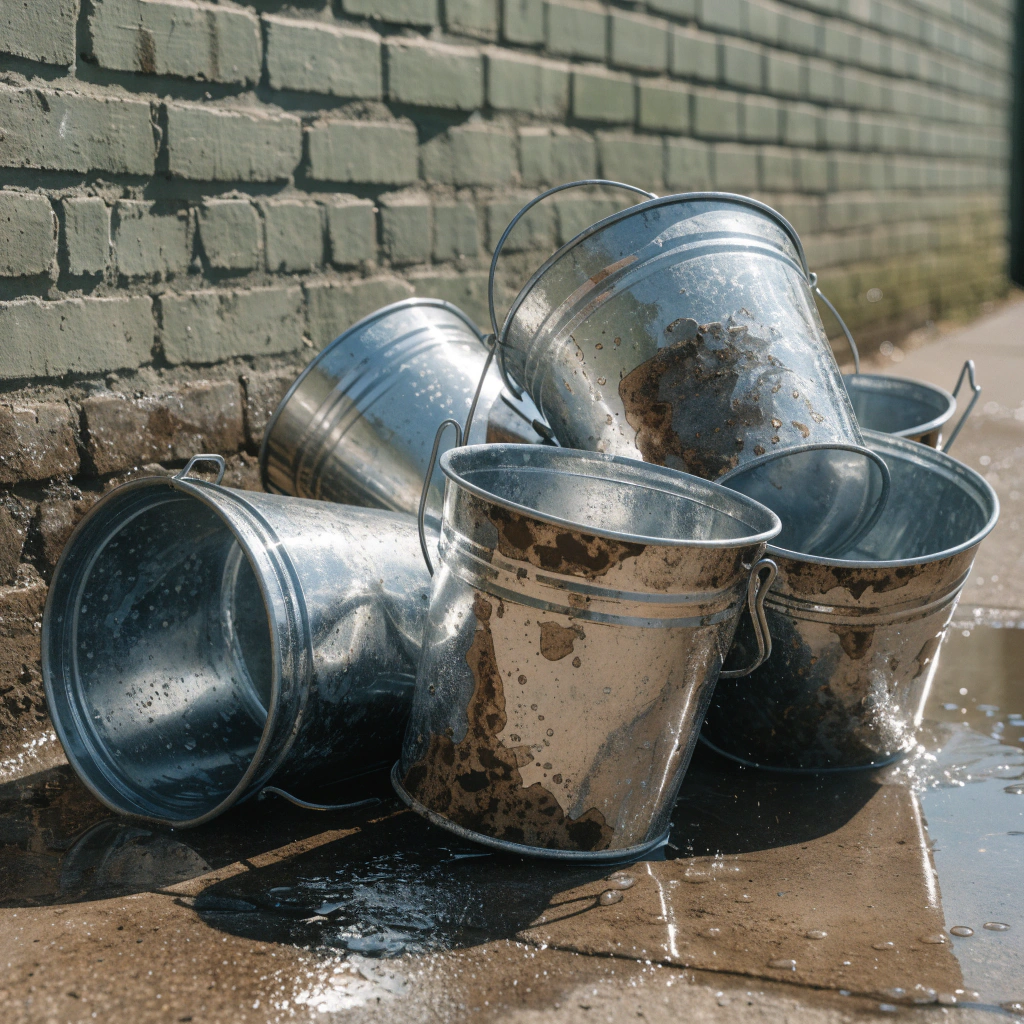
Skipping testing is one of the most frequent reasons for packaging failures. Once these problems occur, the damage to your business can be severe. That’s why every production process should begin with proper validation.
Step 1: Start With Your Product Data (Not the Bucket)
Many buyers focus on the bucket, asking for a specific size or design. Professionals, however, start with the product itself. Why? Because your product will determine how the bucket performs over time.
Key data you need to provide for compatibility testing includes:
| Parameter | Why It Matters |
|---|---|
| pH value[^6] | Determines corrosion risk |
| Solvent composition[^7] | Affects coating stability |
| Oil/fat content | Influences flavor interaction |
| Sulfur content (food)[^8] | Causes blackening |
| Storage duration | Determines long-term resistance |
| Filling temperature | Affects coating stress |
| Transport conditions | Impacts structural design |
Without this information, testing becomes guesswork. Starting with product data ensures that the testing process is tailored to your specific needs.
Step 2: Select 2–3 Candidate Coating Systems
It’s a mistake to test just one coating option. Coatings perform differently based on the product they interact with.
The most common types of coatings for metal buckets include:
- Epoxy
- Epoxy-phenolic
- Polyester
- C-enamel (ideal for sulfur-rich foods)[^9]
Testing multiple options allows you to compare performance and select the best fit. Compatibility isn’t theoretical—it must be proven for your exact product.
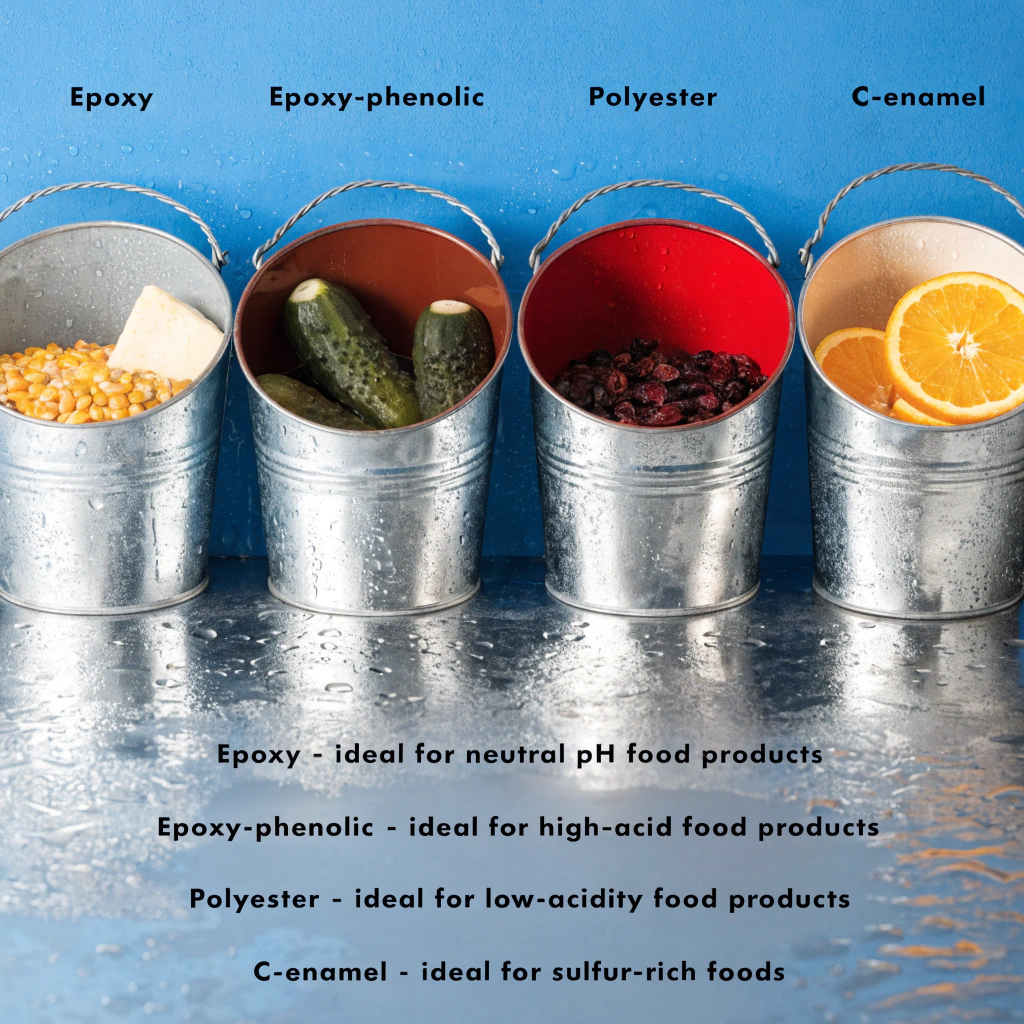
This step ensures you’re not relying on assumptions or supplier claims. It’s the foundation of a robust compatibility testing process.
Step 3: Conduct Short-Term Fill & Seal Testing
The next step is short-term testing. This is your first layer of validation to identify obvious incompatibilities quickly.
Here’s how to conduct short-term testing:
- Method: Fill sample buckets with your product and seal them using actual lids and seams.
- Duration: Store them at a controlled temperature for 7–14 days (30 days is better).
- What to check: Look for coating surface changes, color shifts, odors, flavors, or early corrosion signs.
Short-term testing helps eliminate options that clearly won’t work, saving time and resources for advanced testing later.
Step 4: Accelerated Aging Test (Critical Step)
Real failures often appear after months, which is why accelerated aging is essential[^10]. It simulates long-term storage conditions in a shorter time.
How to run an accelerated aging test:
- Conditions: Store filled buckets at 40–60°C for 2–4 weeks[^11].
- What it simulates: Long-term storage, chemical interactions, coating degradation, and pressure buildup.
- What to observe: Blistering, coating softening, internal corrosion, lid deformation, and seam integrity.
This step is one of the most important. It identifies issues that would otherwise go unnoticed until after shipping or storage.
Step 5: Transport Simulation (Often Ignored)
Failures frequently occur during shipping, not in storage. That’s why transport simulation is critical.
Simulate real logistics conditions by testing for:
- Vibration resistance[^12]
- Drop impacts
- Stacking pressure
Even if the coating is perfect, the structure must withstand real-world transport stress. If seams are weak or the steel is too thin, failures can occur.
Step 6: Leak Testing (Must Be 100%)
After all other tests, confirm the sealing integrity of the bucket. Micro-leaks are often invisible but can cause catastrophic failures over time.
Common leak testing methods include:
| Test Method | What It Detects |
|---|---|
| Air pressure test | Structural leaks |
| Vacuum decay | Micro-leakage |
| Visual inspection | Surface defects |
For chemical-grade buckets, automated leak testing is a must.
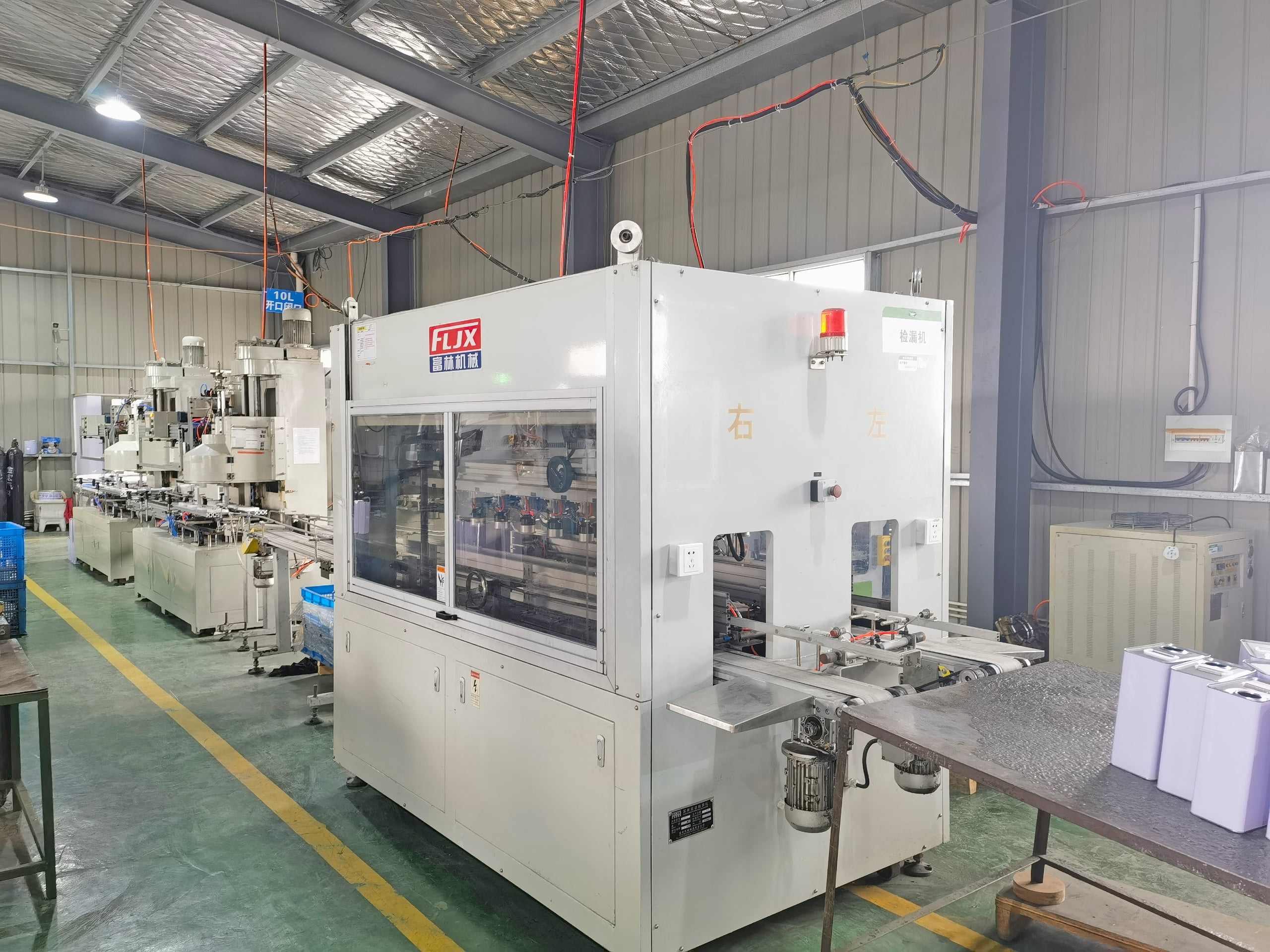
This step ensures your buckets meet the highest safety standards.
Step 7: Evaluate Results Like a Professional
When reviewing results, don’t just ask, “Did it leak?” Dive deeper:
- Did the coating soften or discolor?
- Was there early-stage corrosion?
- Did seams show weakness?
- Were lids or gaskets deformed?
- Was performance stable across all samples?
Choose the option with the highest safety margin and best long-term stability.
Conclusion
Testing metal bucket compatibility is not just a technical exercise—it’s a business protection strategy. Failures often occur long after production, but compatibility testing prevents them before they start.
If you’re unsure how your product will interact with different coatings, consider running small-batch compatibility tests before mass production. Testing now is simple. Fixing failures later is not.
Need Help Selecting the Right Metal Bucket?
Choosing the right coating, seam structure, and lid type depends on your product's chemistry, shelf life, and shipping conditions. We can walk you through the trade-offs and ship samples for compatibility testing before you commit. Browse our full product range or send us your product spec sheet for a tailored recommendation.
Related Reads
[^1]: "49 CFR Part 178 -- Specifications for Packagings - eCFR", https://www.ecfr.gov/current/title-49/subtitle-B/chapter-I/subchapter-C/part-178. Packaging science and standards literature describe product–package compatibility evaluation as a means of identifying chemical interaction, corrosion, migration, leakage, and performance problems before distribution; this supports compatibility testing as a preventive control, though it does not quantify how often skipped testing causes bucket failures specifically. Evidence role: general_support; source type: institution. Supports: Packaging failures can occur when compatibility testing is skipped.. Scope note: Contextual support for packaging compatibility testing broadly, not direct proof of the frequency of metal bucket failures caused by skipped testing. [^2]: "[PDF] Guidance for Industry: Container Closure Systems for Packaging ...", https://www.fda.gov/media/70788/download. Guidance on package qualification and compatibility testing supports the use of preproduction testing to evaluate leakage, corrosion, and material degradation risks under expected product and storage conditions; this is preventive evidence rather than proof that all such failures will be prevented. Evidence role: general_support; source type: government. Supports: Compatibility validation before production helps reduce leaks, corrosion, and related failures.. Scope note: Supports risk reduction through testing, not an absolute guarantee of preventing all leaks or corrosion. [^3]: "Blistering and degradation of polyurethane coatings under different ...", https://www.academia.edu/106047027/Blistering_and_degradation_of_polyurethane_coatings_under_different_accelerated_weathering_tests. Coatings literature identifies solvent exposure, chemical attack, moisture, and adhesion loss as causes of coating softening and blistering, supporting these as plausible failure modes in coated metal containers; the evidence is mechanism-based and not bucket-specific unless a container-focused source is used. Evidence role: mechanism; source type: paper. Supports: Skipped or inadequate compatibility testing can leave coating softening or blistering undetected.. Scope note: Mechanistic support for coating failure generally; may not directly address all metal bucket coating systems. [^4]: "[PDF] CHEMICAL COMPATIBILITY CHART", https://www.wisconsin.edu/ehs/download/Fisher-Scientific-Chemical-Compatibility-Chart.pdf. Corrosion references and food/package interaction studies describe how product chemistry, pH, oxygen, salts, and storage conditions can drive internal corrosion of metal packaging, supporting internal corrosion as a compatibility risk; the source would be contextual unless it studies metal buckets specifically. Evidence role: mechanism; source type: paper. Supports: Product chemistry can cause internal corrosion in metal packaging if compatibility is not validated.. Scope note: Likely supports metal packaging or tinplate/steel cans generally rather than metal buckets alone. [^5]: "Review on metal packaging: materials, forms, food applications ...", https://pmc.ncbi.nlm.nih.gov/articles/PMC7270472/. Food-packaging research documents that interactions between food, coatings, and packaging materials can contribute to taints or off-flavors, supporting sensory change as a relevant compatibility endpoint; this evidence may address food packaging broadly rather than metal buckets only. Evidence role: mechanism; source type: paper. Supports: Incompatible packaging or coatings may contribute to off-flavors in food products.. Scope note: Contextual support for food packaging interactions, not necessarily direct evidence for metal buckets. [^6]: "Corrosion in Tinplate Cans Used for Food Storage - OhioLINK", https://rave.ohiolink.edu/etdc/view?acc_num=osu1626397320664951. Corrosion and food-packaging literature identifies pH as a key factor affecting corrosion rates and metal dissolution in metal containers, supporting its inclusion in compatibility data; the evidence is general unless tied to the specific product and bucket alloy/coating. Evidence role: mechanism; source type: paper. Supports: Product pH is important because it influences corrosion risk in metal packaging.. Scope note: Supports pH as a corrosion factor generally, not a full compatibility assessment by itself. [^7]: "Composition and Properties of Protective Coatings Made of ... - PMC", https://pmc.ncbi.nlm.nih.gov/articles/PMC8196985/. Polymer and coating compatibility references describe solvent resistance as dependent on solvent chemistry and coating polymer structure, supporting solvent composition as a determinant of coating stability; this is mechanism-level evidence and must be matched to the actual coating system for direct proof. Evidence role: mechanism; source type: paper. Supports: Solvent composition affects the stability of protective coatings in metal containers.. Scope note: General coating-chemistry support; direct compatibility still requires product-specific testing. [^8]: "[PDF] IRON SULFIDE DISCOLORATION OF TUNA CANS!.!", https://spo.nmfs.noaa.gov/sites/default/files/pdf-content/mfr18122.pdf. Food canning references describe sulfur compounds in certain foods reacting with metal ions to form dark iron or tin sulfides, supporting sulfur content as a cause of blackening in metal-packaged foods; applicability depends on the metal substrate and protective coating used. Evidence role: mechanism; source type: education. Supports: Sulfur-containing foods can contribute to blackening in metal containers.. Scope note: Directly relevant to metal food packaging, but the degree of risk depends on coating integrity and container metallurgy. [^9]: "Identification of Corrosive Volatile Compounds Found in the ... - PMC", https://pmc.ncbi.nlm.nih.gov/articles/PMC10449590/. Metal packaging references describe C-enamel or sulfur-resistant enamel as a lacquer type used to reduce sulfide staining in cans containing sulfur-bearing foods; this supports the suitability claim in context, though it does not prove any particular supplier’s coating is ideal for every sulfur-rich product. Evidence role: definition; source type: education. Supports: C-enamel is commonly used for sulfur-rich foods because it helps resist sulfide staining.. Scope note: Supports the conventional use of C-enamel for sulfur-staining control, not universal superiority for all sulfur-rich formulations. [^10]: "[PDF] Shelf Life of Medical Devices - FDA", https://www.fda.gov/media/72487/download. Stability-testing and accelerated-aging standards use elevated temperature and defined exposure conditions to estimate or screen long-term material and package performance, supporting accelerated aging as a common validation tool; it is an approximation and cannot fully reproduce all real storage mechanisms. Evidence role: expert_consensus; source type: institution. Supports: Accelerated aging is important because some failures appear only after extended storage.. Scope note: Accelerated aging is a screening or predictive method, not a perfect substitute for real-time aging. [^11]: "[PDF] Accelerated Storage Stability and Corrosion Characteristics Study ...", https://www.epa.gov/sites/default/files/2015-11/documents/final-signed-acc-ss-cc-memo.pdf. Accelerated storage studies and stability-testing practices commonly use elevated temperatures such as 40°C or higher to stress packaging systems and reveal degradation mechanisms more quickly; support for the exact 40–60°C and 2–4 week protocol should be treated as application-specific unless a metal-container standard states it directly. Evidence role: historical_context; source type: paper. Supports: Elevated-temperature storage can be used to accelerate observation of coating and package degradation.. Scope note: Likely supports elevated-temperature accelerated testing generally, not necessarily this exact temperature-duration combination for all metal buckets. [^12]: "ASTM D4169 - Westpak", https://westpak.com/test-standards/astm-d4169/. Distribution-testing standards include vibration testing to simulate transport stresses on packaged products, supporting vibration resistance as a relevant criterion in transport simulation; the source supports the test category rather than a bucket-specific pass/fail threshold. Evidence role: expert_consensus; source type: institution. Supports: Transport simulation for metal buckets should include vibration resistance testing.. Scope note: Supports vibration testing as a standard distribution simulation method, not specific acceptance limits for metal buckets.
<!--[googlesitekit-end-of-content]-->