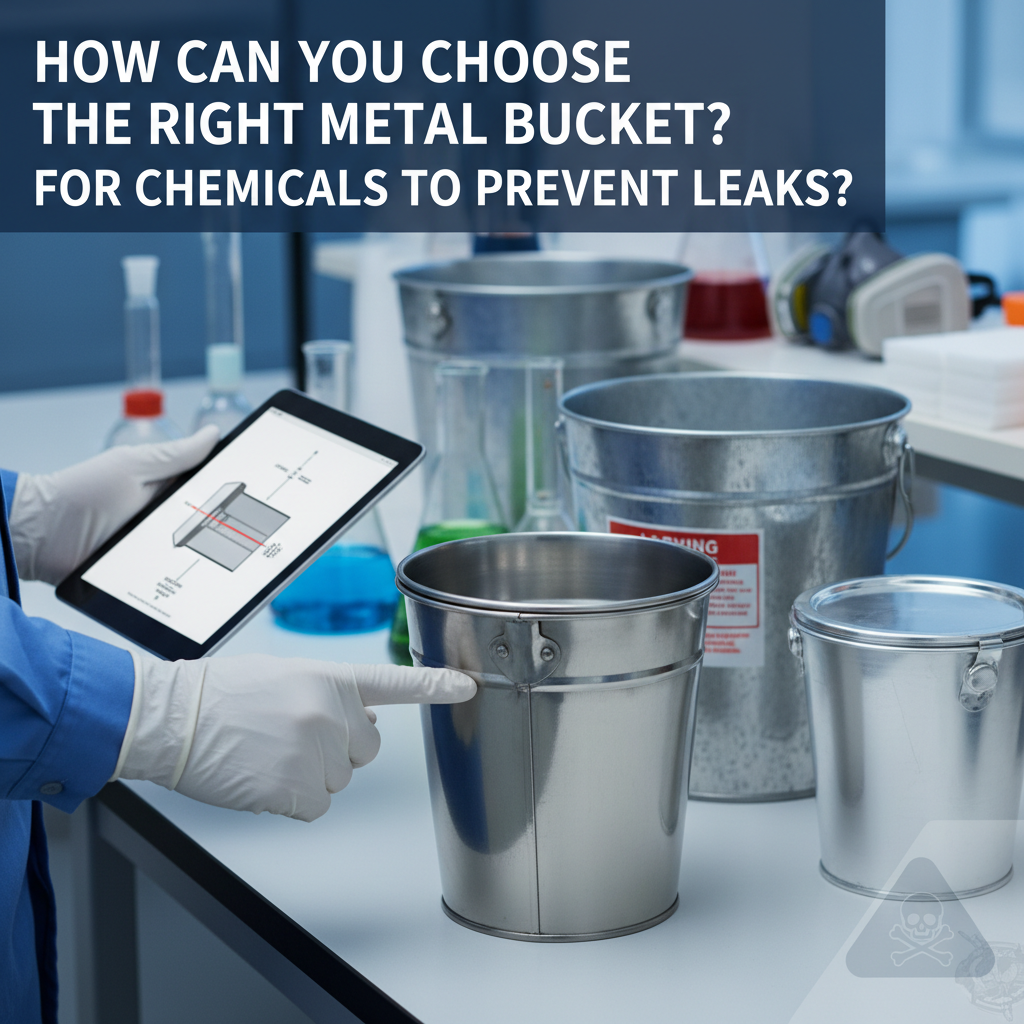
Choosing the wrong chemical bucket1 can lead to disastrous leaks. This checklist will give you the critical details to select a safe, reliable bucket and protect your business.
Many of the failures described below are not isolated issues, but the result of multiple small weaknesses combining over time.
If you want to understand how leakage risks form as a system rather than as single defects, see our in-depth analysis in Prevent Chemical Tin Can Leaks: A Systems Approach.
To choose the right metal bucket for chemicals, you must match the internal coating2 to your product, verify the steel's strength3 for transport, check the welded seam4 for protection, and confirm 100% automated leak testing5. This systematic approach ensures safety and prevents costly leaks after shipment.
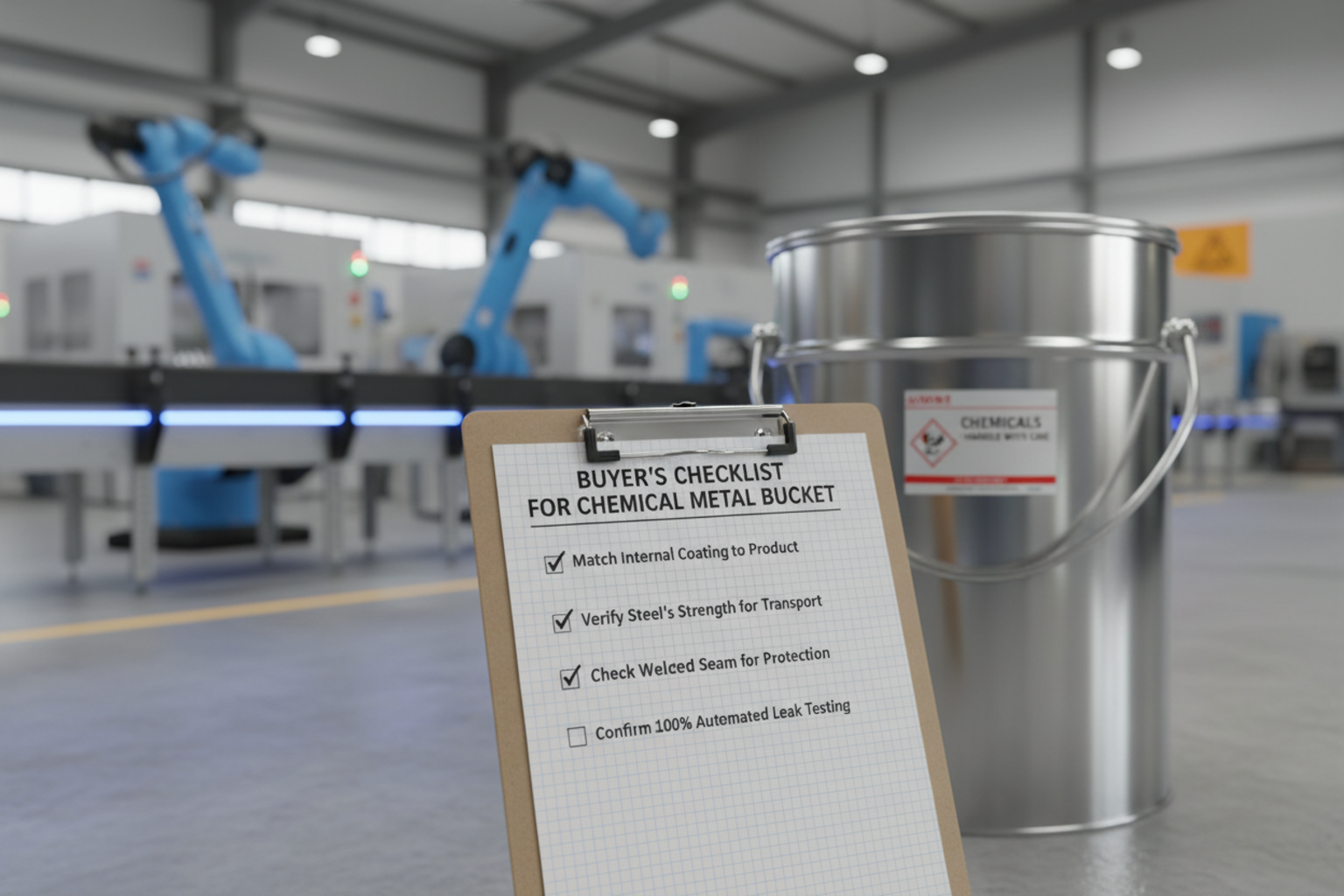
You might think all metal buckets are the same, but the small details make all the difference between a secure container and a future liability. I've seen costly mistakes happen from simple oversights that could have been easily avoided. Let's break down exactly what you need to look for, step by step, so you can avoid these problems. This guide will help you make a much more informed decision.
Should You Start by Choosing the Bucket or Analyzing the Chemical?
Many buyers start by asking for a standard bucket size. This approach ignores the biggest risk: chemical reactions6. Always start by analyzing your product's properties to avoid failure.
The correct first step is to identify your chemical's properties. Is it acidic, alkaline, or solvent-based? This information determines the required internal coating and prevents failures caused by chemical incompatibility, not by a manufacturing defect. A bucket that works for one chemical might fail with another.
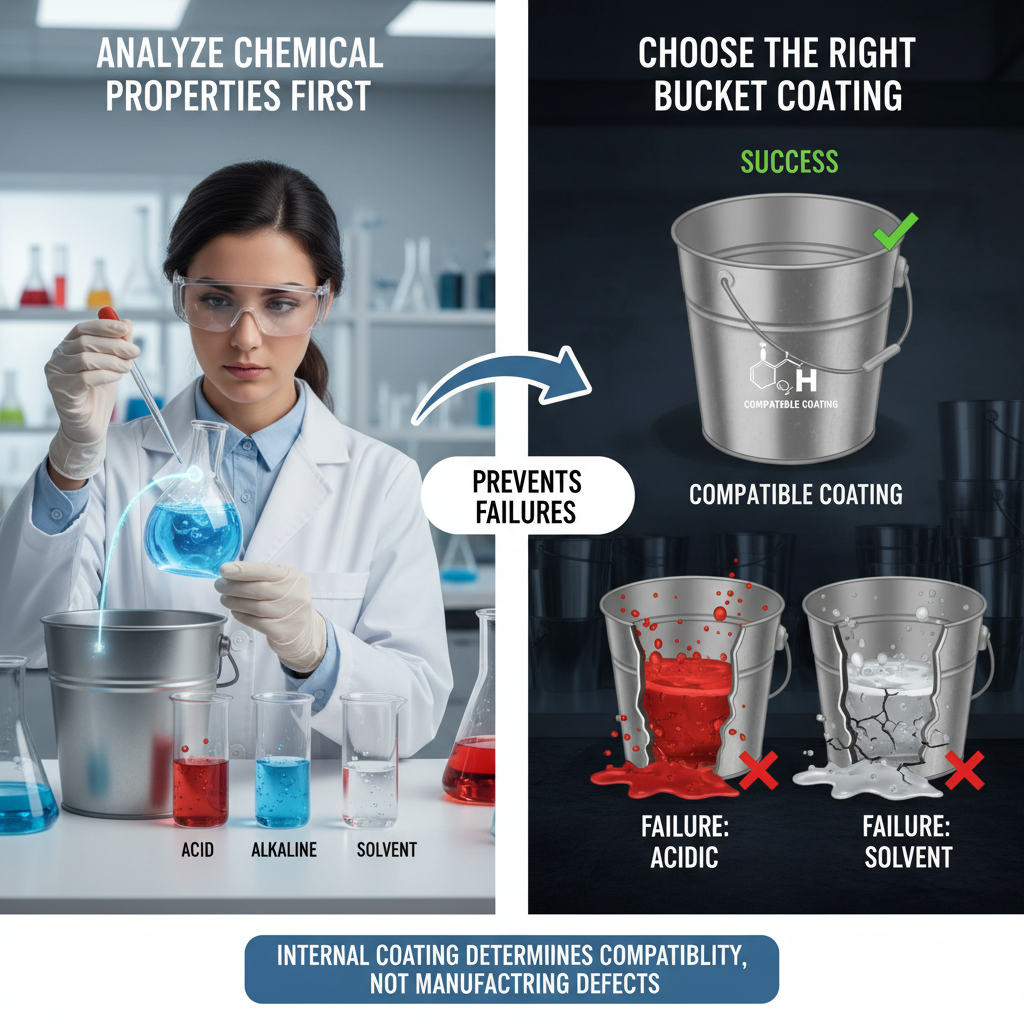
I remember a client who came to us after a major incident. They had ordered thousands of "standard 5-gallon buckets" from another supplier for a new solvent-based adhesive. The buckets looked fine. But weeks after shipping, they started getting calls about leaks. The solvent had slowly attacked the standard internal liner, causing it to soften and fail at the seams. Their starting point was the problem. They asked for a bucket, not a packaging solution for their specific chemical.
The first question should never be "Do you have a 5-gallon bucket?" Instead, you should ask yourself these questions about your product:
Key Chemical Properties to Check
| Chemical Property | Why It Matters | What to Ask Your Supplier |
|---|---|---|
| pH Level7 | Acidic or alkaline products can corrode steel or specific coatings. | "Is this coating resistant to a pH of [your product's pH]?" |
| Solvent Type | Aggressive solvents can soften, blister, or dissolve the wrong liner. | "Is this liner tested for compatibility with [your solvent]?" |
| Vapor Pressure | Volatile products can build internal pressure, stressing seams and lids. | "Is this bucket and lid designed to handle internal pressure?" |
The Safety Data Sheet (SDS) for your chemical is the best place to find this information. A good packaging partner will want to see it. Starting with the chemical ensures the bucket is engineered for your product's unique needs, not just its volume.
Is the Internal Coating Really That Important for Preventing Leaks?
Selecting an internal coating is not about choosing a “standard liner”, but about chemical compatibility, curing performance, and long-term stability.
For a chemistry-driven decision framework — including solvent polarity, pH range, and extreme chemical cases — refer to our complete guide on How to Choose the Internal Coating for Chemical Cans.
You might assume a "standard coating" is good enough. But a mismatch can cause the coating to peel or blister, leading to slow, hidden leaks that appear after shipment.
Yes, the internal coating is a non-negotiable safety feature. It is the primary barrier protecting your chemical from the steel. A mismatch can cause corrosion and leaks weeks after filling. You must always verify the coating is tested and proven for your specific product.
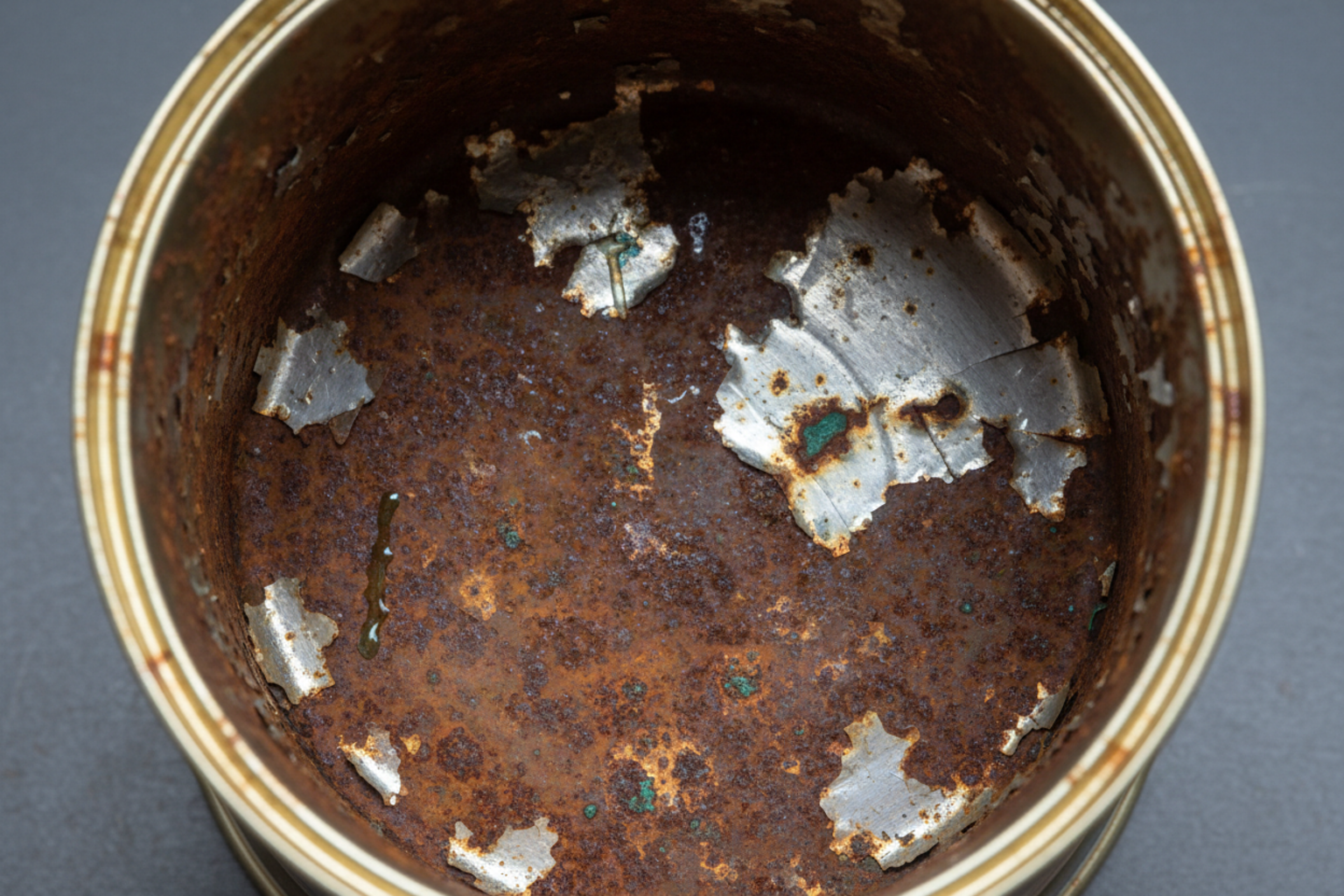
For any chemical product, the steel itself is just the structure. The internal coating is the real protective barrier. Think of it like the insulation on an electrical wire. The wire provides the path, but the insulation prevents dangerous shorts. In our case, the coating prevents the chemical from "shorting out" against the steel. I’ve seen perfectly good steel buckets fail because the coating wasn't right for the job.
A mismatch between the chemical and the coating can lead to several problems:
- Softening or Blistering: The coating loses its integrity and peels away from the steel wall.
- Corrosion: The chemical gets under the failed coating and starts to eat away at the steel.
- Contamination: Particles from the failing coating mix with your product, ruining its quality.
Common Coating Options
| Coating Type | Best For | Key Feature |
|---|---|---|
| Epoxy-Phenolic | General-purpose chemicals, paints, solvents. | A versatile workhorse with good chemical resistance. |
| Phenolic | Acidic products. | Offers strong protection against corrosive materials. |
| Fluoropolymer (PVF) | Highly aggressive chemicals. | The highest level of chemical resistance for extreme applications. |
Never assume a "gold" or "gray" lining is acceptable. These are just colors. You need to know the chemical composition of the coating. Always ask your supplier for a specification sheet for the liner or, even better, request a sample for compatibility testing with your product. This simple step can save you from huge losses down the road.
Why Does the Bucket's Body Strength Matter More Than You Think?
An empty bucket might look and feel strong enough. But when filled and stacked, thin or low-grade steel can deform, crack, or fail under pressure during real-world use.
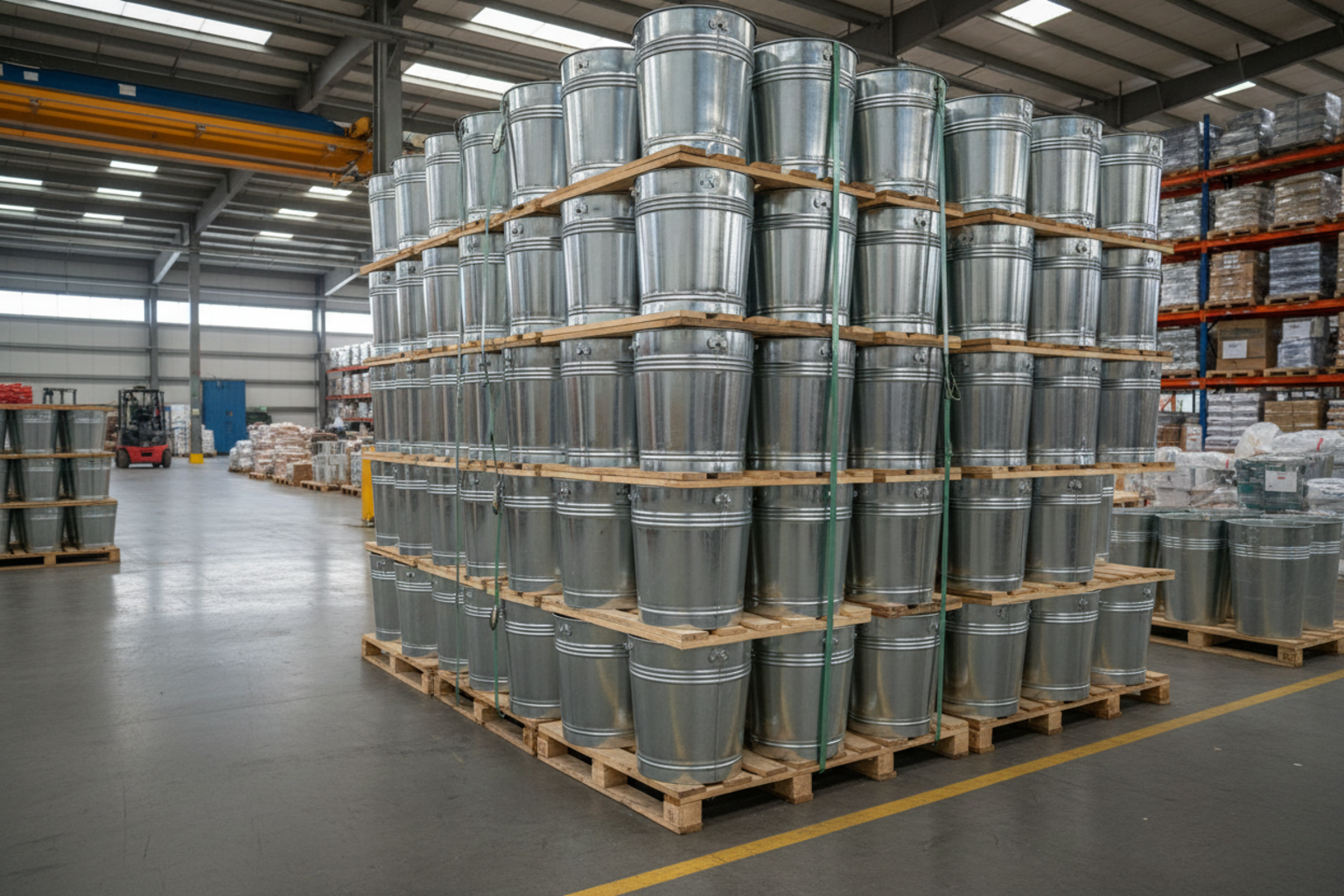
The bucket's body strength8 is the foundation of its safety. It must be strong enough to withstand stacking pressure9 in a warehouse and vibrations during transport. Using low-grade steel increases the risk of deformation and micro-cracks, especially around the seams. High-grade steel is essential for structural integrity.
Material choice is also one of the key reasons many chemical buyers move away from plastic containers for higher-risk products.
We compare structural strength, barrier properties, and long-term safety considerations in detail in Tinplate vs Plastic for Chemical Packaging.
The strength of the steel is about more than just preventing dents. It’s about ensuring the container remains a sealed system under stress. I always tell my clients to think about the entire journey of the bucket. It will be filled, sealed, stacked on a pallet, loaded onto a truck, and vibrated for hundreds or thousands of miles. Then it will be unloaded and stacked again.
Each of these steps puts stress on the bucket's body.
- Stacking Pressure: A pallet of buckets can weigh over a ton. The bottom buckets must support this entire load without buckling. Weak steel will deform, compromising the seams.
- Vibration and Impact: During transport, constant vibration can cause stress fractures in weak points, especially if the steel is too brittle.
- Internal Pressure: Temperature changes can cause the contents to expand, putting outward pressure on the bucket walls and seams.
Using high-grade, low-carbon tinplate is the solution. "Low-carbon" simply means the steel is less brittle and can be formed into a strong bucket body without creating micro-cracks. It provides better formability, which leads to stronger, more reliable seams. The bucket's body strength is the platform for every other safety feature. If the steel fails, nothing else matters.
Is the Welded Seam the Weakest Point of a Chemical Bucket?
Side seam corrosion is one of the most common delayed failure modes in chemical packaging.
We break down real-world examples, root causes, and prevention strategies in our article on Common Leakage Problems in Chemical Tin Cans.
Leaks rarely happen on the flat surfaces of a bucket. They start at the seams. Welding the side seam burns off the internal coating, creating a hidden vulnerability for corrosion.
The welded side seam is a critical risk area. The intense heat from welding removes the protective internal coating, leaving a line of exposed raw steel on the inside. Without a secondary protective layer, corrosion will start here and slowly develop into a leak long after the bucket leaves the factory.
In my nearly two decades in this business, I can tell you that the side seam is where most preventable failures occur. Modern chemical buckets use a process called Electric Resistance Welding10 (ERW). This creates a very strong mechanical bond. However, it also creates a major challenge. The heat is so intense that it vaporizes the internal liner along the weld line.
This leaves a narrow strip of bare steel. If your product is even mildly corrosive or water-based, this exposed steel is where rust will begin. It might not be visible at first. The leak can take weeks or months to appear, usually when the bucket is already in your customer's hands.
A professional manufacturer solves this problem by applying a secondary coating over the internal weld seam. The best method is to use a powder coating stripe. This powder is sprayed onto the seam and then cured with heat, creating a durable, seamless protective layer that restores 100% of the corrosion resistance. Some lower-cost manufacturers might use a simple liquid stripe, which is not nearly as robust. You should always ask your supplier, "How do you protect the internal weld seam?" If they don't have a clear, confident answer, you should be very concerned.
How Does the Lid and Seam Design Stop Chemical Leaks?
A bucket is only as secure as its closure. A weak lid or seam can easily fail under internal pressure or the stress of transport, leading to a major spill.
The lid and seam design are critical for leak resistance. A secure system uses a reinforced lid, a multi-layer double seam, and a chemically resistant gasket. This combination creates a long, complex path that makes it very difficult for liquid or vapor to escape, even under pressure.
A bucket's closure is an engineered system. It’s not just a lid that sits on top. For chemical products, you need to look for specific features. The top of the bucket body and the edge of the lid are rolled together in a process that creates what we call a "double seam." Think of it like folding two pieces of paper together multiple times to create a strong mechanical lock.
A standard food can might have a 3-layer seam. But for chemicals, you should look for a 5-layer or even 7-layer double seam. This creates an incredibly tight seal that is highly resistant to pressure and vibration.
Inside this seam is a gasket. This is a rubbery compound that fills any microscopic gaps to make the seal airtight and liquid-tight. This gasket must be made of a material that won't swell or degrade when it comes in contact with your chemical.
Finally, the lid itself must be strong. Lids for liquid products often have reinforcing ribs stamped into them to prevent them from deforming under stacking pressure9 or from internal vapor pressure11. A flimsy lid can pop off or buckle, breaking the seal. If a supplier's quote doesn't specify the seam design or gasket material12, that is a huge red flag.
Why Is 100% Leak Testing a Must-Have for Chemical Buckets?
You cannot see a microscopic leak with your eyes. These tiny, invisible flaws are the ones that cause big problems after your product has been filled and shipped.
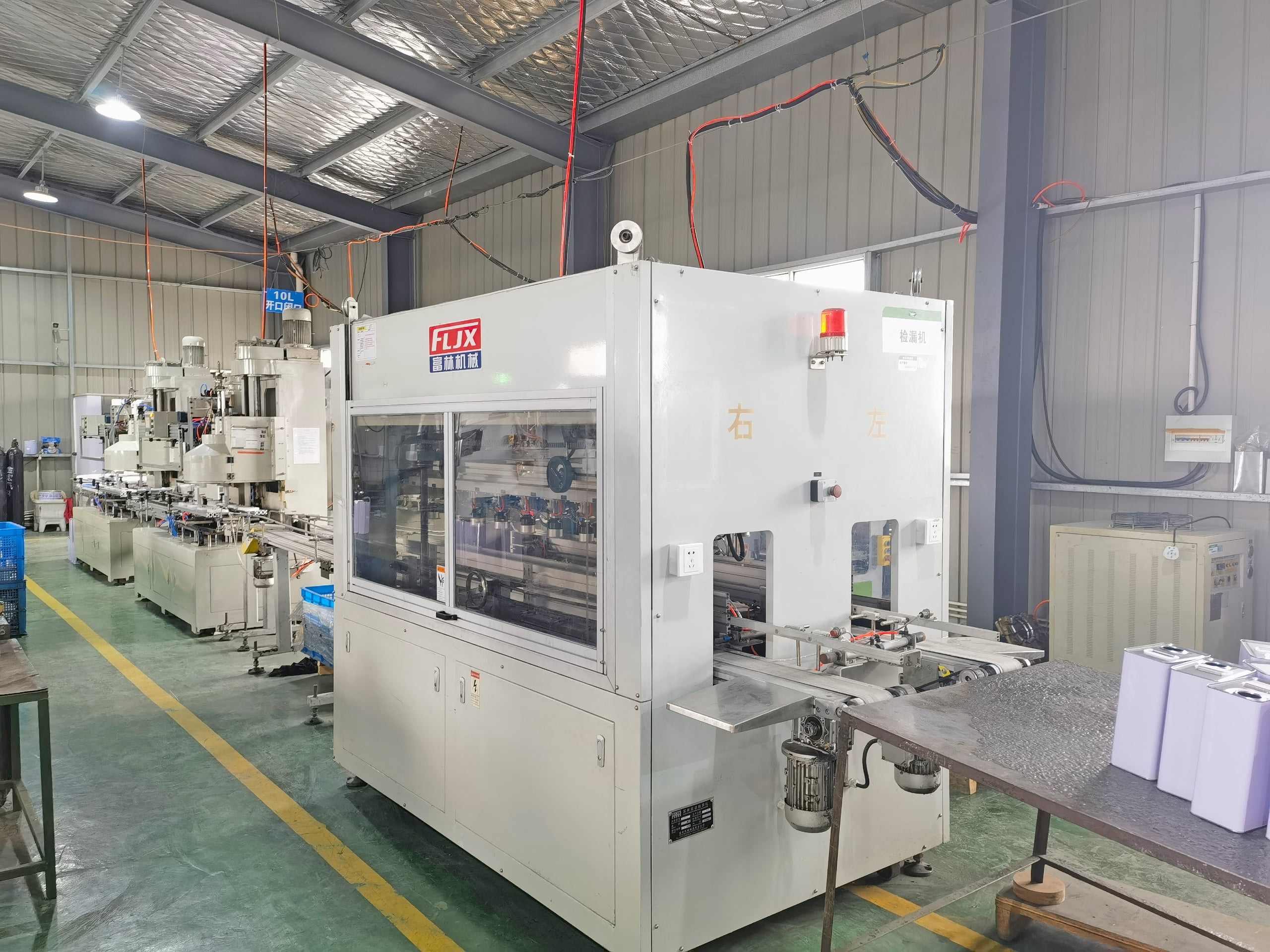
100% automated leak testing5 is non-negotiable for chemical packaging. It ensures every single bucket is verified to be leak-tight before it leaves the factory. Methods like air pressure or vacuum decay testing find the microscopic flaws that visual checks miss, protecting you from post-shipment failures.
Some manufacturers use a process called statistical quality control, or sample testing. This means they only test a small number of buckets from a very large batch. If that small sample passes, they assume the entire batch of thousands is also good. In my opinion, this is just a gamble. It passes the risk of a faulty bucket from the manufacturer onto you, the buyer.
At our facility, we believe that for chemical packaging, every single bucket must be tested. We use automated leak detectors on our production lines. Here is how one of the methods works in simple terms:
- A bucket comes down the line.
- A test head seals the top of the bucket.
- A small, precise amount of air pressure is applied inside.
- Sensitive sensors measure if the pressure drops, even by a tiny amount.
- If the pressure drops, it means there is a leak, and the machine automatically rejects the bucket.
This process takes only a few seconds per bucket. It guarantees that any container with a micro-crack, a bad seam, or a pinhole is removed before it can ever be filled with your product. If a supplier tells you that leak testing is optional or costs extra, you are talking to the wrong supplier for chemical packaging.
Why Should You Care About Your Supplier's Manufacturing Process?
Some suppliers are vague when you ask about their production methods. This lack of clarity often hides shortcuts in quality control and creates hidden risks for you.
Transparency in the manufacturing process13 is a sign of a trustworthy partner. A serious supplier should be able to clearly explain their material selection, coating process, seam protection, and quality controls. This transparency is not just marketing; it is direct evidence of their process control and commitment to safety.
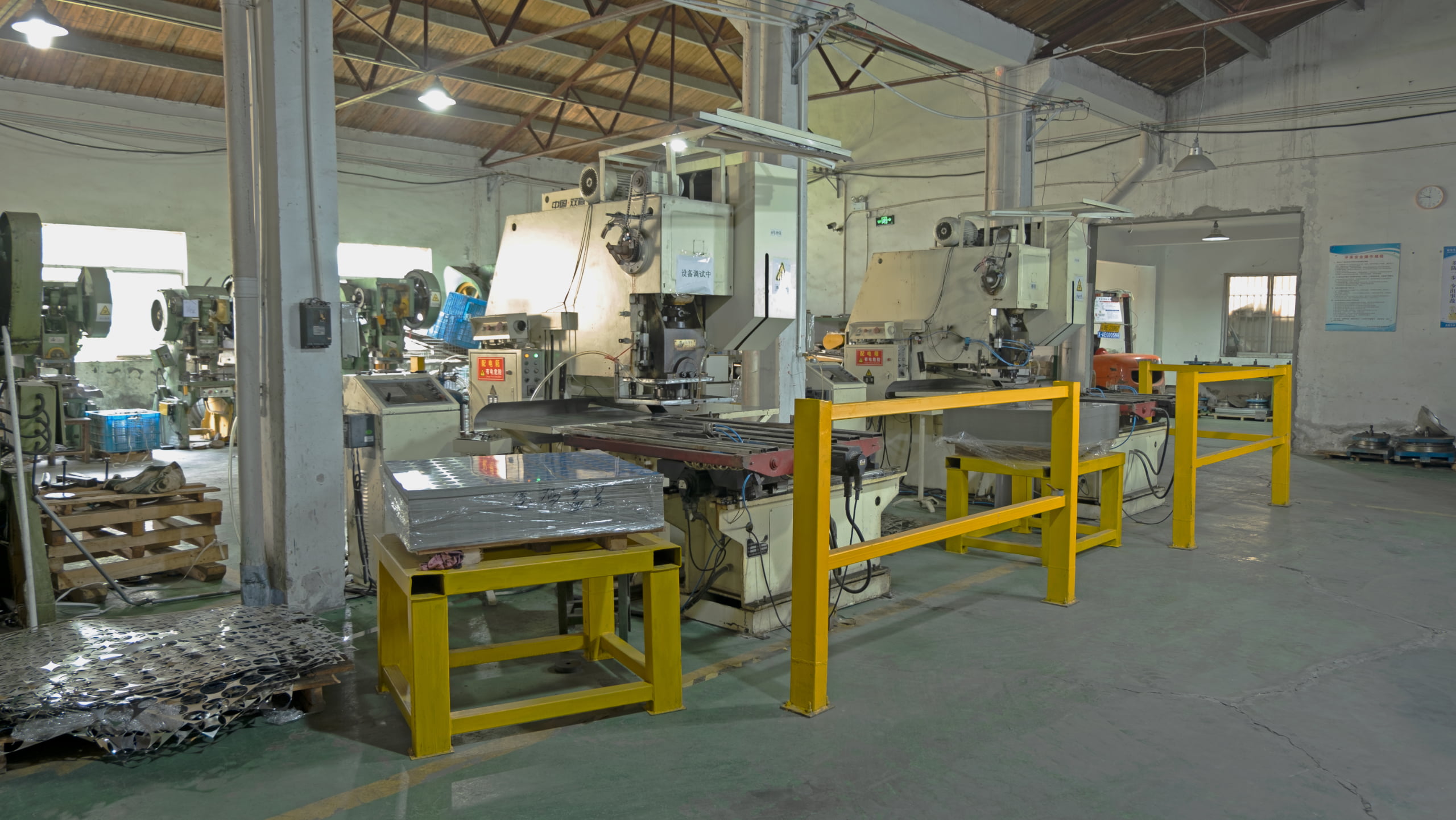
When you are buying a container for a chemical product, you are not just buying a piece of steel. You are buying a safety system. You are trusting that supplier with your product's integrity and your company's reputation. That is why understanding their process is so important.
A good partner will be proud to tell you how they operate. They should be able to answer these questions clearly:
- Where do you source your steel and coatings from?
- How do you test incoming raw materials?
- Can you explain how the internal weld seam is protected?
- What is your process for curing the internal liner?
- Is your leak testing 100% automated or based on random sampling?
- Are you ISO 9001 certified14?
If a potential supplier is hesitant or gives you vague answers, it suggests they either don't know the details or they don't want you to know. This is a major red flag. This is why we control our entire manufacturing process under one roof. From slitting the raw steel coils to printing, forming, and assembly, we have full control over every step. It allows us to guarantee the quality and be completely transparent with our clients.
If you are sourcing containers for chemicals or food-grade products and want to minimize leakage risk from the start, you can explore our range of chemical & food-grade metal buckets, engineered with compatible coatings, reinforced seams, and 100% automated leak testing.
Conclusion
Choosing the right chemical bucket is about preventing leaks and protecting your product.These technical details empower you to select a supplier who treats packaging as a critical safety system.
Explore this resource to understand the critical factors in choosing a safe and reliable chemical bucket. ↩
Learn about the significance of internal coatings in preventing leaks and ensuring safety. ↩
Discover how the strength of steel impacts the integrity and safety of chemical buckets. ↩
Understand the vulnerabilities of welded seams and how they can lead to leaks. ↩
Find out why 100% automated leak testing is essential for ensuring the safety of chemical containers. ↩
Explore the importance of understanding chemical reactions when choosing the right bucket. ↩
Learn how pH levels can affect the compatibility of coatings and materials in chemical buckets. ↩
Discover the importance of body strength in maintaining the safety and reliability of chemical containers. ↩
Learn about the impact of stacking pressure on the integrity of chemical buckets during storage. ↩
Understand the welding process and its implications for the safety of chemical containers. ↩
Understand the role of vapor pressure in ensuring the safety and integrity of chemical containers. ↩
Explore the importance of gasket materials in ensuring airtight and liquid-tight seals. ↩
Discover how a supplier's manufacturing process affects the quality and safety of chemical containers. ↩
Understand the significance of ISO 9001 certification in ensuring quality and safety standards. ↩