Chemical leaks are expensive and dangerous, leading to product loss and shipment rejections. These "accidents" are often predictable, but finding the cause after the fact is nearly impossible.
To prevent leaks in chemical tin cans, you must treat it as a system failure. This involves selecting the correct internal coating1,internal coating for chemical cans, ensuring a robust seam design2, controlling manufacturing defects3, and performing 100% automated leak testing4 before shipment. It is a process of prevention, not reaction.
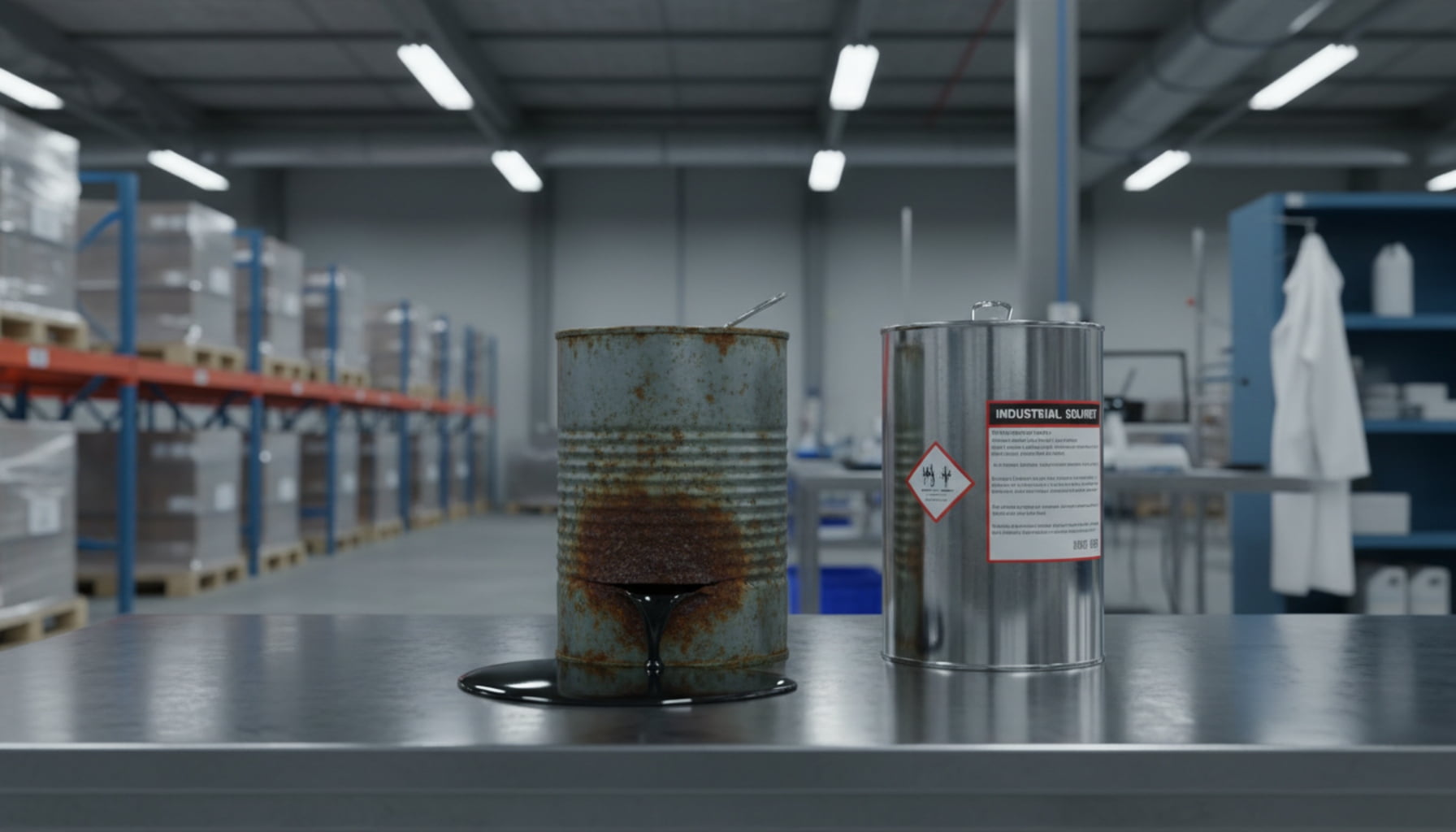
In my experience as a metal packaging manufacturer since 2006, I have seen that most leakage problems are not random. They are the result of specific decisions made during design and production. A leak is not just a defect; it's a failure of the entire packaging system. In this guide, I will break down where leaks happen, why they happen, and how you can prevent them before your products ever leave the factory. Let's dive into the details.
What Does “Leakage” Mean in Chemical Tin Cans?
You probably think of leakage as a simple drip from a can. But slow, invisible leaks can cause massive damage long after your product ships, making it hard to fix.
Leakage is any unintended escape of product, whether it is a liquid, vapor, or gas. It can appear as visible dripping, slow micro-seepage5 that only shows up after months, or failures caused by pressure changes during transport. It's a broad problem with serious consequences.
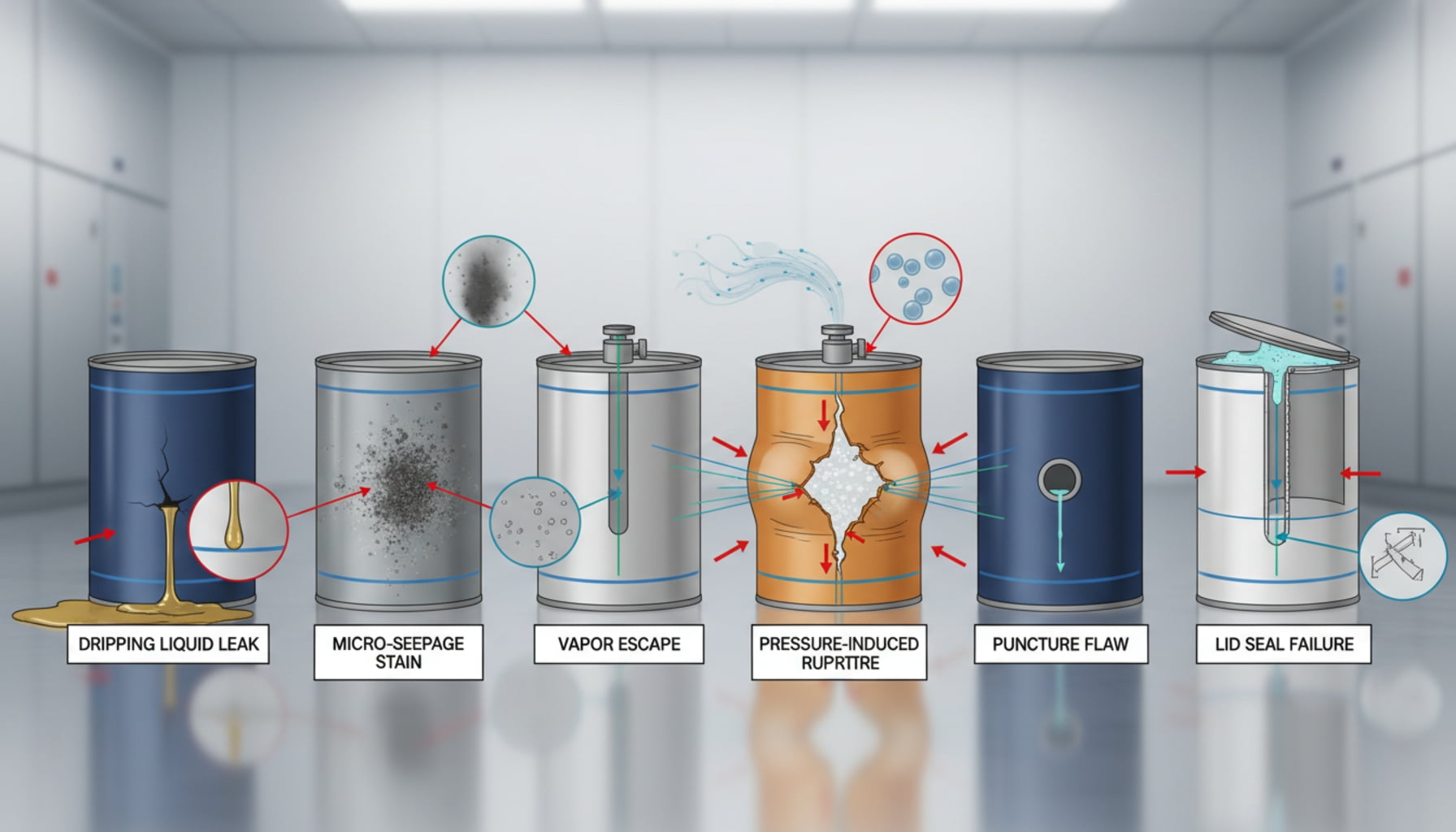
When most people talk about leakage, they picture liquid dripping onto a warehouse floor. In reality, the problem is much more complex. A can might pass every quality check at the factory, only to fail weeks later after being shipped thousands of kilometers. By then, assigning responsibility is a difficult and expensive process.
The Hidden Dangers of Different Leak Types
Understanding the different forms of leakage is key to preventing them. They are not all the same, and each presents a unique challenge.
| Leakage Type | Description | Common Cause |
|---|---|---|
| Visible Leakage | Obvious dripping or wet surfaces on the can. | Major seam failure, puncture, or gasket issue. |
| Micro-seepage | Slow, invisible permeation of product through a micro-flaw. | Tiny pinholes in coatings or seams. |
| Pressure-induced | Leaks that only occur under internal pressure changes. | Weak seams that open under stress. |
| Transport Leakage | Failures caused by vibration, impact, or stacking. | Insufficient structural integrity for transit. |
Different leakage types often indicate different root causes. In many cases, the failure can be traced back to either incorrect coating compatibility or inappropriate packaging material selection.
- Learn how to select the right coating in How to Choose the Internal Coating for Chemical Cans
- Understand when metal packaging outperforms plastic in Tinplate vs Plastic for Chemical Packaging
Many of our clients come to us after experiencing these delayed failures. They are the most frustrating because the product was perfect when it left. The real test happens in the supply chain6, not just in the lab.
Where Do Chemical Tin Cans Leak Most Often?
You might think a leak can happen anywhere on a can's surface. This makes prevention feel like a guessing game, but the truth is much simpler than that.
Most leaks happen at structural transition points, not on the flat surfaces. The highest-risk areas are the weld seam7 where the can body is joined and the double seam8 where the lid and bottom are attached. These spots experience the most stress.
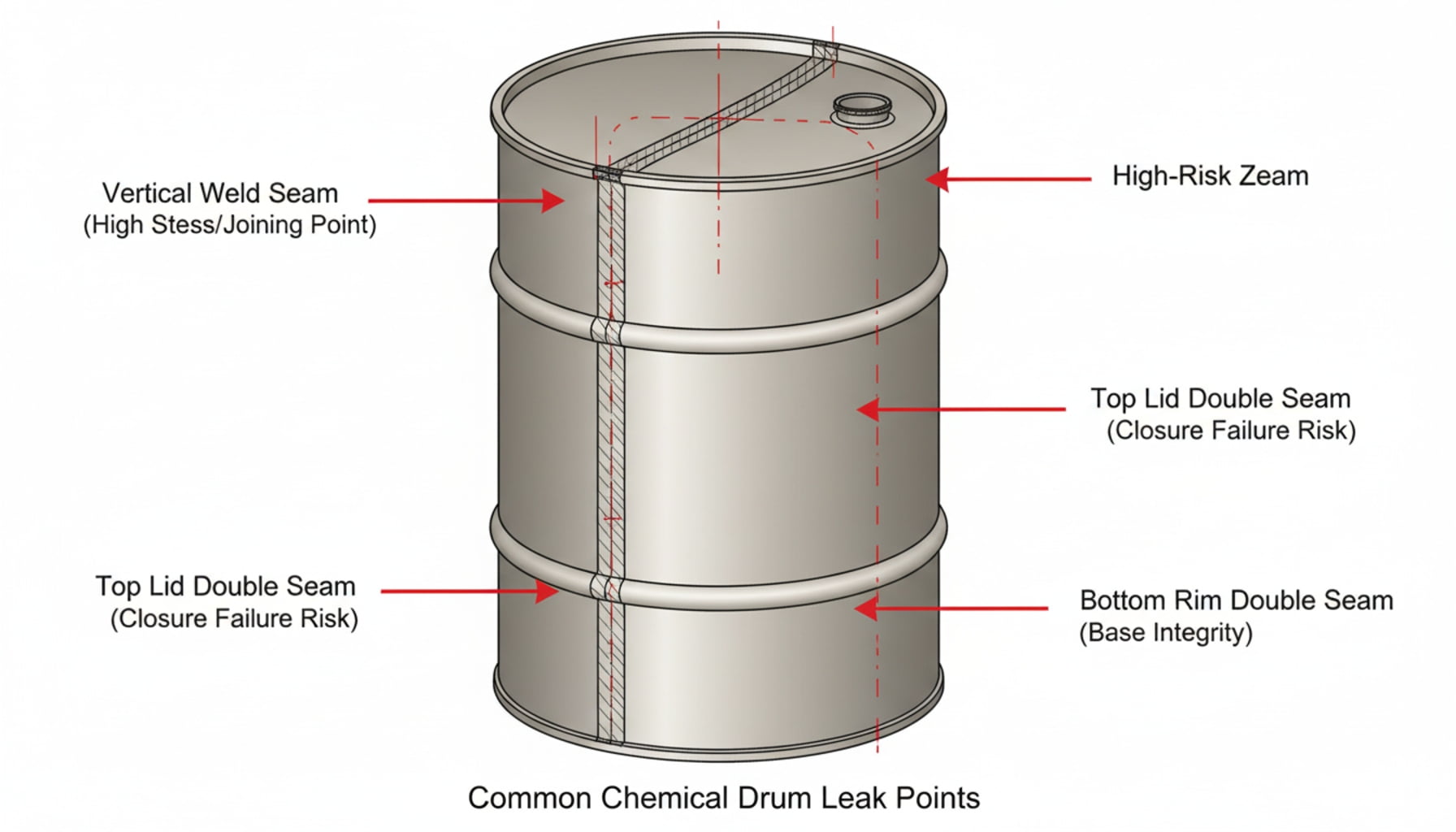
Understanding where leaks start is the first step to stopping them. From what I’ve seen, the flat tinplate9 surfaces are almost never the problem because they are well-protected by coatings. The danger zones are always the places where metal is welded, folded, or compressed. These processes introduce heat and stress, which can create tiny discontinuities in the protective coating.
Why Structural Transition Points Are Vulnerable
These areas are the weak links in the chain. During manufacturing, the metal is put under immense pressure, and this is where failures can begin if not controlled properly.
| Leakage Location | Typical Symptoms | Risk Level |
|---|---|---|
| Weld Seam | Rust lines, slow seepage along the seam. | High |
| Double Seam (Curling) | Leakage under vibration or pressure. | Critical |
| Can Body | Pinholes, localized corrosion10 (rare). | Medium |
| Lid Gasket | Drips during transport or when tilted. | Medium |
The weld seam and the double seam are where most of our quality control efforts are focused. A small imperfection here is far more dangerous than a scratch on the can body. For a deeper look at how these structures are made, you can read our guide on how tinplate cans are manufactured for chemical packaging.
Can the Wrong Internal Coating Cause a Tin Can to Leak?
A can is leaking, so you immediately blame the metal structure or the seams. But this overlooks the real cause, leading you to face the same failure again and again.
Yes, an incorrect internal coating1 is one of the most common, yet misunderstood, causes of leakage. If the coating is not compatible with the chemical inside, it can soften, crack, or peel away, exposing the steel to corrosion and causing a leak.
Many leaks actually begin as coating failures, not metal failures. I have investigated many cases where the can's structure was perfectly sound, but the wrong coating was chosen for the product. The chemical inside slowly attacked the protective layer until it reached the steel, and a leak was inevitable. This is why product compatibility testing is so important.
How Chemical Reactions Trigger Leaks
The interaction between the product and the coating is a chemical one. If they are not a good match, the coating will break down.
| Chemical Type | Coating Problem | Result |
|---|---|---|
| Water-based Chemicals | Can attack steel through microscopic pinholes in the coating. | Localized rust and pinhole leaks. |
| Polar Solvents | Can dissolve an incompatible coating over time. | Loss of adhesion, exposing the entire surface. |
| Aggressive Ions (e.g., Chloride) | Can cause severe, localized corrosion10 under the coating. | Rapidly forming pinholes in the steel. |
It is critical to understand that the coating is the first line of defense. We always ask our clients for their product's Material Safety Data Sheet (MSDS)11 so we can recommend the correct coating system. Choosing the right one prevents these problems from ever starting.
How Critical Are Seam Design and Curling Layers for Preventing Leaks?
You see two chemical pails that look identical on the outside. But one leaks under pressure during transport while the other remains secure, and you have no idea why.
The seam design is the most critical sealing structure in a chemical tin can. The number of curling layers12 in the seam determines its strength. A 7-layer seam provides far more protection against leaks under pressure and vibration than a standard 5-layer seam.
This is one of the biggest differences between professional metal packaging and low-cost alternatives. At our factory, the seam design is never a "one-size-fits-all" solution. The size of the can and the hazards of the product inside determine the right seam structure. I've seen many cases where a customer switched to a cheaper pail, only to face costly leakage problems because the seam was downgraded from 7 to 5 layers.
More Layers, More Safety
Think of extra layers as a backup system. More layers create a more complex path for any liquid to escape, which dramatically reduces the risk of a leak.
| Can Size | Curling Layers | Design Purpose |
|---|---|---|
| 1–10L Cans | 5-layer curling | Provides a compact, reliable seal for standard vibration resistance. |
| 20L Pails | 7-layer curling | Designed for high internal pressure and heavy stacking loads. |
This extra redundancy is a safety feature, not a cosmetic one. It ensures the can can tolerate deformation from being dropped or stacked without the seam opening. It's a small detail in the design that makes a huge difference in real-world performance.
Can Hidden Manufacturing Defects Cause Chemical Cans to Leak?
You have chosen the right can design and the correct internal coating. Yet, you still experience random leaks, leaving you frustrated and confused about what went wrong this time.
Absolutely. Even with the best design, invisible defects introduced during production are a common source of leaks. Small issues like an incompletely protected weld seam, heat-damaged coating, or an improperly rolled seam create weak points that fail later on under stress.
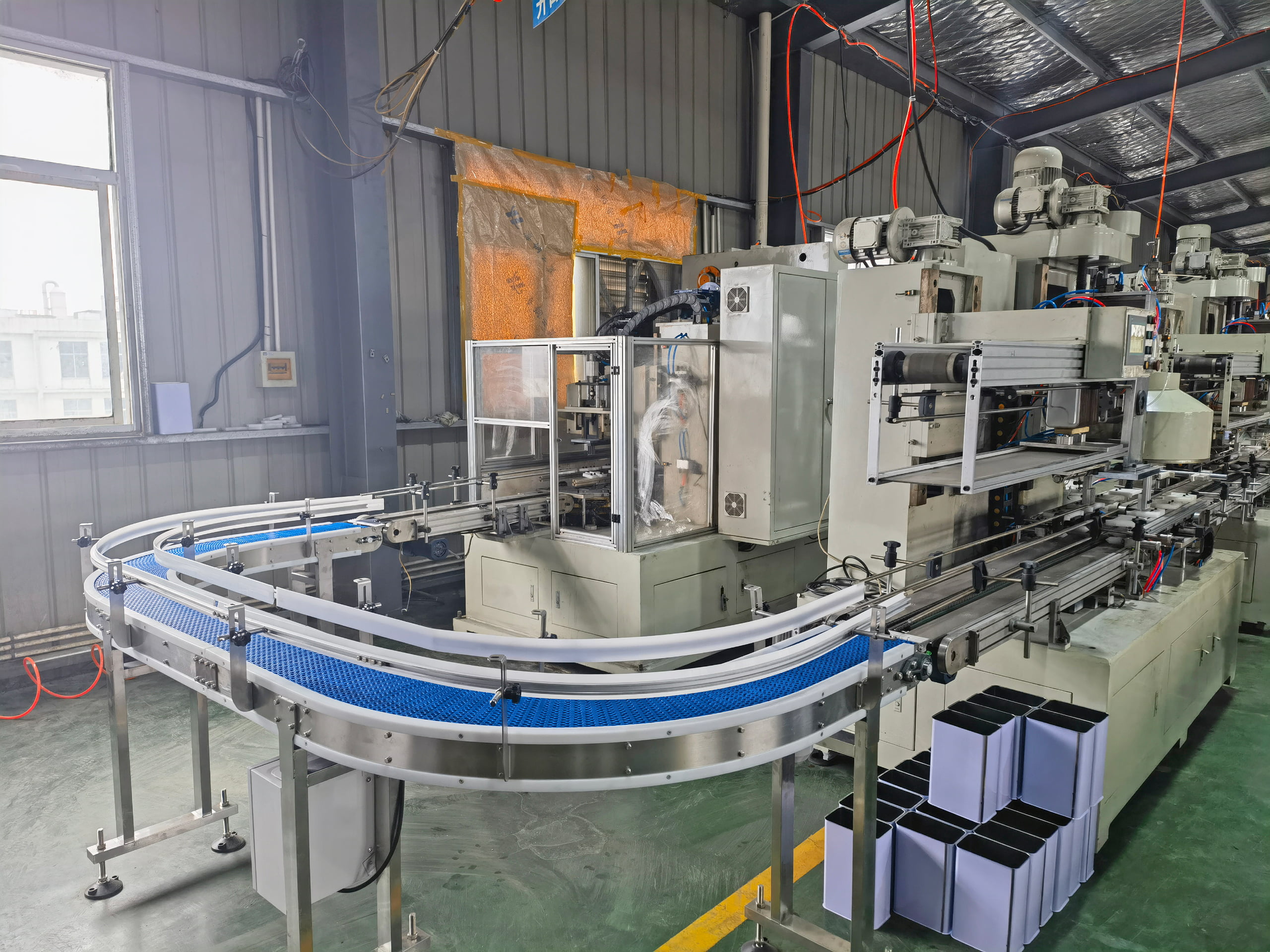
Leakage often originates from these tiny flaws that are impossible to see with the naked eye. This is why strict process control during manufacturing is just as important as the initial design. A single machine out of calibration can produce thousands of defective cans that look perfect on the outside but are doomed to fail.
The Critical Role of the Weld Seam
The weld seam deserves special attention. The heat from welding the can body together can destroy the internal coating in that area, creating a perfect starting point for corrosion.
- Incomplete Weld Seam Protection: If the protective powder coating applied over the weld is not complete, it leaves the steel exposed.
- Heat-Damaged Coating: The area next to the weld can also be damaged by heat, weakening its adhesion.
- Improperly Rolled Seams: If a seam is rolled with too much or too little pressure, it will not create a perfect seal.
From what I've seen in our factory, controlling the weld seam protection step is one of the most important quality checks we perform. It’s why professional chemical cans have a distinct powder stripe on the inside—that stripe is a critical layer of defense.
Why is Automated Leak Testing Your Last Line of Defense?
You trust your manufacturing process to produce perfect cans every time. But a single, undetected micro-leak can ruin an entire shipment, damage your reputation, and cost you thousands.
Leak testing is your final quality gate. It does not add quality to the can; it only reveals it. Automated testing is essential because it can detect microscopic leaks that are invisible to the human eye and apply consistent pressure to simulate real-world conditions.
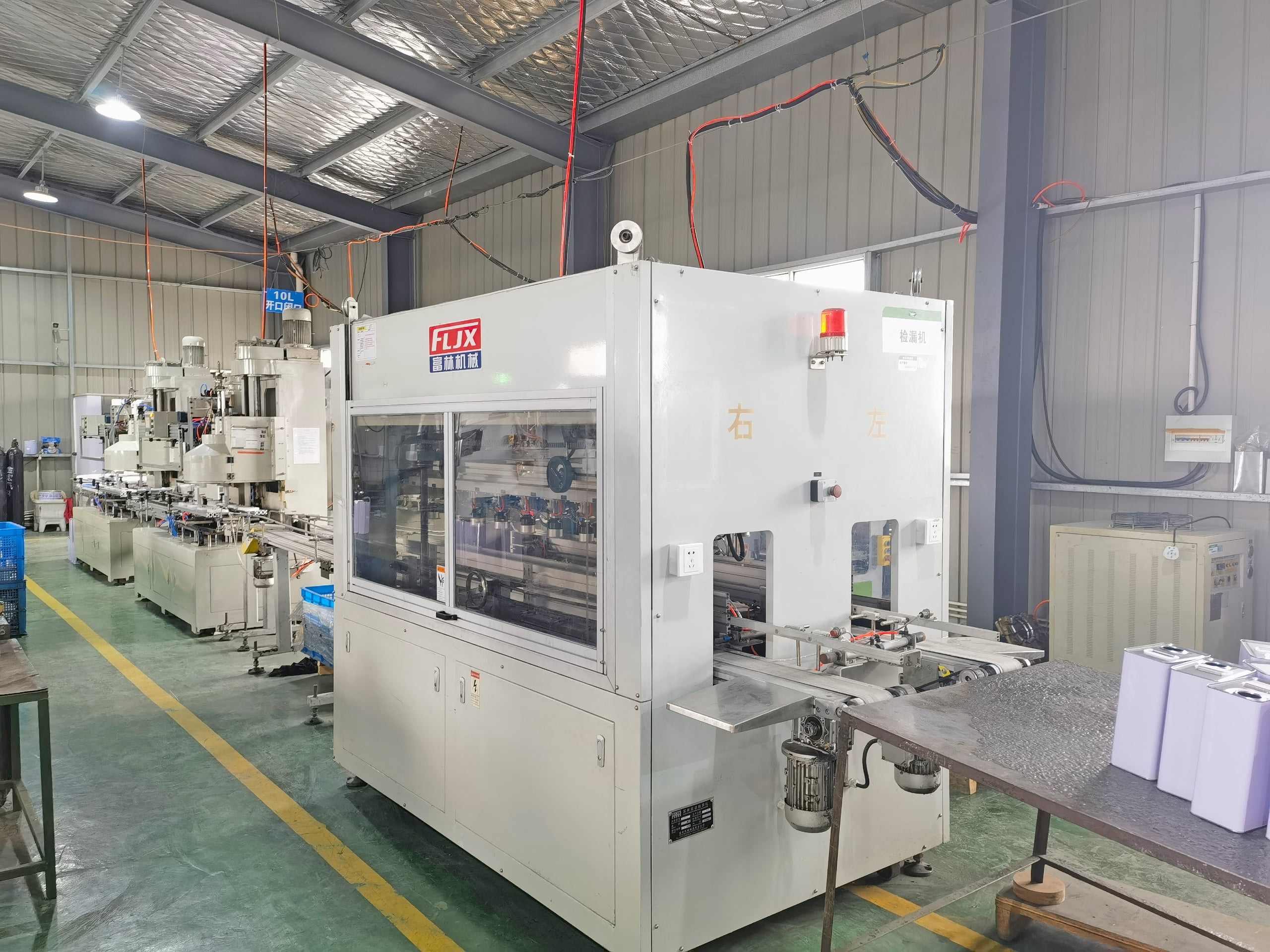
Every single chemical can we produce must be tested. There are no exceptions. Even with the best designs and the most controlled processes, a failure can still occur. The leak tester is the final guard that stands between our controlled factory environment and the unpredictable supply chain. It's the last chance to catch a problem before it gets to our customer.
What Automated Testing Catches
Relying on human inspection for leaks is simply not effective enough for hazardous chemicals. An automated system is faster, more reliable, and far more sensitive.
- Detects Micro-Leaks: It can find holes so small that they would take weeks to show a visible leak.
- Simulates Transport Conditions: The pressure test mimics the stress a can will experience during shipping and handling.
- Eliminates Human Error: It provides consistent, objective results for every can, removing any guesswork.
At our facility, every production line feeds into a fully automated leak detection system. Any can that fails the test is automatically removed and scrapped. This non-negotiable step is crucial for ensuring the safety and integrity of the packaging.
How Do Professionals Prevent Leaks Before They Even Happen?
You are tired of constantly reacting to leakage problems after they have already occurred. This firefighting approach is stressful, expensive, and never truly solves the root of the issue.
Professionals don't just "fix" leaks; they design them out of the system from the very beginning. Leak prevention is a holistic process that combines correct design, verified materials, controlled manufacturing, and rigorous quality control. It is about managing risk, not just cutting costs.

Companies that view packaging as a simple cost item often call us with the same leakage problems over and over. In contrast, the companies that treat packaging as a critical part of their risk management13 strategy rarely have to call us about leaks at all. This difference in mindset is everything. Prevention starts with seeing the can as an essential part of the product's safety and performance.
A System, Not a Single Step
A successful leak prevention strategy involves every stage of the packaging lifecycle14. You cannot focus on one area and neglect the others.
| Stage | Key Control Point |
|---|---|
| Design | Select the correct internal coating and seam structure for the product. |
| Material | Use only verified tinplate and a proven coating system from a reliable supplier. |
| Manufacturing | Ensure complete weld seam protection and precise control over the forming process. |
| Quality Control | Implement 100% automated leak testing for every can. |
| Logistics | Validate stack height limits and secure pallets to prevent transport damage. |
By addressing all of these points, you create a robust system where the potential for failure is minimized at every step. It’s a proactive approach that saves enormous amounts of time, money, and stress in the long run.
Conclusion
Chemical leakage is rarely an accident. It is almost always an engineered outcome, caused either intentionally by cutting corners or unintentionally by a lack of proper system controls.
Learn how the right internal coating can prevent leaks and enhance product safety. ↩
Discover how seam design impacts the integrity and safety of chemical packaging. ↩
Identifying manufacturing defects can help you avoid costly leaks and product failures. ↩
Explore how automated leak testing ensures the quality and safety of chemical cans. ↩
Understanding micro-seepage can help you prevent hidden leaks in your products. ↩
Understanding the supply chain's role can help you mitigate risks associated with leaks. ↩
Understanding the importance of the weld seam can help you enhance can durability. ↩
Learn about the significance of double seams in preventing leaks and ensuring safety. ↩
Understanding tinplate's properties can help you make informed choices for packaging materials. ↩
Identifying causes of localized corrosion can help you prevent leaks and product loss. ↩
Understanding MSDS can help you choose the right materials for safe packaging. ↩
Learn how the number of curling layers can enhance the leak resistance of cans. ↩
Explore how effective risk management can minimize leakage issues in chemical packaging. ↩
Understanding the packaging lifecycle can help you implement comprehensive leak prevention strategies. ↩